
 Fatherland – Film Review
by Frank L.
Director – Paweł Pawlikowski
Writers – Paweł Pawlikowski, Henk Handloegten
Stars – Sandra Hüller, Hanns Zischler, August Diehl
“At the height of the Cold War, Fatherland centres on the relationship between the writer Thomas Mann and his daughter Erika—actress, writer and rally driver—as they embark on a road trip in a black Buick cruiser across a Germany in ruins.”
In a prologue, the film begins with an insight into what will happen as Klaus Mann (Auguste Diehl), undressed, speaks on the phone from his hotel bedroom in France with his sister Erika. He covers some of the issues that will emerge in their forthcoming visit to the Fatherland.
In 1949, after its defeat in the Second World War, the victorious Allies divided Germany into two states: the BRD and the DDR. In the rubble of Frankfurt, Thomas Mann (Hanns Zischler), accompanied by his daughter Erika (Sandra Huller) returns to his native land, having fled in 1933 when Hitler came to power. He had been invited to attend Goethe’s 200th birthday celebrations in Frankfurt in the BRD, as well as those in Weimar in the DDR. So art in the form of Goethe transcended the recent political division of Germany. However, the manner in which Frankfurt and Weimar chose to mark the bicentenary was markedly different. In Frankfurt, the influence of American popular culture is apparent and includes a female vocalist singing a popular song with a jazz band, while in Weimar, culture is represented by the Minister for Culture, a military gentleman, with disciplined rows of citizens. The contrast is stark.
Various personal and political tensions are documented, including the fact that Mann emigrated in 1933, Erika had been married to a leading Nazi actor, and Wagner’s two grandsons wanted to ingratiate themselves with Mann. Each incident gives rise to a sequence of dissension. It is illuminating.
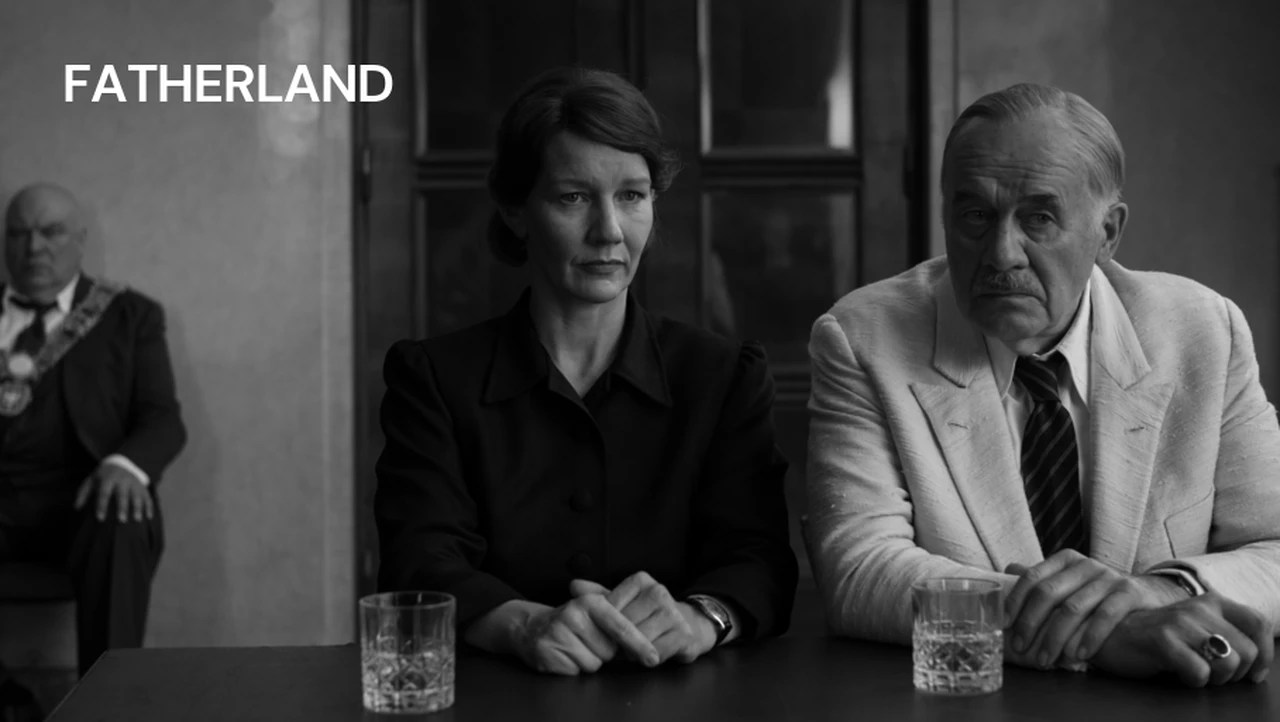
The film is in black and white with subtitles. Huller is in many ways the main figure, as it is clear in his mature years Mann needs his daughter Erika. Her reserve is impressive, but it can and does break. When it does, she shows an anger which is both forceful and uncompromising. At all times she is a powerful presence. Zissler, as Mann, who in 1949 was 74 years old, conveys his stature as the winner of the Nobel Prize for Literature, but he is at a distance in assimilating what has happened to Germany since he fled in 1933. He is dependent on Erika. But his faculties are acute; when Erika states “let’s go home”, he replies “where is that?”.
This film is measured and understated. The acting complements the complex story that is being told. It is an insight into the uncertain equilibrium of Germany in the aftermath of the war when its outward devastation was everywhere to be seen. It is also valuable as it documents how starkly different from the beginning the BRD and the DDR were. That fact has consequences today. It is a film that should be seen by anyone who is interested in Europe. The story told chimes with the political tensions that are current in Germany. This film is worth seeing not only for the story that it tells but also for the beautiful manner in which it is shot. The acting hits just the right note. The entire film is both gripping and enlightening.
Categories: Best New Movies, Header, Movie Review, Movies


