
Q&A with Fíonna Hewitt-Twamley – Myra’s Story
Myra’s Story will run at the Gaiety Theatre Dublin from 26th – 31st October 2026. Tickets on sale from Ticketmaster.ie
What did you think when you first read the script of Myra’s Story?
From the very first read of Myra’s Story in 2018, I knew it was a very special piece of writing, with a very important message. A topic relevant the world over, that would not only resonate with an Irish audience, but an International one too.
How did you become involved in the production? Did you audition?
I was contacted by my agent, who said a writer from Derry wanted me to meet him the following day to read a script he had written 10 years previously. Auditions had already been held, and my name had been offered by auditionees as somebody who could carry this script and do it justice on stage. Shout out to those generous Actors who put my name forward!
The problem was, it was the night of the IFTAs, and I was up for ‘Best Supporting Actress’. So, you know the deal: hair, nails, tan, etc., so when I heard the premise of the script – homeless, alcoholic lady- I thought ‘uh-oh!’. The timing wasn’t great, but I met Brian Foster at 10am the following day in the ITI, complete with tan, nails, etc. and the rest, as they say, is history! Brian Foster said afterwards that he knew from the moment I walked in, that I was his Myra that he had been searching for.
You play 16 very distinct characters in Myra’s Story. How much of a challenge is that for you as an Actor?
Yes, the 16 characters are very distinct, comprising men, women and children. As an Actor, that’s our job: to be able to play a variety of characters. Not normally all in the same production, and not normally on stage together! So, yes, initially I had to ‘form, bend and shape’ those characters to fit who they were within the script. I knew I could do that, using vocal range, facial expressions and physicality, as there are obviously no ‘costume changes’. It really was fun naming them, identifying their traits and putting a voice to them. I winged it the first day at audition, and Brian Foster was a little taken aback at my ambition for their vocals, as he hadn’t intended me to actually ‘play’ these characters, but recount their interactions in Myra’s voice. I felt that would have lessened the play and the production. Luckily, he realised quite quickly that my vocal range could carry it.
With the homelessness figures mentioned constantly in the media, do you think Myra’s Story manages to put a human face on those figures?
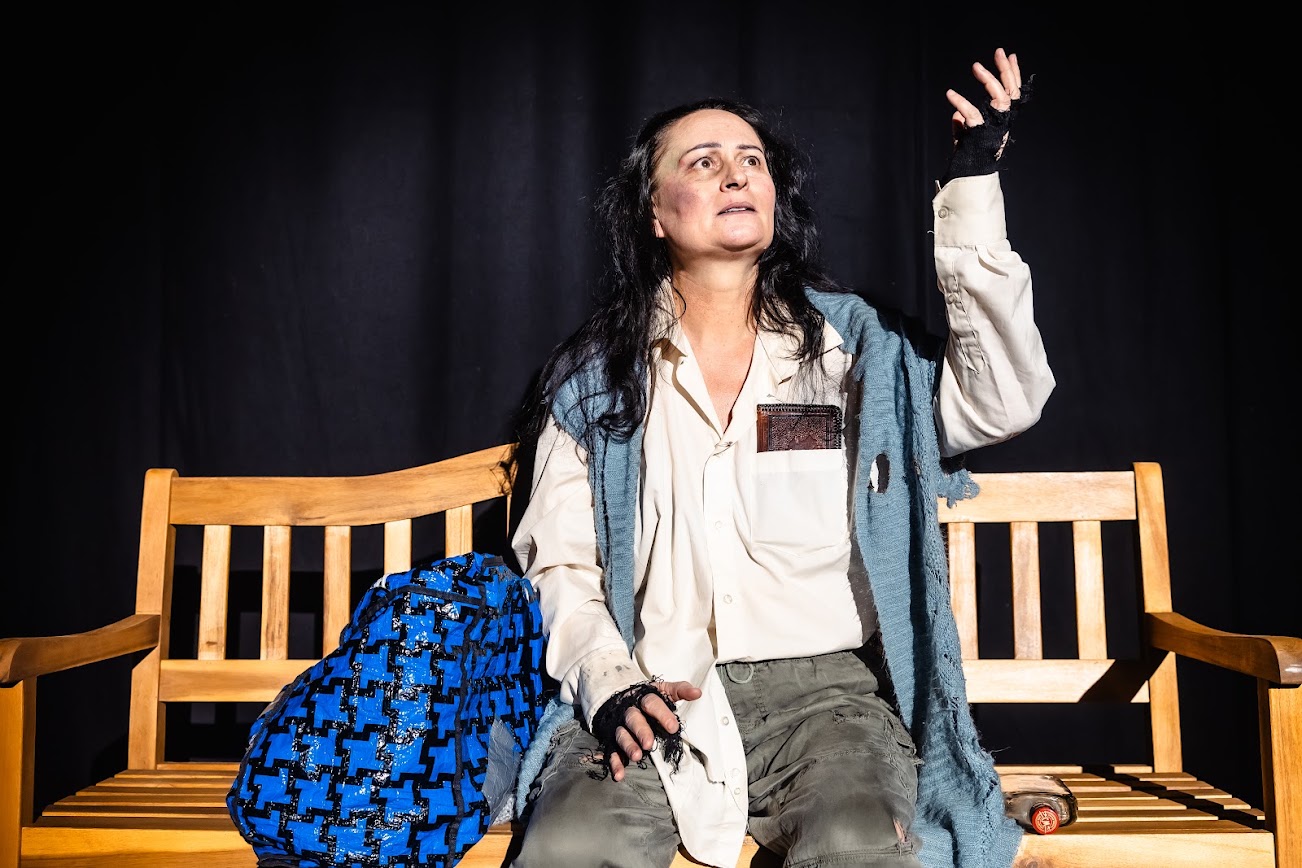
Most definitely. What the public sees on the streets daily is a human silhouette, not a ‘real’ person, with a backstory, a history, a family, a home, possibly a job, and carrying a very real hurt. When Myra is introduced initially, she resembles what people see daily. The gift that Myra’s Story gives to an audience is the ability to look beyond the ragged clothes, the sharp tongue and the aggressive manner. As the play progresses, they then get to see the potential she had, and what she has lost, due to trauma, both personal and environmental, that eventually leads her to her dissociation from her intended life path. By the time the audience leaves the theatre, the insight they have received into a day in the life of Myra definitely changes perceptions of homelessness and addiction, as well as the propensity for it to happen to any one of us, and our ability to judge when we ‘have never walked a mile in those shoes’.
You have been performing this play for several years now; how do you keep it fresh?
It’s a story that needs to be told everywhere, to as many people as possible, to both raise funds for homeless and addiction charities, to raise awareness and to change perceptions. Although some people have come to see Myra’s Story multiple times, it’s basically a new audience every night. The story stays the same, and the audience changes nightly, but it’s my passion, and my job, to relay it like the very first time each night. Also, I love it, so it never gets stale. It’s a story that needs to be told!
Have you ever suffered from stage fright?
I’m lucky that I haven’t and don’t suffer stage fright. As a performer, I am very aware of it, and with good prep, good sleep, and realms of positivity from the crew, staff at Trafalgar, as well as the audience on the Myra’s Story Facebook page, all help to keep my mind relaxed and positive. Also, nervous energy is very real, and can be a good thing when harvested and utilised while on stage. Fingers crossed Myra’s Story can reach the goal of raising a million for charities. Halfway there, so hopefully achievable! Come to see it, open your eyes, open your mind, and leave preconceptions at the door. I promise you, you won’t regret it!
Myra’s Story will run at the Gaiety Theatre Dublin from 26th – 31st October 2026. Tickets on sale from Ticketmaster.ie
Categories: Header, interview, Theatre, Theatre Review


