
Crisis Actor – Dublin Fringe Festival – Review
CRISIS ACTOR – Eoghan Carrick + Lauren Jones
Created by Eoghan Carrick and Lauren Jones. Performed by Emily Terndrup and members of the audience. This event features smoke machines, strobe lighting and excessively loud noise/music.
“Crisis acting is a real job: performers simulate emergencies so others can train for disaster. But online, the term has been twisted into something darker — a conspiracy theory, a denial of reality, a way to claim that violence was staged.”
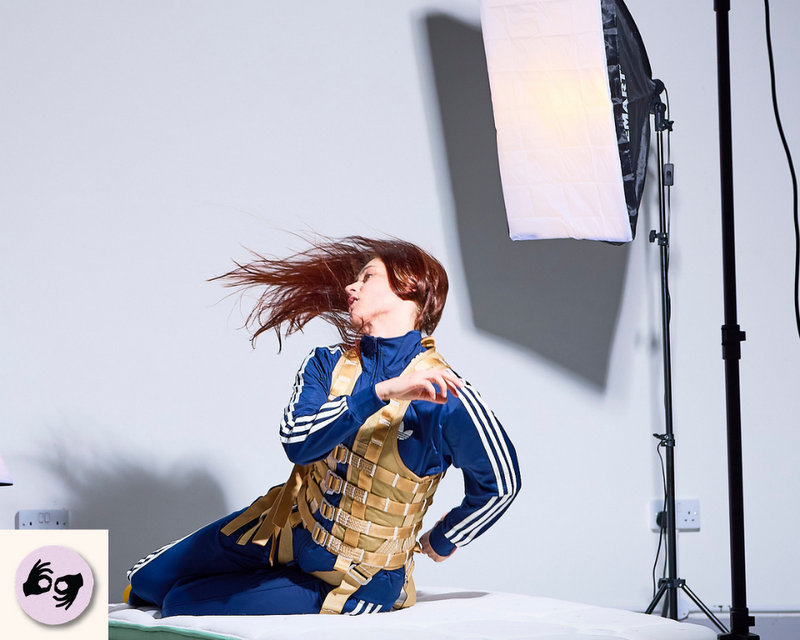
Image Credit: Pato Cassinoni
As the audience enters the theatre, the performer, Emily Terndrup, is already on stage. She lies sprawled across the floor, with a pool of blood apparently leading from her body. Yet the audience largely ignores her presence, instinctively aware of the conventions and etiquette of the theatre. There is no genuine concern that she might actually be dead or seriously injured. It is precisely this assumption that the piece sets out to examine: the theatrical concepts we have absorbed over time and now follow almost unconsciously.
When the performance begins, Emily opens her eyes and addresses the audience directly. She gets to her feet and explains why she was lying on the floor. We learn that she works as a ‘crisis actor’ and has played the role of someone seriously injured, dying or dead hundreds of times. Her job is to help prepare people for real-life emergencies by creating convincing simulations of crisis situations. She tells us that she was once a stage actor before falling into this new profession, partly because the pay is better, but also because she has come to prefer it. There is something she enjoys about these unscripted performances, where the boundary between performer and audience is far less clearly defined.
Created by Eoghan Carrick and Lauren Jones, the piece is an intriguing production that uses thought experiments and a variety of theatrical concepts to draw the audience into the world of its central character. There is a degree of audience participation, although it is relatively undemanding, and those who would rather remain observers should be able to avoid much of it by choosing a seat further back.
The production also makes effective use of theatrical tricks, including staged confrontations and the occasional more flamboyant surprise. Although the piece is largely constructed around a monologue, its small moments of audience interaction, combined with lines of dialogue appearing on the screen at the back of the stage, give it a more immersive quality. Terndrup is an engaging presence throughout, delivering some particularly effective passages of dialogue and introspection as she explores the strange relationship between performance, reality and our expectations of both.
This is theatre firmly positioned on the more experimental end of the spectrum — the sort of work that the Fringe Festival frequently provides a home for. That approach will inevitably appeal more to some than others. Nevertheless, there is something genuinely thought-provoking at its heart. By taking the familiar conventions of theatre and turning them back on the audience, the production asks us to consider how readily we distinguish between what is real and what is merely being performed. It is a dark, inventive and thoughtful piece that deserves to be seen.
Categories: Festivals, Header, Theatre, Theatre Review


