
SOAK: The Perfect Man – Dublin Fringe Festival – Review
Samuel Yakura & +353
Venue – Project Arts Centre – Cube
Duration – 75mins
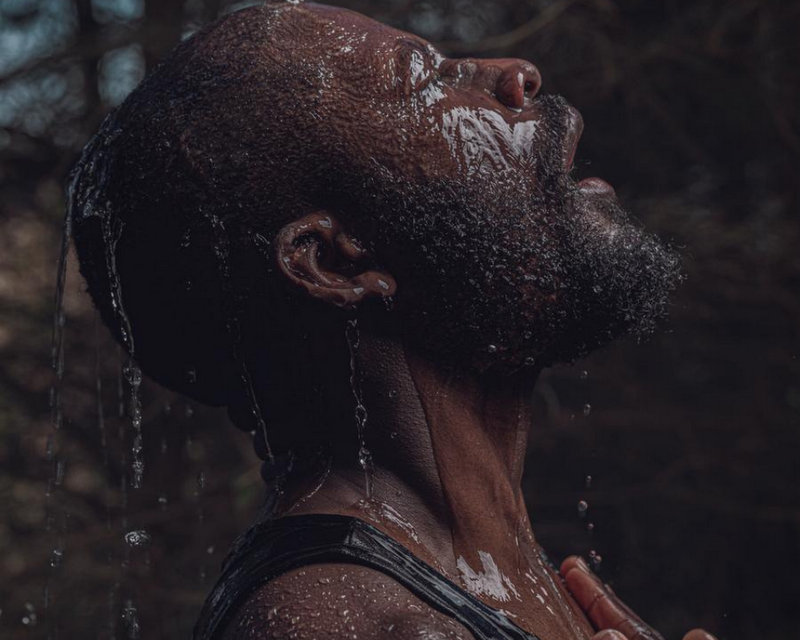
Image Credit: Chibuikem James
The Cube at the Project Arts Centre is presented as a theatre-in-the-round for this production. As the audience enters, there is already something unexpected taking place: drums and keyboards are being played quietly by Osazee Aiguokhian and Michael Atunwa at the centre of the space. It is an intriguing introduction and an early indication that this is unlikely to be a conventional theatrical experience. Described as a “contemporary music-theatre experience blending live music, slam spoken word and performance”, the production moves fluidly between these different forms, creating something that sits somewhere between concert, poetry performance and traditional theatre.
Samuel Yakura is a Nigerian-born writer, poet and performing artist based in Ireland. He is the central protagonist here, portraying a young man attempting to navigate the complexities of his own life while dealing with an ailing father and the weight of familial expectations. Yakura previously brought The Perfect Immigrant to the Dublin Fringe Festival in 2022, and there is a similar interest here in identity, belonging and the experience of negotiating different cultural expectations.
The second performer, Chisom Princess George, takes on all the remaining characters, including sisters, therapists and various other figures encountered throughout the story. This requires her to shift rapidly between personalities and perspectives, but George handles these transitions with considerable confidence. She is also the production’s principal vocalist, and her impressive voice and range provide some of its most memorable moments.
This is not a musical in the traditional sense, but rather a play punctuated by musical interludes. Songs appear throughout the performance, with the musicians and vocalist creating a live soundtrack that continually changes the atmosphere of the small theatre. The combination of drums, keyboards, bass and vocals gives the piece an energy that would be difficult to replicate with recorded music.
The story explores different stages of his life, including his childhood fascination with cartoons and children’s television, before moving into his teenage years and his burgeoning sexuality. However, the central focus is the complicated relationship between a firstborn son and his Nigerian father. Alongside the affection and familial bond is a sense of expectation and the pressure to succeed.
The narrative itself is relatively slight, and the production is less concerned with conventional plot development than with memories, anecdotes and fragments of experience. What emerges is a portrait of a father-son relationship shaped by love, ambition and cultural expectation. The father is more than simply an individual character; he becomes a representation of the pressures and aspirations placed upon a firstborn son.
The movement between spoken word, poetry and music is effective. Yakura’s spoken word allows the production to move beyond straightforward storytelling, giving voice to thoughts and emotions that might be difficult to express through conventional dialogue. George’s singing provides a similarly emotional dimension, while the live musicians continually reshape the mood of the piece. At its best, the production succeeds because of this blending of forms, creating a distinctive portrait of family, identity and the complicated expectations placed upon the firstborn son.
Categories: Header, Theatre, Theatre Review


