
Heroes of Tomorrow – Dublin Theatre Festival – Review
Heroes of Tomorrow – Written & Created by Feidlim Cannon, Gary Keegan & Andy Smith
Dates: 25 Sep to 4th Oct
Venue: Project Arts Centre (Space Upstairs)
Cast: Malua Ní Chléirigh, Alice Roots, Michael Tient.
Production photos by Ste Murray
This piece tells the story of an artist named Jan Hansen, a “celebrated Scandinavian artist who is about to present his latest work”. Hansen is far from a conventional artist, using his work to agitate for change across a range of social and environmental issues.
The fictional artist becomes a starting point for a wider discussion about the ability of art to bring about change. The piece comes from the BrokenTalkers team of Feidlim Cannon and Gary Keegan, working alongside Andy Smith, a theatre-maker based in Lancaster whose work frequently explores social and political themes.
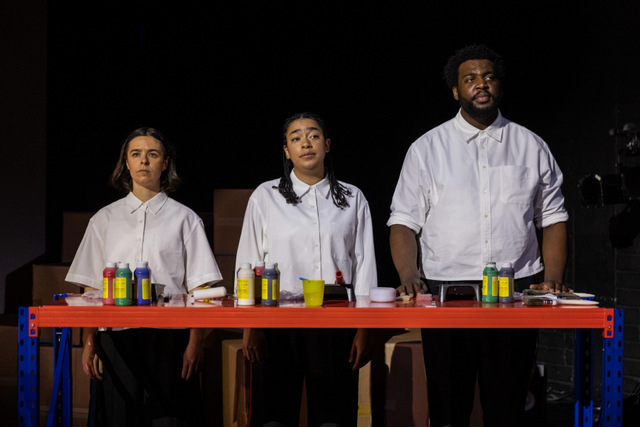
The play opens with three actors on stage — Malua Ní Chléirigh, Alice Roots and Michael Tient. They address the audience directly, presenting a series of seemingly simple facts about the evolution of various art forms and society itself, before moving into more contemporary innovations such as artificial intelligence. Through the character of Hansen, the production begins to examine the uneasy relationship between artists and the industries that fund them. If artists rely on corporate donations to make their work, to what extent do they become complicit in the activities of those providing the money?
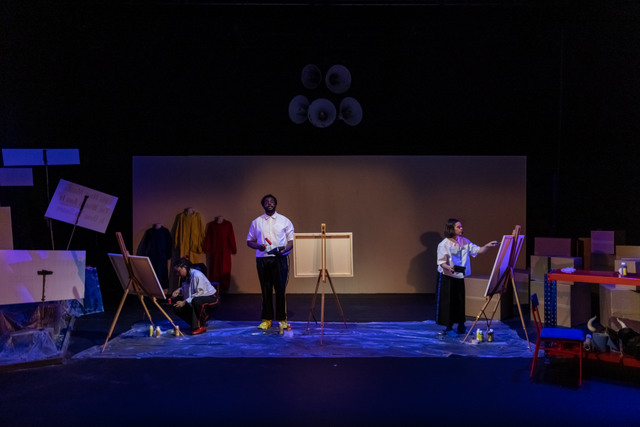
The three performers deliver the text in a deliberately straightforward manner, speaking directly to the audience with an almost disarming friendliness. There is also a strong visual element to the production, with the actors creating works of art on stage, only to destroy or dismantle them in a variety of ways.
What emerges is something of a potted history of art, creativity and the evolution of our species. The various subjects explored can initially feel disconnected, even random, but gradually they begin to form a larger and more coherent picture. The production is ultimately interested in the role art can play in challenging the world around us.
Can art really be an effective form of protest? Or does success inevitably make artists less willing to take risks? And what happens when the structures an artist seeks to challenge are also the ones providing the money that allows them to work?
These are questions that extend well beyond the theatre. They touch on the debates surrounding politics, sport, culture and our willingness to stand up for what we believe in. The current controversy around the Irish football team playing Israel, for example, provides another context in which questions of protest, principle and complicity can be considered.
It is an intentionally provocative piece, and one that is likely to continue its work long after the curtain comes down. Expect to leave the theatre debating its finer points — and perhaps, more importantly, wondering what part each of us can play in changing the world around us.
Categories: Header, Theatre, Theatre Review


