
 Trolley Boy – Dublin Fringe Festival – Review
Trolley Boy – Diarmuid Armstrong Mayock
Venue – Civic Theatre – Main Space
Duration – 60mins
Image Credit: Jimmy Kilgallen
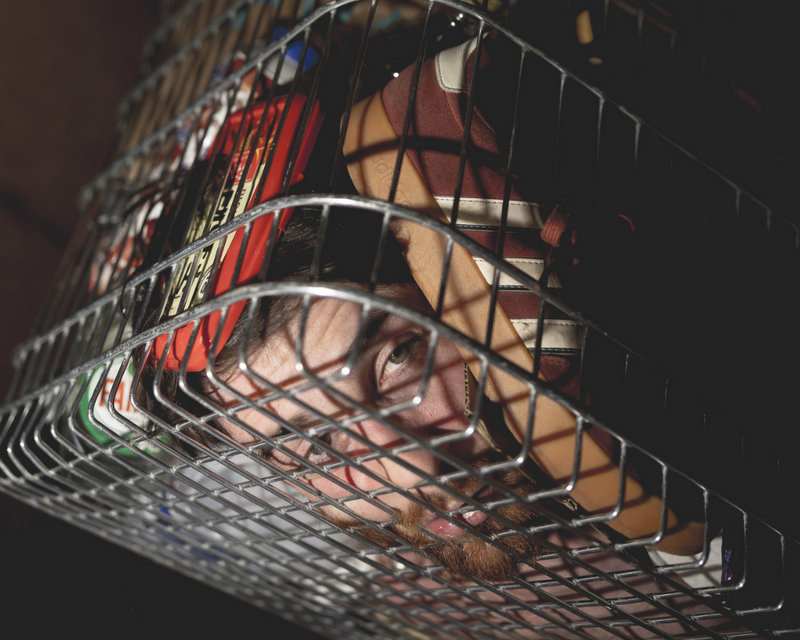
The production opens with a birth, but not a normal one. We meet a crying man, slowly pushing a shopping trolley across the stage. He wails with obvious pain and agitation, although the source of his distress is initially unclear. As he pushes the trolley, another man suddenly falls from within it and onto the floor. He is fully clothed and certainly not childlike, but this is Bob, our main protagonist. From this strange, unsettling beginning, we are introduced to his world: a supermarket that is not simply where he lives, but a place he never leaves.
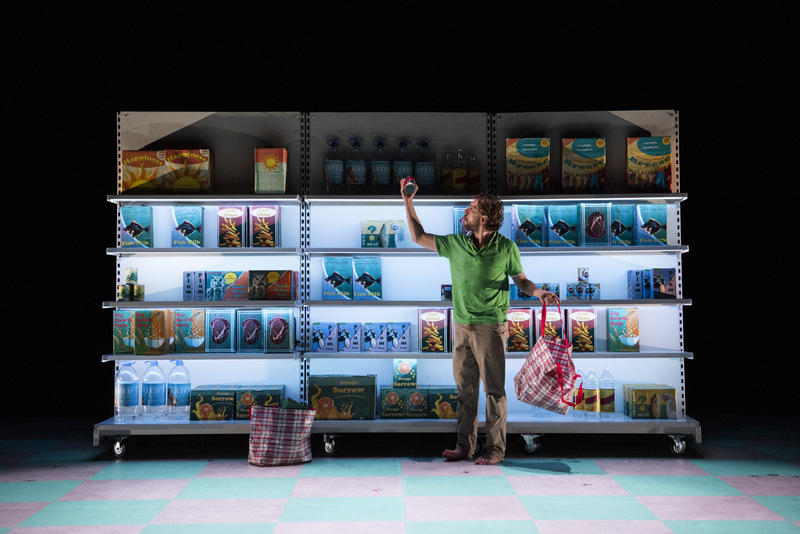
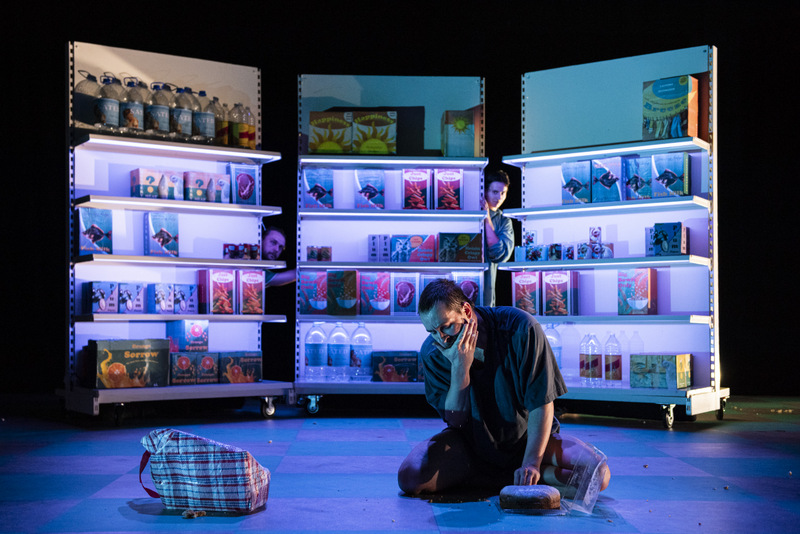
The piece is set in “a dark, endless shop existing beyond reality”, and the design effectively creates this strange, liminal environment so beloved in modern horror films (Vivarium (2019), Backrooms (2026), etc.). A tiled supermarket floor is surrounded by three shelving units, stocked with consumer goods decorated with colourful markings. The shelves are mounted on casters, allowing them to be pushed and rearranged throughout the performance. This simple device gives the space a constantly shifting quality, creating subtly different configurations while reinforcing the sense that Bob is trapped within an environment that is both familiar and strangely unreal.
Sound design by Lughaidh Armstrong Mayock initially provides us with the bland, inoffensive familiarity of elevator music: an endless stream of piped music that seems designed to fill the silence without actually saying anything. As the production develops, however, the soundscape becomes more expansive and adventurous, giving the performers greater freedom to move and allowing the atmosphere to become increasingly unsettling.
There are elements of a conventional story here, although the narrative remains deliberately elusive. Several characters appear and disappear, drifting into Bob’s world before departing almost as quickly as they arrived. Among them is an elderly shoplifter, along with a succession of other figures who interact with Bob for brief periods. They become temporary companions, obstacles or distractions, only to disappear and leave him alone once again. This constant cycle of arrival and departure contributes to the sense of isolation at the heart of the production.
The supermarket becomes a microcosm, a self-contained world that attempts to encapsulate all of life. The familiar rituals of shopping are transformed into something much darker, suggesting a world in which consumerism has become so all-encompassing that there is nowhere outside it to escape to. This appears to be choreographer Diarmuid Armstrong Mayock’s central vision: a portrait of contemporary life in which the supermarket becomes a metaphor for existence itself. Are we looking at consumerism gone mad, or is this something even darker? The production leaves the question open, allowing the audience to impose its own meaning on the increasingly surreal events taking place.
The difficulty is that the production struggles to sustain its central idea over its full running time. Repetition is clearly part of the intention, reflecting the monotonous cycles of consumer culture, but what initially feels intriguing begins, at times, to feel unnecessarily prolonged.
There is plenty to admire here. The visual concept is strong, the mobile set creates an effective sense of instability, and the performers commit fully to the production’s unusual physical language. At its best, Trolley Boy is funny, unsettling and hypnotic, taking a familiar environment and making it feel alien. The concept is strong enough to make an immediate impression; the challenge is knowing when to let the trolley stop.
Cast & Crew:
Choreography: Diarmuid Armstrong Mayock, in collaboration with the dancers
Dancers: Kévin Coquelard, Valentin Lemaitre, Nathalie Schmidt, Astrid Sweeney
Executive producer: Greta Bourke
Lighting Design: Matt Burke
Composition: Dee Armstrong & Lughaidh Armstrong Mayock
Sound design: Lughaidh Armstrong Mayock
Set design: Bridget Ní Dhuinn
Costume design: LaurA Fajardo
Chief LX: Tiana Kokalj
Stage manager: Sinead Cormack
Production manager (Black Box Theatre): Fiona Murray
Production manager (The Civic): Eimear Conroy
Technician/set builder: Fiachra Davoren
Videography: Luca Truffarelli
Photography: Jimmy Kilgallen
Graphic Design: Nuria Vega Bariani
Mentors: Luke Murphy & Oona Doherty
Categories: Dance, Header, Theatre, Theatre Review


