

Q&A with Xnthony – Lourdes – Dublin Theatre Festival
Venue – Civic Theatre, Tallaght – 25 Sep – 10 Oct
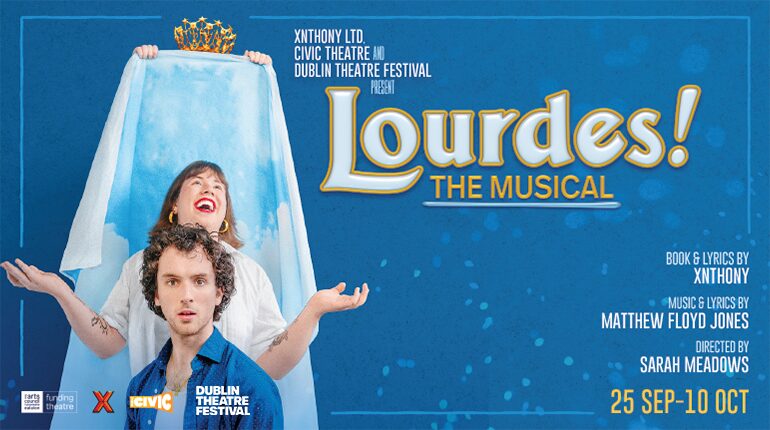
“Award-winning musical theatre creator, Xnthony, returns with a new show about miracles and the people who stage them. Lourdes! The Musical is an electrifying pilgrimage of Hail Marys mixed with the best new pop bangers and will rip your heart out and leave you thinking for days – premieres at Dublin Theatre Festival 2026”
Were you surprised by the reaction to Oliver Cromwell is Really Very Sorry, or were you quietly expecting the five-star reviews?
The success of Oliver Cromwell Is Really Very Sorry was a complete surprise to me. I’d spent a long time working outside the so-called theatre industry, making cabaret and club work, and the response to that work had been, shall we say, varied! I really struggled before Oliver Cromwell to nail what I felt was a genuinely good theatrical experience, and by the time I was making it, I honestly thought it might be my last piece of theatre, so I just went for it.
I wasn’t making it with any expectation of five-star reviews. I was really just trying to honour the impulse that had made me want to make it in the first place, and to create something that felt truthful to what I found funny, engaging and interesting.
When it connected with audiences, it was a huge surprise. The fact that people still come up to me in the street shouting “Oliver Cromwell!” is still thrilling.
There is a bit of a double-edged sword to that success, though. It creates this idea of the “difficult second album”, which is nonsense because Oliver Cromwell was about my ninth album! But its success has enabled me to make new work on a much bigger scale, which is exciting.
It’s also been a lesson in following your instincts. You can spend so much time thinking about trends or what you imagine people want you to make, but Oliver Cromwell worked because I followed the thing that genuinely excited me. I think there’s something to be said for trusting that instinct, even when you’re not sure where it’s going to take you.
This new production is now in the Dublin Theatre Festival, as opposed to being in the Dublin Fringe Festival. Does this now make you part of the establishment?
This is a funny question because I do sometimes ask myself: if an establishment organisation approached me and said, “We’d like you to make a show,” would I say yes or no?
It’s hard to know. I think there’s always a danger that when you become part of an institution, you can lose some control or authenticity. At the same time, it would be lovely to make something purely for the fun of making it, without having to worry about the lights, the funding, the management and all the other stuff that comes with producing a show. It would be quite nice for someone else to mind all of that for a change!
I don’t think being part of the Dublin Theatre Festival means we’ve suddenly become part of the establishment. For me, it’s much more a signifier of the festival’s belief in the work and its ability to reach an audience. We’re running for three weeks, for the full festival, which is a huge vote of confidence.
And we’re at the Civic Theatre in Tallaght, rather than a city-centre venue. That’s really exciting to me because we’re reaching people who might not always go to the theatre, and who might come along and encounter something unexpected. Maybe they’ll see something that surprises them, or learn something new, and then come back and see something even more daring the next time.
So no, I don’t think we’re part of the establishment. I have no immediate plans to start making inverted-commas “establishment” work. But you never know!
What inspired the new production? What can the audience expect?
Initially, I was inspired to write the show because I was making Oliver Cromwell Is Really Very Sorry at the time, and I tend to instinctively move in the opposite direction with each new piece. I like creating something that feels quite different from whatever I’ve just made.
When I first came up with the idea, all I really knew was that I’d been to Lourdes many times and that it felt like completely untapped subject matter. There was so much there to explore: the Church, faith, belief, pilgrimage and the whole industrial complex that has grown up around it.
But as the work developed, and as my own life changed over the four years I was making it, the show became less about skewering the Church and much more about how individual people approach faith when they’re in crisis.
So audiences can absolutely expect that Xnthony Limited humour, it’s still there in abundance, but it’s also an extremely heartfelt show. It deals with heavy themes around illness, loss, mourning and grief.
Ultimately, though, I think it’s a show about where we find miracles. Rather than looking for them in some far-off holy place, it’s about finding them in other people, in community and in the unexpected ways we look after each other.
They say creating a Musical is one of the most complicated art forms, due to all the various elements involved. How long did this work take from the initial idea to making it to the stage?
Correct. Making a musical is really hard. It’s incredibly challenging. It’s the 4D chess of theatre.
I think there’s sometimes a tendency within the industry to view musicals as being a bit like panto, and I’m not saying that to be shady about panto, because pantos are amazing! But a musical is a very specific form. It isn’t just song and text sitting alongside each other; it’s song with text. The musical has to use song to say what the characters need to say. The songs can’t simply be there because it would be nice to have a song.
You’re constantly balancing the book, the dialogue, the lyrics, the music and the character’s journey. The composer and I would sometimes spend weeks litigating a single line or idea. I’ll often have an instinct for a song or a number, but then you have to ask: does this belong to this character? Does it move the story forward? Does it tell us something we couldn’t have got from the dialogue?
So yes, it can be incredibly time-consuming. This show has taken about four years. The idea was already sitting in my brain in 2022, and since then there have been multiple developments, rewrites, misdirections and moments where I thought I was making one show and realised I was actually making another.
Can you tell our readers a little about Matthew Floyd Jones and how you worked together creating this piece?
Matthew Floyd Jones is an amazing composer. He’s had some West End hits himself, including Kathy & Stella Solve A Murder. I approached him because I knew he had a really exceptional understanding of musical theatre and, crucially, how you can use the form to tell a story.
That was important because Lourdes! The Musical is quite different from Oliver Cromwell Is Really Very Sorry. With Oliver Cromwell, we were using pop music as the storytelling language. Lourdes has multiple characters, multiple arcs and a much more traditional musical-theatre structure, so I needed someone who was incredibly competent and athletic as a composer, someone who could move between completely different characters, styles and emotional worlds.
Our process was often very simple. We’d be crouched together in some tiny studio, throwing around one-liners, phrases and ideas for songs. I might come in with an instinct for something like “Club Is Church”, which is one of the songs in the show, and an idea of what that song needed to be. Then we’d just bash out words and melodies together. I’d bring references, he’d bring references, and we’d see what happened. It was really, really fun.
Sometimes that process is incredibly laborious, and a song takes ages to find. Other times something just arrives.
Do you suffer from opening night nerves?
Ask my boyfriend. I wouldn’t know.
LOURDES! The Musical opens at Civic Theatre Tallaght (25 September – 10 October), as part of Dublin Theatre Festival 2026 – https://dublintheatrefestival.ie/event/lourdes-the-musical/


