
Just an Illusion – Film Review
Directors – Olivier Nakache, Éric Toledano
Writers – Olivier Nakache, Éric Toledano, Nathalie Hertzberg
Stars- Simon Boublil, Louis Garrel, Camille Cottin
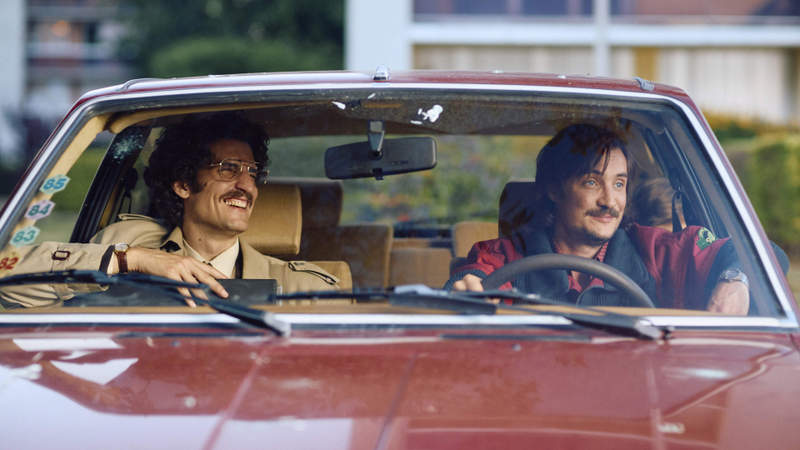
A joyful coming-of-age film that races along as we follow the day-to-day travails of Vincent (Simon Boublil) as he leaves the world of childhood behind, if only partially behind. For family arguments, there has seldom been a better film. No great traumatic murderous showdowns but instead the sometimes sparkling ‘you did, you didn’t’ rows that mark most lives. We are back in the 1980s. As with the accuracy of arguments, there is an accuracy in the representation of the period – those clothes, those cars, the general ambience of 1980s suburban France. There is an evocation of period that is a triumph of production skills. It is not all cream-coloured trench coats and big hairstyles; there is also a realistic evocation of the economic challenges of the time – rising unemployment and uncertainty. It is the milieu in which teenage Vincent is coming of age – his bar mitzvah and the out-of-control guest list (and cost) looms large. It is hugely nostalgic but never sentimental.
Family dynamic is clearly more important than the overall chaos of the period. Vincent’s world is very much of the moment, dominated by his classmate gang and their frustrated attempts to procure, let alone view, a soft-porn video. There is his brother with whom he shares a crowded bedroom – a brother growing too cool for the restrictive suburban norm and who finds his little brother a nuisance. Then there is the love interest and that almost embarrassingly accurate evocation of first love, as Vincent sets out to pal up with the more worldly girl of his reverie. As if he has not enough on his plate – like not having the right ‘cool’ jacket, Vincent is also beginning to wonder about life’s great questions – why are we here, what is it all about? Is he Jewish? Is he French – Jewish? Is he French Arab Jewish? Questions perhaps still not answered to this day by wider French society. It is early teenage years but seen through a gentle comic lens – never slapstick or farcical but perhaps all too accurate – the sort of things that are agony at the time but can be seen as comedy when appreciated from middle-age distance and assurance.
It is set in France – no surprise there, but the cleverness is that it could in reality be anywhere. We don’t, for example, see any of the cliché images – no hazy Tour Eiffel or crowded Champs-Élysées. But we do see bedrooms and kitchens, the rush to get ready in the morning, the traffic jams, the stress of the everyday, life itself. In that sense, there is an entry point for every viewer to glimpse back at their own teenage years, to cringe at what now embarrasses us and to sigh, perhaps, at what we now remember fondly.
The well-known opening line of L.P. Hartley’s The Go-Between (1953)h states: “The past is a foreign country; they do things differently there.” That may well be the case, and for younger viewers much may seem strange, not least the fashion and interior décor. Yet the film is also a reminder that each period comes with its own worries and social issues and that we too will one day look back at these years through a prism of nostalgia, and cringe at the hairstyles and now-tasteful décor. The film sparkles and entertains, while dealing with some serious issues of recollection and closeness of kith and kin.
.
Categories: Header, Movie Review, Movies


