
 Audrey or Sorrow – Abbey Theatre – Review
23 February – 30 March 2024
A Landmark Productions and Abbey Theatre co-production
– Written by Marina Carr – Directed by Caitríona McLaughlin
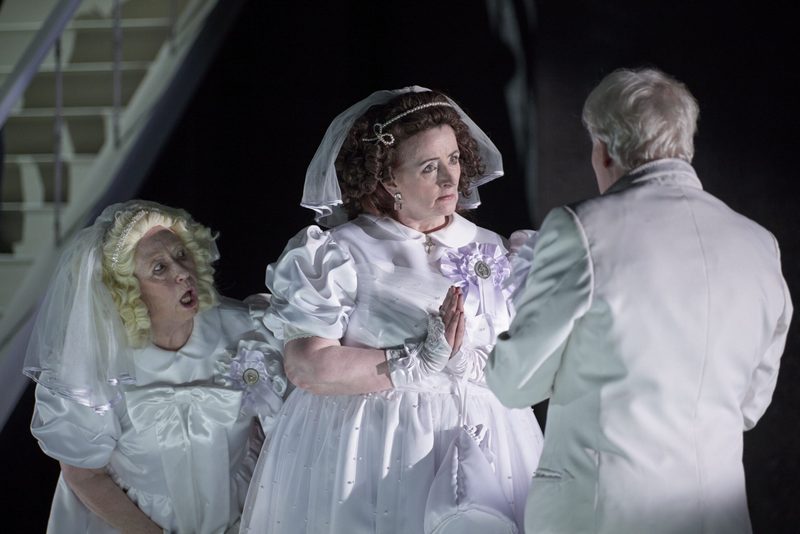
At the start of the production, we meet Mac (Anna Healy) and Grass (Marie Mullen). They are two unusual characters, dressed in bizarre clothing and drinking imaginary tea from empty cups. They act like two small children playing at being grown-ups. Their conversation brings up unusual topics, such as the existence of the tooth fairy! Slowly, we start to realise that all is not as it seems in this “story of badly-behaved ghosts”.
This is a new work by playwright Marina Carr, who is known for works such as Portia Coughlan (1996) and By the Bog of Cats (1998). More recently, she wrote Hecuba (2015), produced by Rough Magic in 2019 and iGirl (2021) at the Abbey. She is one of the most important modern Irish playwrights and her work is known for its complex characters and tense situations. While this piece is similar in some respects, it is also quite unique amongst her work.
The three ‘younger’ characters of Purley (Nick Dunning), Mac (Anna Healy) and Grass (Marie Mullen) introduce an unnerving element to the production. They add a touch of the bizarre and are often quite humorous. The sinister Audrey (Aisling O’Sullivan) is always present, controlling the proceedings and manipulating others to her will. After the interval, the work changes focus again and we see characters that were minor elements in the first Act take centre stage.
The play gives the audience a drip feed of information as it slowly becomes clear who each of the characters really are. It’s a complex play that could be watched on more than one occasion, as much of what you see in the first Act only makes sense with what you learn in the second.
You can tell that Marie Mullen, Anna Healy and Nick Dunning are having a ball on stage with these larger-than-life characters. Their clothing and delivery are never mundane in their portrayal of spirits from another realm. Aisling O’Sullivan as Audrey is the villain of the piece, and we’re never quite sure of her motivation as she remains elusive. Is it revenge or something else? The other two main characters are Maria (Zara Devlin) and David (Patrick Martins), a young couple who are struggling to make sense of the events happening around them.
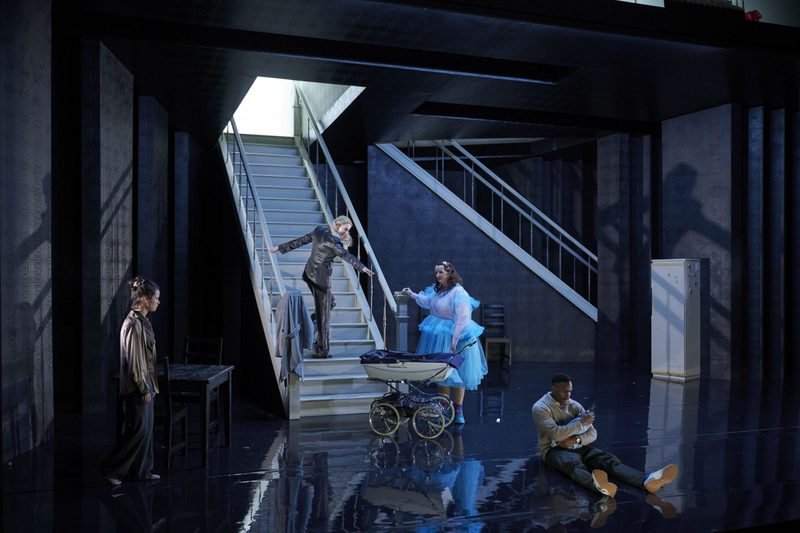
The stage by set designer Jamie Vartan is an unusual creation. It’s a simple but stark space, with two long flights of stairs moving into the heavens at quite an abrupt angle. It’s a sinister enough space for these strange happenings to transpire.
The work is extremely dark and infant mortality features heavily, which will make uncomfortable viewing for some audience members. The Abbey website comes complete with content advice which can be found here.
When dealing with elements of the Supernatural, a writer is granted a certain freedom. Marina Carr has made good use of this opportunity. It’s always interesting to see something new on stage and this work is quite original and innovative. While it’s not always clear what message or ideas the play is trying to explore, it feels like it’s creating a new mythology. The subject matter is decidedly bleak, but there is enough humour from the individuals involved to bring the audience along for this uncomfortable ride. If you’re looking for an easy night at the theatre, it’s not here but if you’re looking for something unique, then look no further.
Credits
Written by: Marina Carr
Directed by: Caitríona McLaughlin
Set Designer: Jamie Vartan
Costume Designer: Katie Davenport
Lighting Designer: Sinéad Wallace
Sound Designer and Composer: Sinéad Diskin
Movement Director: Sue Mythen
Associate Director and Voice Director: Andrea Ainsworth
Assistant Director: John King
Casting Director: Sarah Jones
Hair and Make-Up: Tee Elliott
Maria: Zara Devlin
Purley: Nick Dunning
Mac: Anna Healy
David: Patrick Martins
Grass: Marie Mullen
Mother: Aislín McGuckin
Audrey: Aisling O’Sullivan
Father: Howard Teale
Categories: Header, Theatre, Theatre Review


 No More Workhorse
i walked out at the interval. I could not hear the dialogue and had no idea what was going on. I asked a group of ladies in front of me if they were able to hear what was being said. They admitted that they could not and had no idea what the message was.
Part of the problem was that the actors quite often had their back to the audience.