
You Can See Everything – Film Review
by Frank L.
Directors – Nathan Fielder, Lance Oppenheim
Stars – Amanda Seyfried, Christopher Abbott, Nathan Fielder
At the beginning of 2023, Elizabeth Holmes was facing a prison sentence of 11 years and 3 months for conspiracy to commit wire fraud and three counts of wire fraud in connection with her blood-testing start-up company, Theranos. At its height in 2014, Theranos was valued at approximately US$9 billion, with Holmes owning around half of the company. Subsequently, it became apparent that its technology did not work. However, Holmes refuses to accept the underlying facts. She appears to subscribe to the school of “alternative facts”, whose deployment has become increasingly commonplace since 2016, following the presidential election in the United States.
To bolster her belief in the veracity of her own story, Holmes invited Fielder and Oppenheim to stay with her, her partner, Billy Evans, and their two infant children (the younger only a few weeks old) in their sophisticated rented beachside home near San Diego, California. This was shortly before she was due to begin her prison sentence, just over a month later. We see the family going about their mundane daily routines, such as walking along the beach. These sequences are interspersed with Fielder asking Holmes penetrating questions about her behaviour in relation to Theranos. With wide-eyed innocence, she refuses to admit any fault on her part, no matter what contradictory evidence Fielder presents. In her world, it seems that everyone else is out of step with her.
Also prominent in the family circle is Evans. He comes from a well-heeled San Diego family who own several hotels and is a constant presence throughout the film. He met Holmes after the Theranos bubble had burst, but it seems it was love at first sight. He is a tall man of impressive appearance, but he is also opinionated and has a controlling streak. For instance, he has very definite views on the correct method of whisking eggs! He exudes the manner of someone who has grown up in privileged surroundings.
In the first half of the film, Holmes is centre stage, with Fielder directing his questions towards her. However, Fielder and Oppenheim have to change tack once Holmes is incarcerated and no longer available to them. They are forced to improvise. The scheme they devise keeps Holmes prominent, while also allowing Evans to reveal more of himself, which he duly does.
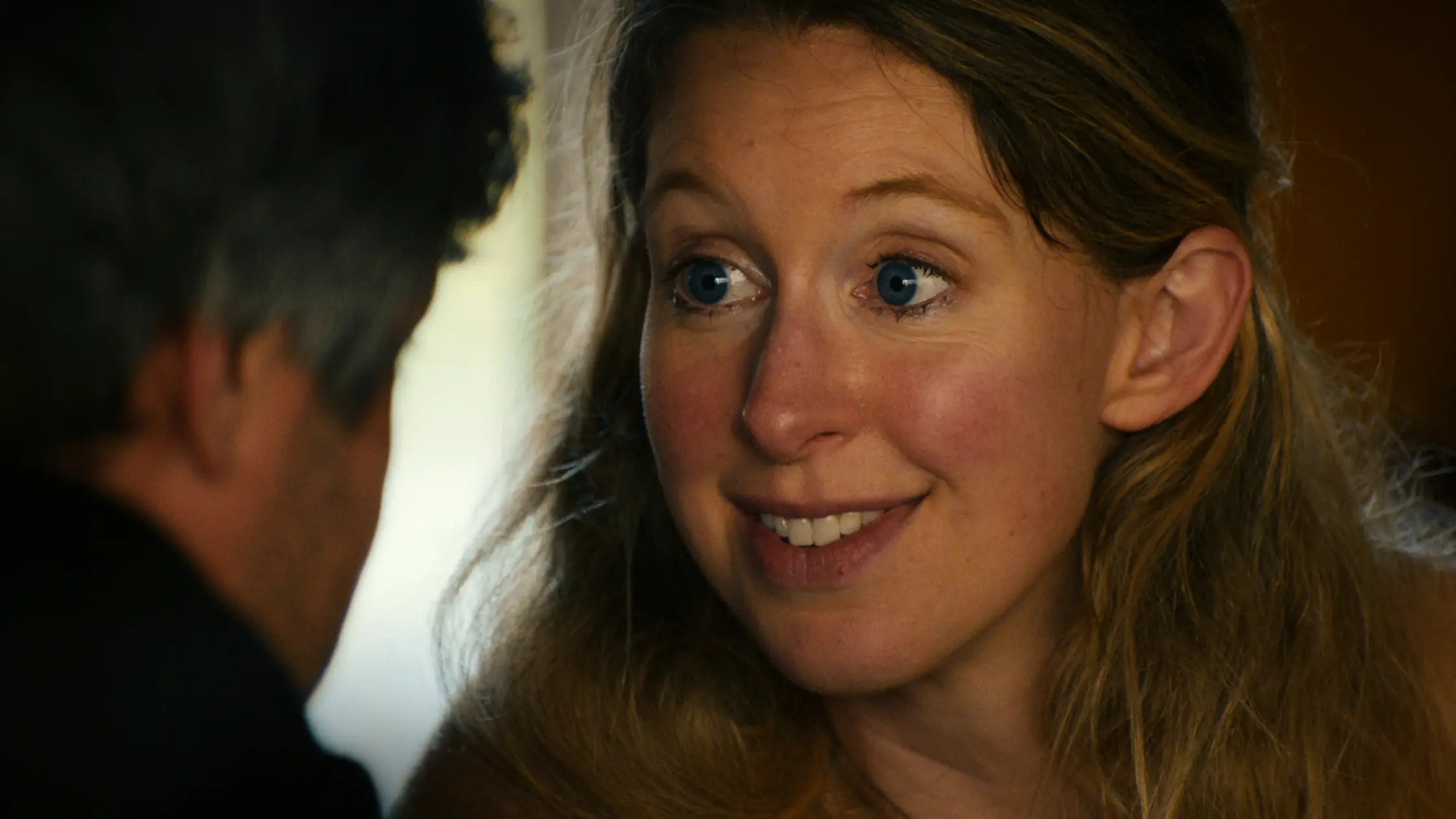
Holmes, with her wide-eyed expression and habit of looking directly into the camera, is a phenomenon. Fielder, as an observer and questioner, is superb. Evans, meanwhile, gradually diminishes in stature as the film progresses. At almost three hours in length, the film is an extensive investigation of Holmes and Evans. It is an extraordinary piece of filmmaking, but, above all, it remains fascinating throughout. In fact, it is riveting from beginning to end.
Categories: Best Documentary, Best New Movies, Header, Movie Review, Movies


