
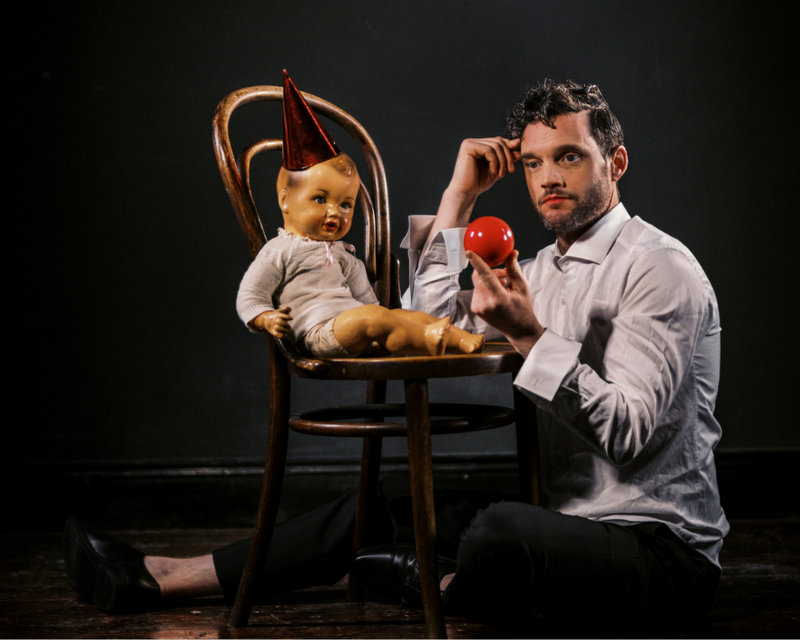
 Q&A with Louis Lovett – Kafka’s Doll – Dublin Fringe Festival
PERFORMANCES: 4 Sep, 18:00 (preview), 5 Sep, 18:00, 7–11 Sep, 18:00, 12 Sep, 13:00 & 18:00
Can you tell me a little about how the production came about? What did you think when you first read the script by Frances Kay?
Frances Kay is a long-time collaborator of Theatre Lovett. In fact, she wrote the very first play we did: A Man in Half, which was a one-person show based on the Jekyll and Hyde story. Frances brought the story of Kafka’s Doll to us. As is often the way, we let that idea simmer for quite a while before Muireann and I decided to ask Frances to go for it and write her version of the story.
When we first read an early draft, we liked many elements and asked Frances whether she might tweak other elements. We work very closely with writers and like to collaborate on the writing. This is because Theatre Lovett has quite a particular style of theatricality – certainly not naturalism, quite heightened and so we love the writing to allow scope for that non-linear approach.
When did you first discover Kafka’s work, and was it love at first sight?
I first read Kafka’s The Trial when I was seventeen and was both delighted and dismayed at the frustration of K’s plight. I wouldn’t say it was love at first sight. I read Metamorphosis next and would have seen a number of play versions of that story around the turn of the century… yes, that’s the first time I’ve ever used that phrase and actually meant it. A big moment for me just now. Thank you, No More Workhorse.
Does this work aim to show a different side of Kafka?
Frances Kay was very clear that she wanted to show the humorous side of Kafka. He was a bit of a messer with his friends. Quick to laugh and play jokes. His stark vision of the world was imbued with hilarity at the many bizarre scenarios he evoked.
You are listed as a co-director of this piece with your wife, Muireann Ahern, who is also the Co-Artistic Director of Theatre Lovett. Can you explain the dynamic of who gets to decide what? Are there ever disagreements on set?
We rarely disagree. We do disagree, but rarely. We share a very close idea of what our theatre should be. Needless to say, this means we can skip along at a pretty pace, not needing to stop and ‘confer’. When Muireann is directing me, she also does not need to choose her words and can cut to the chase and tell me ‘Stop doing that, Louis.’ or ‘Louis, that is awful, try something else.’ This is fine by me as I trust her, but we do need to flag it with collaborators lest they tear up on my behalf.
You are also one of the three cast members in this production, alongside Charlotte Cleary and Cormac Mohally. Can you tell me about your roles in this production?
We are very fortunate to have landed upon Charlotte and Cormac as our cast members. They both bring very different styles and attributes to the production. It is not a play where we have distinct characters, but rather we step into the role of certain characters now and then. We all narrate at different times and meet the audience as members of the Kafka Kan Kan Kabaret Kafe. Frances Kay, the writer, has taken a little-known anecdote from Kafka’s latter years and fleshed it out. She has borrowed from some of his short stories to create the ‘letters’ that a doll sends (via the hand of Franz Kafka) to a little girl he meets in a Berlin park.
There is live music by Nico Brown. Does the music play an important role in the production?
The music was live when it was recorded but shall not be live in the theatre! Nico Brown is another long-time collaborator of Theatre Lovett and gave me my first professional theatre job ó shin, ó shin. The show is very musical, and Nico’s gorgeous tunes evoke Europe of the 1920s. Charlotte and I get to sing, and we get to ask Cormac Mohally not to sing. All good.
You are known for creating work for all ages. Do you have to do anything different to appeal to children and adults alike?
Yes, you do. You make two shows in one. The directors have two dials within reach, and the rehearsal process is an act of twiddling those dials continuously. One dial is labelled ‘adult’ and the other ‘child’. Then Muireann swaps the labels. But then she knows that what engages one, engages the other. After all, we’re only human, as the song goes. Alas, all this jiggery-pokery requires twice the work, but rarely have we twice the amount of time. So, we must borrow from the time of the owl and burrow into the night with our twiddling.
Theatre Lovett’s Kafka’s Doll opens at the Abbey Theatre, Peacock stage (4 – 12 Sep), as part of Dublin Fringe Festival 2026 – https://www.fringefest.com/festival/whats-on/kafkas-doll


