
Swan Lake – Ballet De Santiago – Bord Gáis Energy Theatre – Review
by Brian Merriman
Ballet De Santiago
Dates: 18-23 August 2026 at 7.30pm, matinees on 22nd at 2.30pm and on the 23rd at 1.00pm.
Content warning: Strobe lighting, flashing lights, smoke and haze effects.
Under 16s must be accompanied by a parent or guardian (18+); no children under 3 admitted.
In 1877, the world-famous Bolshoi Ballet Company premiered Tchaikovsky’s now-legendary work, which he completed 150 years ago in 1876 to mixed reviews. Julius Reisinger’s choreography apparently lacked dramatic impact, despite the rich symphonic score.
In 1895, the ballet had a complete makeover by choreographers Marius Petipa and Lev Ivanov, and arranger Riccardo Drigo in St Petersburg, which carved out its now-enduring reputation. Swan Lake’s new dramatic edge in 1895 emphasised and exploited the themes of love, betrayal, and redemption. It moved the central character, Odette, from a more sterile swan maiden to a dramatic Princess cursed to live as a swan until true love breaks the spell.
Since 1895, countless productions, stars (including Morales Anderson) and companies have not only ensured its iconic status endures, but underwrite its continuance as a staple in ballet excellence. Each company that performs this work becomes the current curator of Swan Lake, as it continues to delight and awe audiences across the world.
150 years since finishing the score, it is a bold promise indeed by Ballet de Santiago to claim that this European premiere will be Swan Lake as you’ve ‘never seen it before’. We expect the standards, dancing skills, the magnificent score and the awe-inspiring spectacle that have enthralled audiences over the generations. Morales Anderson and Ballet de Santiago know what they need to deliver. BGET audiences have already approved of Matthew Bourne’s innovation, and are open to more. Having benefitted from one makeover in 1895, what can this new production offer over 130 years later?
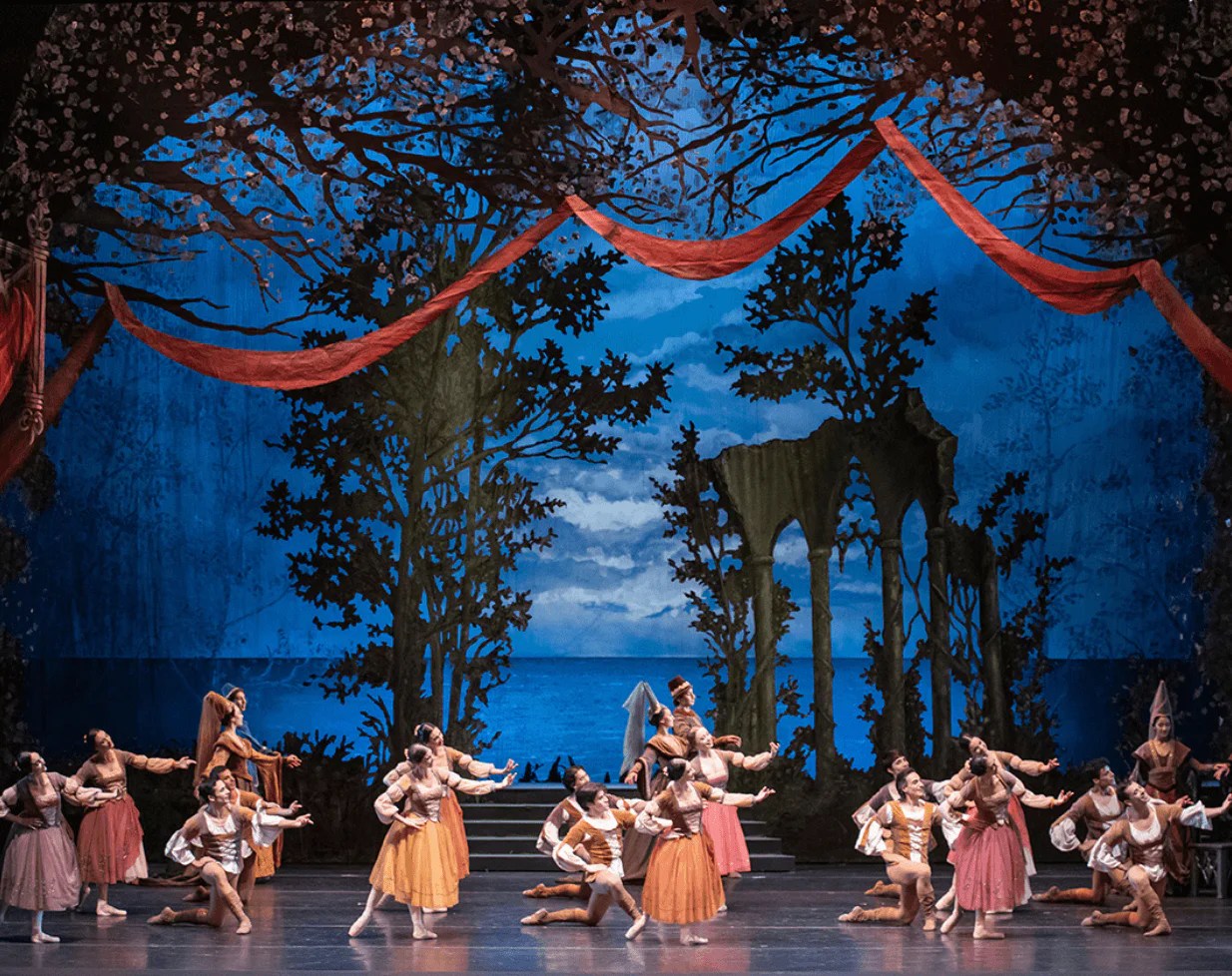
There are undoubted pressures on any European premiere opening night. Act 1 opens in the Palace Gardens. It was lavishly costumed but quite traditional in its staging. As a travelling ensemble, the set by Campuzano was a collection of well-cut cloths and gauzes. It created a beautiful silvery grey backdrop that illuminated the magnificent colour and detail in Pablo Nunez’s costumes, enhanced by the many moods of Ricardo Castro’s atmospheric lighting.
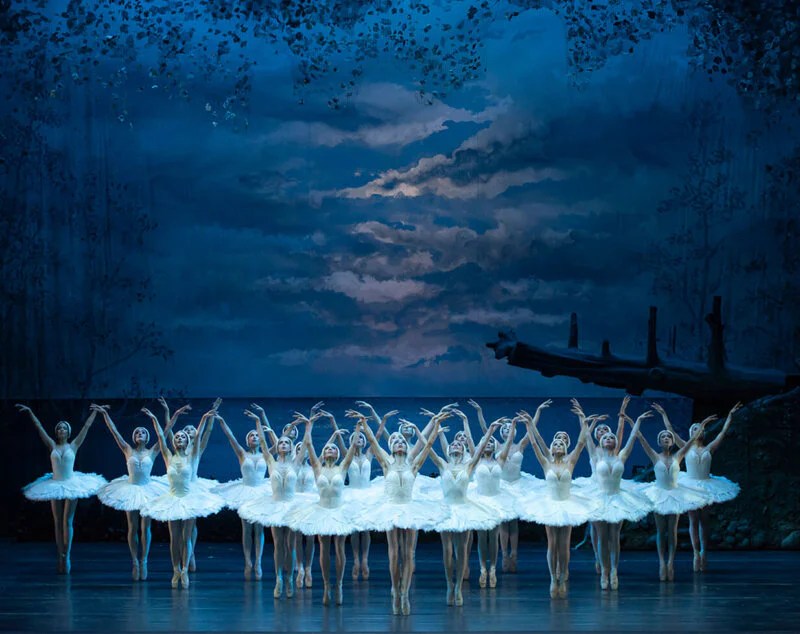
A grumbling speaker didn’t help Act 1, but this experienced and vast corps de ballet (24 swans) settled in promptly, and each Act that followed was like witnessing another bloom, layer by layer of a lotus flower.
The quality of any company is in the depth of its talent. Ballet de Santiago has a rich and skilful young talent bank. The vignettes in each Act showed off the high standard and detailed execution of dance sequences from pas de deux to larger ensemble work. Matias Romero, Rocio Gomez and Milagros Perrella’s pas de trois really settled down Act 1 and rightly signalled that so much more quality was to follow.
The RTE Concert Orchestra shone in all departments under the baton of Pedro-Pablo Prudencio, with all sections in fine form. The visual feast on stage was a seamless blend of production and performance. The props were impressive in detail and scale, with a crown for the Queen that raised the bar for fairytale fantasy! The many tableaux that ended each Act were beautifully executed. They really created the sense of romance that underscores the love story of Siegfried and Odette/Odile.
Katherine Rodriguez’s dual role of Odette and Odile (the white and black swans) was a tour de force. Her solo work looked effortless, and her presence, emotion and athleticism dominated the production, with a freshness that was maintained throughout the 160 minutes (including the interval), which flew by. Emmanuel Vazquez as Siegfried was a warm, authentic and likeable love interest. His command of the stage, artistry and interaction with Rodriguez made for a partnership that enthralled and impressed.
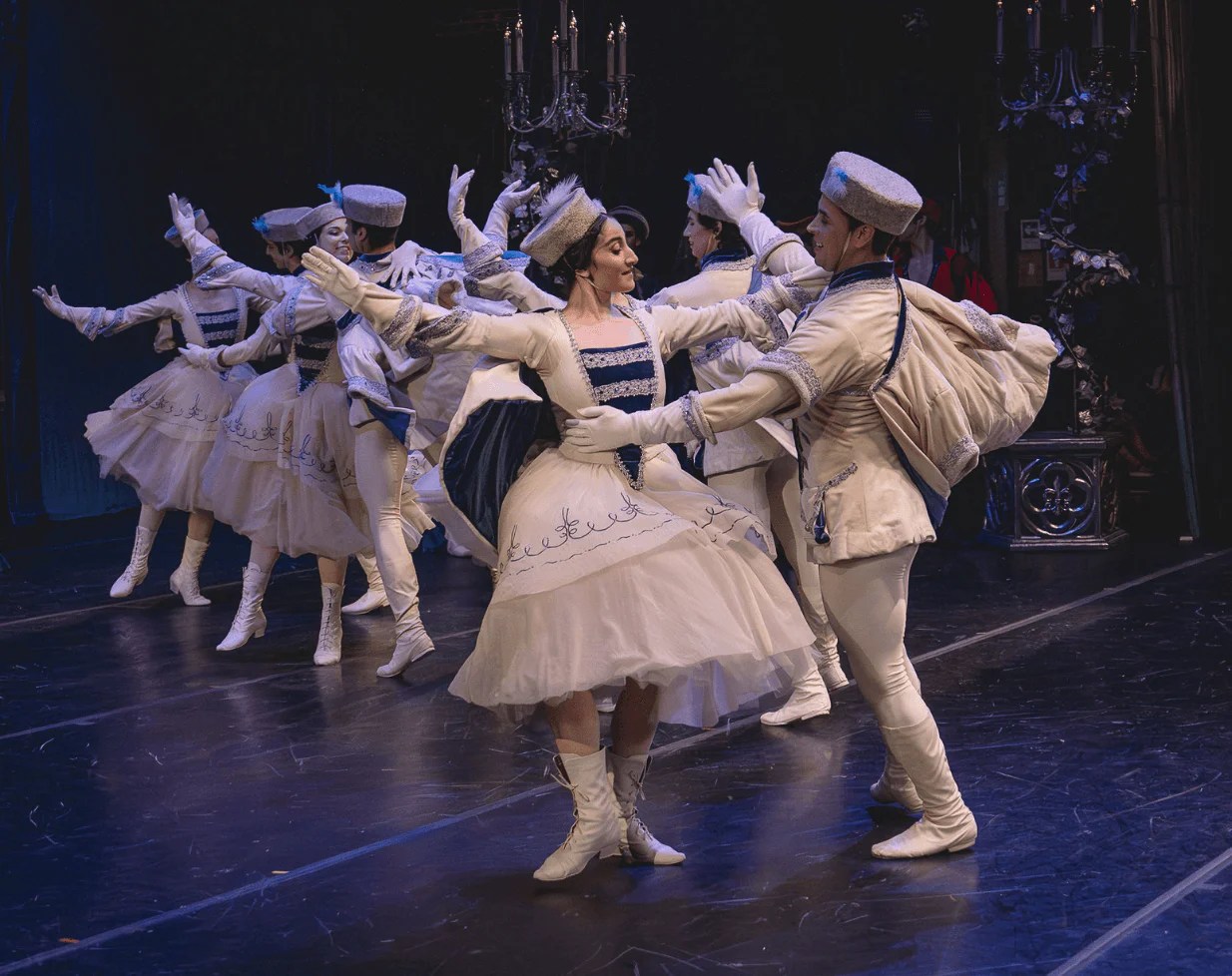
Act Three’s opening dance sequences in the Ball at the Castle, inspired by folk themes, were a visual delight and displayed the talent of the corps joyfully. The dramatic scenes were equally impactful, giving all the essential elements that are required for a first-class production of Swan Lake. The skill set was top class, the spectacle memorable, and the score was full of emotion. The non-dancing roles and, strangely, the very fine male corps were excluded from the final bows. They deserve more recognition.
I don’t know what Tchaikovsky had imagined in his head when he composed this work, 150 years ago, but he was doubtless well pleased with the creativity of Mr Morales Anderson, the rich musical interpretation of the RTE Concert Orchestra and the sheer balletic quality of the multi-talented corps that are the Balle de Santiago. Their Swan Lake is a visual, balletic and aural, timeless treat.
Produced by Ballet de Santiago, Chile
Artistic Director: Cesar Morales Anderson
Composed by Pyotr Ilyich Tchaikovsky
Performed by The RTÉ Concert Orchestra
Musical Director and Conductor: Pedro Pablo Prudencio
Set Design: Enrique Campuzano
Costume Design: Pablo Nunez
Lighting: Ricardo Castro
Starring: Katherine Rodriguez, Emmanuel Vazquez, Matias Romero, Deborah Oribe and Mariselba Silva (some roles are shared with a different cast for each performance)
Story inspired by Russian and German folktales including Johann Karl August Musäus’s “The Stolen Veil”
Categories: Dance, Header, Theatre, Theatre Review


I would like to add a different perspective that of a Russian audience member who grew up with the tradition of classical Russian ballet.I have had the privilege of seeing principal dancers from the Bolshoi Theatre on tour in Russia, in my home city of Omsk. My son has also experienced ballet both in Russia and here in Europe. So for us, Swan Lake is more than a beautiful ballet set to Tchaikovsky’s music. There are things in its music, its story and its spirit that feel deeply familiar to us. That was why I was particularly curious to see how Ballet de Santiago, a Chilean company, would approach this work. I believe every culture inevitably brings something of its own to ballet. Perhaps it is impossible for a Latin American dancer to feel every shade of the Russian spirit in exactly the same way as someone who grew up surrounded by that culture just as it would be difficult for a Russian dancer to reproduce the Latin American spirit with complete naturalness. At certain moments I could feel that difference. I could feel the effort to reach into a tradition that was not originally their own. But I do not say this as a criticism. On the contrary, what touched me was the respect and sincerity of that effortBallet de Santiago did not try to turn Tchaikovsky into something else. I felt that they approached the classical tradition with care. They allowed the brilliance and emotional power of Tchaikovsky’s music to remain at the heart of the performance, and they clearly wanted to understand the world of Swan Lake, not simply to remake it in their own image. For that, I am genuinely grateful to them. There was something else that mattered greatly to me the meaning of the ending. I recently saw another European production of Swan Lake in Budapest. Beautiful as it was, its ending left me with a very different feeling almost as though darkness and evil had ultimately triumphed over goodness. In Dublin, I felt the opposite. Evil may be powerful. It may frighten, deceive and destroy. But ultimately love and goodness can be stronger. For me, that is an essential part of Swan Lake. And I was very happy that Ballet de Santiago allowed me to leave the theatre with that feeling. But perhaps my greatest and most unexpected discovery that evening was not on the stage at all. It was the Irish audience. I admit this with a little embarrassment now, but before the performance I wondered how such a classical ballet would be received here. There were people of very different ages in the theatre, including children, and I caught myself thinking: will they understand it? Will the children remain interested for such a long performance? A young Irish girl was sitting directly in front of me. She did not take her eyes off the stage for a single moment. She never became restless. She never looked away. She never seemed bored. I could see the whole ballet passing through her. Even in the movement of her shoulders I could see her tension, her sympathy, her fear and her joy. She was experiencing everything that was happening to Odette and Siegfried. She was not simply watching Swan Lake. She was living it. At some point I realised that, alongside the performance, I had begun watching this child because her response to what was happening on stage was so genuine and so moving. And she changed something in my own experience of that evening. I had come to the theatre as a Russian woman wanting to see what a Chilean ballet company would do with Tchaikovsky and with a work so deeply connected to the Russian ballet tradition. I left with something I had not expected at all enormous respect for the Irish audience. I was happy to see Tchaikovsky’s Swan Lake performed on an Irish stage. I was grateful to Ballet de Santiago for approaching this great work with such respect, sincerity and commitment. But I was also deeply moved to see a child from another country, another language and another cultural tradition respond so completely to this music and this story. Perhaps that is one of the greatest things art can do. It crosses borders that words sometimes cannot. It needs no translation.
Thank you, Ballet de Santiago, the RTÉ Concert Orchestra and Bord Gáis Energy Theatre for a memorable evening and thank you to the Irish audience for giving me one of the most unexpected and beautiful impressions of the night.
A lovely insightful comment! Thanks