
The Whiteheaded Boy -Abbey Theatre – Review
by Frank L.
An Abbey Theatre production – The Whiteheaded Boy – Written by Lennox Robinson – Directed by Annie Ryan
Dates – 3 June – 25 July 2026
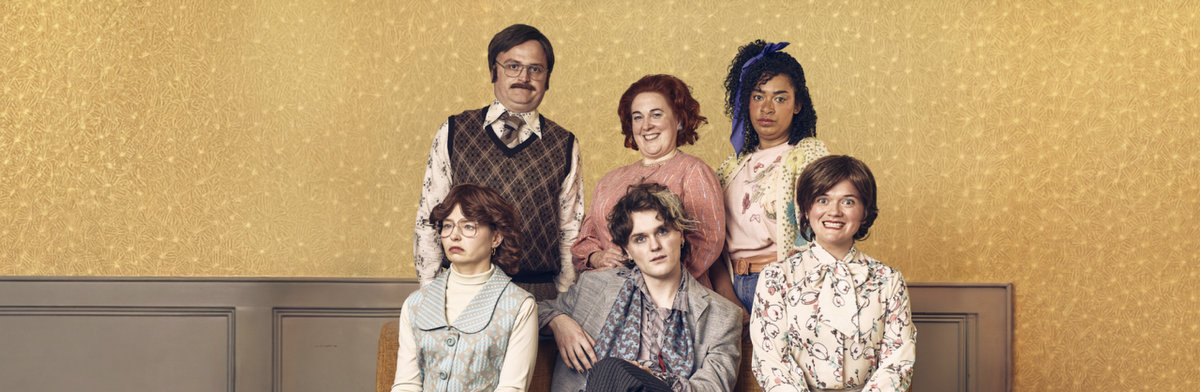
The Whiteheaded Boy premiered at the Abbey Theatre on 13 December 1916. Almost 110 years later, it returns to the Abbey in a new production which, according to director Annie Ryan, is set in 1979–80. Maree Kearns’s set design effectively evokes that period, with a mixture of contemporary furnishings and older objects that one would expect to find in a bourgeois household in a rural Irish town.
The Geoghegan household consists of Mrs Geoghegan (Clare Barrett) and her six adult children: Jane (Fionnuala Gygax), Kate (Genevieve Hume-Beaman), George (Peter McGann), Peter (Ben Waddell), Baby (Charlotte Cleary), and the youngest, Denis (Teddy Moore), the eponymous “Whiteheaded Boy” who, in the eyes of his adoring mother, can do no wrong. Apart from Denis, they all remain living at home, frustrated and constrained in different ways. Completing the family circle is Aunt Ellen (Anna Healy), a comfortably off schemer who is a frequent visitor to the household.
The Geoghegan children are trapped at home because any spare money the family has is devoted to Denis, who is supposedly studying medicine at Trinity College. Unlike his siblings, he has managed to gain a degree of freedom from the confines of family life. However, Denis is easily distracted, and passing examinations appears to be a skill that continually eludes him.
He has a girlfriend, Delia (Malua Ní Chléirigh), the daughter of John Duffy (Andrew Bennett), the town’s leading businessman. The frustrations experienced by the siblings are exemplified by Jane, who cannot find a private place where she can spend time intimately with her long-standing boyfriend, Donough (Michael Teint).
At Mrs Geoghegan’s insistence, any profits generated by the family business, which is managed by Peter, must be spent on Denis. All of the children are subservient to their mother, whose attention is focused almost exclusively on her youngest son. Yet Denis has once again failed his examinations, leading to a reckoning spearheaded by the hardworking George.
Throughout the production, music from the late 1970s and early 1980s provides a fitting backdrop. Kate, the long-suffering family drudge, dances to it during quiet moments, and even before the play properly begins, she entertains the audience with her attempts to swat a fly. Hume-Beaman makes a strong impression, displaying excellent miming skills. Barrett similarly showcases her considerable comic talents as she deflects every criticism directed at her darling, can-do-no-wrong Denis.
Denis himself is a somewhat puzzling figure, presented with a highly camp manner that makes his relationship with Delia feel rather unconvincing. A far more compelling dynamic emerges between John Duffy and Aunt Ellen as they rekindle memories of a shared past. Bennett and Healy demonstrate once again that they are masters of their craft.
Middle-class families with six children are far less common today. Presumably there are still “whiteheaded boys” in contemporary households, but the ways in which they are indulged and favoured would differ considerably from those depicted by Lennox Robinson more than a century ago. Annie Ryan’s lively reimagining succeeds in drawing out the play’s enduring themes of family expectation, generational frustration and parental favouritism. While this production is undoubtedly enjoyable on one level, by the end one is left pondering the question of why it was revived. It is not a challenging night at the theatre, but productions at this time of year rarely are. The production delivers energy, strong ensemble performances, and an attempt to view a classic through a more contemporary and feminist lens, which ensures that it remains engaging.
Credits
Mrs. Geoghegan: Clare Barrett
John Duffy: Andrew Bennett
Baby: Charlotte Cleary
Jane: Fionnuala Gygax
Aunt Ellen: Anna Healy
Kate: Genevieve Hulme-Beaman
George: Peter McGann
Denis: Teddy Moore
Delia: Malua Ní Chléirigh
Donough: Michael Tient
Peter: Ben Waddell
Writer: Lennox Robinson
Director: Annie Ryan
Set Design: Maree Kearns
Costume Design: Sinéad Cuthbert
Lighting Design: Sarah Jane Shiels
Composer & Sound Design: Denis Clohessy
Intimacy Director: Sue Mythen
Voice Director: Andrea Ainsworth
Casting Director: Barry Coyle
Assistant Director: Giulia Grillo
Assistant Costumer Designer: Toni Bailey
Assistant Voice Director: Gillian McCarthy
Assistant Lighting Designer: Daisy Long
Promotional Photography: Pato Cassinoni
Categories: Header, Theatre, Theatre Review


