
Les Ballets Trockadero De Monte Carlo – Bord Gáis Energy Theatre – Review
LES BALLETS TROCKADERO DE MONTE CARLO – Produced by Dance Consortium
Dates: 30 April – 01 May 2026
The Trocks’ Dublin shows are the start of a 14-venue tour of Ireland and the UK presented by Dance Consortium.
Les Ballets Trockadero de Monte Carlo—or simply The Trocks—is an all-male drag ballet troupe that has toured the world with a distinctive, highly skilled production blending slapstick humour and elegant movement in equal measure. It’s an unlikely pairing: at one moment, a performer moves in perfect synchrony with the music; the next, they are bickering, stumbling, or collapsing in comic disarray. The company returns to Dublin to open the Dublin Dance Festival 2026.
The troupe’s surprising origins were explored in an after-show Q&A, with roots tracing back to the New York drag scene of the early 1970s. Founded in 1972 as the Trockadero Gloxinia Ballet Company, the group has evolved over five decades into the polished ensemble seen today. In its early years, male dancers were unaccustomed to performing en pointe, requiring many to master the technique from scratch. Today, it is far less unusual for young men to train en pointe—a quiet marker of how much the dance world has changed over the past half-century.
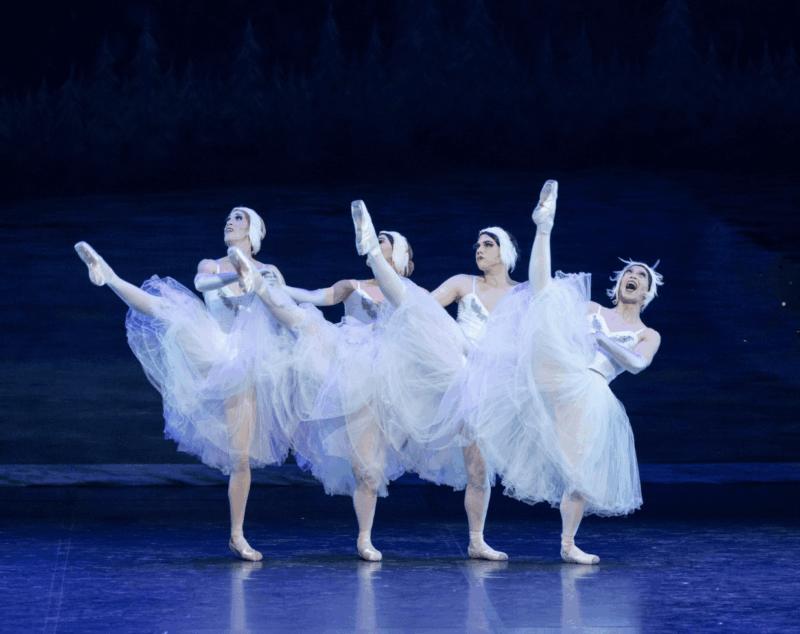
The evening opens with Le Lac des Cygnes (Swan Lake, Act II), immediately setting the tone. One of ballet’s most recognisable works is reimagined with the troupe’s signature twist: while much of the choreography remains faithful to tradition, moments both subtle and overt shift the emphasis from classical purity to comedic invention.
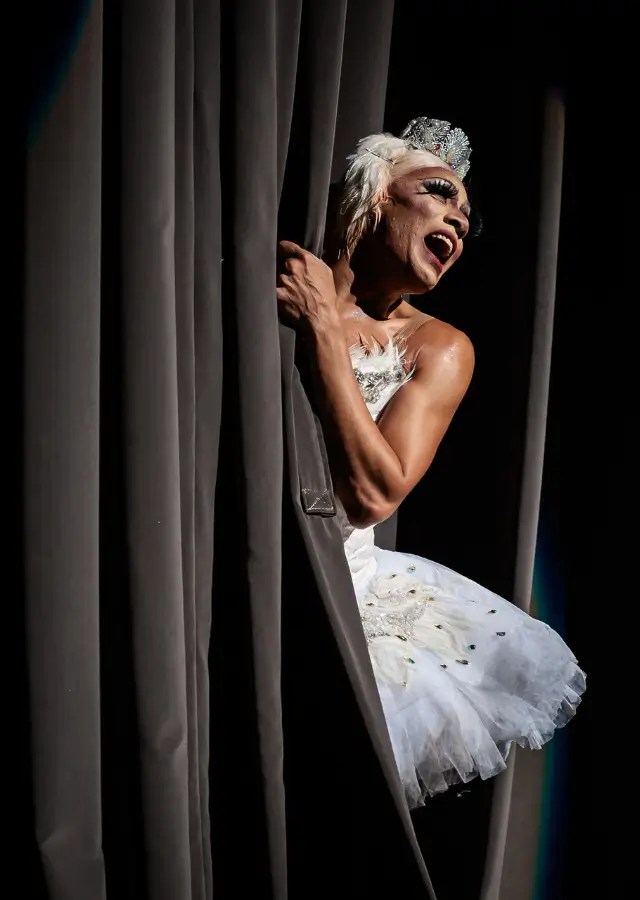
This is followed by a pas de deux—traditionally a duet between a male and female dancer—here reinterpreted through an all-male lens. The highlight of the evening comes with The Dying Swan, performed in near darkness, a single spotlight tracing the dancer’s movement. As the swan falters, confetti spills from their dress, drifting to the stage like falling leaves—a poignant, absurdly beautiful image.
The final piece, Valpurgeyeva Noch, drawn from the opera Faust, is described as “inspired by the Bolshoi Ballet.” It nods to Lavrovsky’s original choreography while gleefully embracing chaos. A swirl of nymphs and fauns fills the stage in lavish, unruly spectacle, as elegance gives way—just slightly—to madness.
Will classical ballet purists be enchanted or exasperated? Much depends on their sense of humour. There is plenty here to admire: technically accomplished dancers whose physiques differ markedly from the traditional female form. In the Q&A, this contrast was likened to the difference between Steffi Graf and Andre Agassi—one embodying delicate precision, the other power and force. The comedy, meanwhile, is inventive and sharply observed: dancers tangle themselves in limbs, teeter on the brink of control, and compete for the audience’s attention, waving, jostling, and even kicking one another in passing.
It’s a singular take on classical ballet—one that finds not only beauty in precision, but humour in its collapse.
Categories: Header, Theatre, Theatre Review


 No More Workhorse
I went to this as well, and had a great time. Being completely unfamiliar with ballet, this comedy ballet hybrid show seemed like a good introduction. Beautiful work and such funny comedic moments, whether subtle or wildly exaggerated. They ran the gamut. Also a lovely bonus that they run a Q and A on night 1! Really interesting to get a sense of the history of the show.