
 The Beekeeper of Aleppo – Gaiety Theatre – Review
by Frank L.
The Beekeeper of Aleppo by Christy Lefteri
Dates: 28th Apr. – 2nd May.
Christy Lefteri is the daughter of Greek Cypriot parents who met in London after fleeing the Turkish invasion of 1974. The experience of displacement lies at the heart of her work. In response to the Syrian Civil War, she worked with refugees in Athens, an experience that deeply informs her writing. Her second novel, The Beekeeper of Aleppo (2019), centres on the lives of refugees and asylum seekers—individuals whose worlds have been irrevocably upended by forces beyond their control. In 2023, the novel was adapted for the stage by Nesrin Alrefaai and Matthew Spangler.
Aleppo, once an ancient and thriving city of approximately two million people, was devastated during the Syrian Civil War, with over 30,000 lives lost. Lefteri focuses on Nuri (Adam Sina), a beekeeper, and his wife Afra (Farah Saffari), as they flee their shattered home. Traumatised and grieving, they set their sights on England. The narrative follows their journey to a Greek island and then to Athens, as they struggle to reach safety. Their suffering is compounded by the death of their son in a bombing—an event so devastating that Afra loses her sight.
England is evoked as a place where bees can live and flourish. Bees, in their ordered and purposeful societies, go about their rituals, producing honey through cooperation and balance. By contrast, human migrants seeking refuge in England must navigate rigid and often impersonal bureaucracies, systems that seem ill-equipped to respond to the complex realities of forced displacement. The play explores this tension, tracing Nuri and Afra’s encounters with officialdom in both Greece and England, and illuminating the gap between institutional processes and human need.
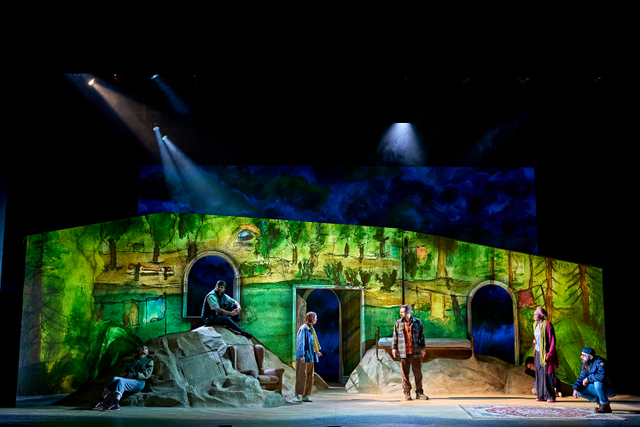
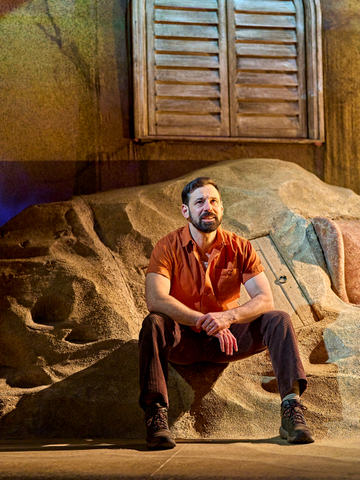
The staging reinforces this sense of dislocation. Desert-like mounds of sand dominate the set, with a comfortable armchair incongruously embedded within them, while elsewhere a simple iron bedstead stands. The world appears unsettled, almost inverted. At the back of the stage, faint outlines of windows—one shuttered—and a doorway suggest spaces that are both present and inaccessible. The overall impression is one of impermanence and transience: Nuri and Afra are always in transit, never at rest.
A range of secondary characters populate the story, both in Athens and England: a fellow refugee beekeeper who has successfully resettled, a smuggler, representatives of officialdom, and other displaced individuals. Yet the emotional core of the play remains firmly with Nuri and Afra. Adam Sina carries a demanding role with nuance and intensity, conveying the emotional turmoil and resilience of his character. Afra, profoundly traumatised, is given less scope in dialogue, yet Farah Saffari delivers a haunting portrayal of a woman damaged both psychologically and physically, her blindness symbolising a deeper rupture.
The issues surrounding refugees and asylum seekers are not going away; tragically, they are part of our contemporary reality. This play places their humanity front and centre. Nuri and Afra have endured horrors that are difficult to comprehend, yet the bureaucratic systems they encounter often fail to recognise this. In contrast, Nuri’s identity as a beekeeper gestures towards a more balanced and humane way of living.
This is a powerful and thought-provoking piece of theatre. It invites reflection on the tensions between bureaucracy and compassion, and encourages a more generous understanding of the complexities faced by refugees and asylum seekers. Despite its serious themes, it remains an engaging and deeply affecting production.
Categories: Header, Theatre, Theatre Review


