
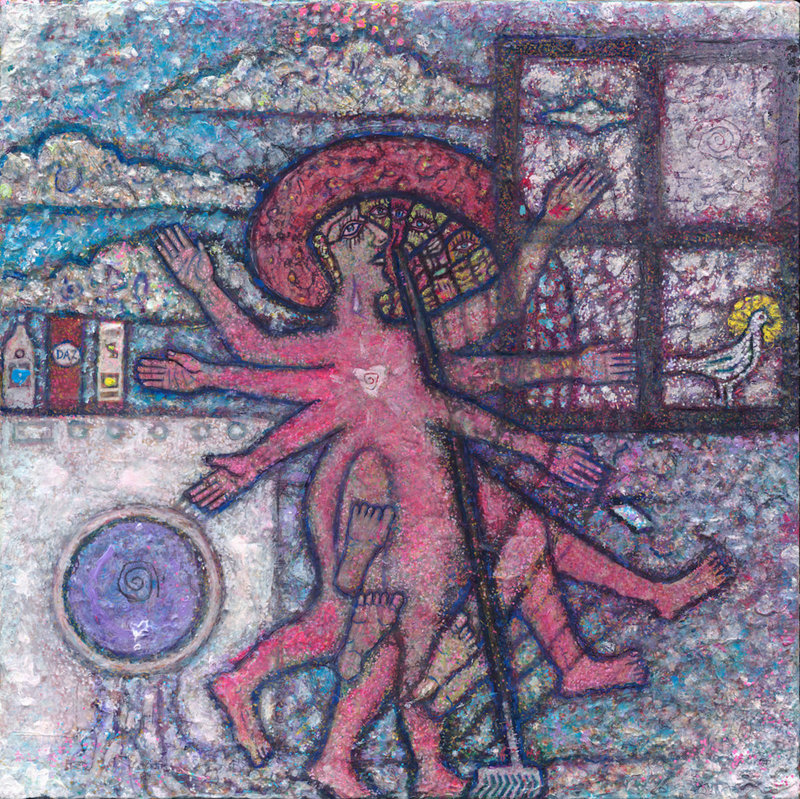
Crying Loser – The Ick – Album Deep Dive
by Liam Griffin
There are really only two ways to fight fire. One is with its antidote, water, and the other is with itself. On their debut album, The Ick, Crying Loser, Cork ‘no-wave’ outfit made up of Arthur Pawsey (vocals, guitar), Micheál Fitzgerald (bass), Samuel Clague (bass clarinet), and Ruairí de Búrca (drums), chose the latter. They fight the flames that lick the ankles of the modern world with a good ol’ blazing inferno of their own.
For those unaware, ‘no-wave’, or “nah-wave” as Crying Loser’s Instagram bio has it – which is so Cork it makes me, a Corkonian, chuckle – is a musical genre that spawned in late ‘70’s New York as a reaction to the punk and new-wave scenes that were dominating the airwaves at that time. No-wave got its name from the Brian Eno-produced ‘No New York’ (1978) compilation and had its sights set, as Kim Gordon of Sonic Youth once suggested, on “destroying rock.”
The first wave of no-wave bands, like The Contortions and Teenage Jesus and the Jerks – who, of course, would deny that it was a wave that they’d arrived on as there was no wave –, had a trusty trio of weapons they routinely drew in the war they’d waged against mainstream rock: dissonance, noise, and a great big dollop of nihilism. Crying Loser wholeheartedly carry on that tradition and freely brandish about that unholy trinity on The Ick. Although their chosen armaments have the potential to be unruly, Crying Loser’s songs, which originated “from noisy improvisations in a basement”, always remain within their grasp. The noise, dissonance, and nihilistic attitude that fizz throughout the album never overshadow or even threaten to overwhelm the great songwriting. Not once does The Ick’s tail, which does furiously wriggle and shake, ever go as far as to wag the dog.
Nevertheless, The Ick is abrasive and stridently delivered. Take the anthemic and catchy ‘Do The Jerk’ for instance, the third single from the album. It’s on the edge of manic; it’s feverish, feral, and wild. On it, Pawsey doesn’t just invite you to do the jerk; in no uncertain terms, he damn demands it of you. In truth, he needn’t have bothered at all, though as the piercing jabs of guitar almost compel your body to jerk anyway. The squalls and shrieks that close out the track are everything I love about Crying Loser’s Cork-infused brand of no-wave, nah-wave: they’re stirring and teeter on the edge of terrifying. ‘Eat The Evidence’ also has a rousing finish, which might just be the group’s forte. It collapses into a Sonic Youth-esque noise section for the last minute or so, with wails of guitar feedback floating atop driving drums and steady bass.
The shouty ‘Flesh Interface’, on which there’s a sense of re-awakening and of eyes being opened – ah, now I see! –, is another highlight. It’s the repetition of “now I know / which side the bread is buttered”, which is snarled a total of eight times, so you’re pretty much walloped over the head with it, which points to a sense of reclaiming one’s power. Crying Loser make their point by brute force because sometimes to get your view across in a world supersaturated in jibber-jabber, you need to shout the loudest and for the longest. ‘The Weight of Want’ makes its point, of “trashcan happiness” and saying “yes to pleasure” and “yes to pain”, by simmering and gathering momentum until it reaches boiling point; then it stalks and crawls all over you.
For however frictional The Ick might be, it’s also quite playful. Take ‘Bad Haircut’ for example, which sets an Avril Lavigne interview, which she conducted whilst on her European Tour in 2002, against an ominous soundscape. In the interview, Lavigne, then only eighteen, considers if it’s because she has “attitude” and “a lot more edge to myself than a lot of other artists” that the media has slapped the ‘punk’ label on her (even though she says that she doesn’t call herself punk because “it’s more punk to tell people you’re not punk than to sit there and say that you are punk”). Lavigne seems blissfully unaware of just how watered-down and mega-mainstream-marketable her brand of teenybopper “punk” was, thus being altogether antithetical to punk, which, on reflection, presents like an identity she was trying on for size. Nevertheless, her youthful meditation on punk is quite endearing, and for Crying Loser it symbolises just how unserious and pliable a musical genre and cultural movement punk, with all its associated outlooks and ideals, was and is.
It’s important to give Clague’s bass clarinet playing on the album its fair dues. Not only does it accentuate its playfulness, but in many ways it drives it. What’s more, it adds a whole new textural layer to the frantic chaos of The Ick with its sporadic spurts of sound. Clague uses his bass clarinet as it might be used in a free jazz ensemble, with the difference being that his bass clarinet was brought up on The Velvet Underground and exclusively wears second-hand suits that have rips and holes here, there, and everywhere.
Music that’s truly nonconforming, rebellious, and subversive, as no-wave was and “nah wave” is, is as necessary now as it’s ever been. One of the most potent ways music can be these things is by reflecting the nastiest and most unpalatable disavowed parts of society and its systems back to it, by expressing them sonically, so that it can get a good and proper look at the state of itself. That’s what I was getting at when I said at the start of this that Crying Loser fight fire with fire on The Ick. They really do just that.
The primary thing that no-wave got right, as I see it, is that it made a virtue out of agitating and pricking at the status quo, which I believe is something all art ought to strive to do. Moreover, it gave voice to the disjointed, volatile, and unsettling climate of the Petri dish in which it grew, New York in the late ‘70’s. Crying Loser carry that torch into the modern day. But not only does society get a good look at itself in The Ick’s mirror, we, the listeners, do too. We need discordant and frenzied music to represent the discordant and frenzied parts of ourselves, for they’re there even if we try to ignore them.
Once we’ve seen our reflection and have gotten over the shock, the hope is that we can then go about changing things for the better. Getting The Ick from Crying Loser and coming face-to-face with those unsavoury parts of ourselves, and the societies we’ve had a hand in building and in which we’re embedded, doesn’t leave you cynical, enervated, or with a sour taste in your mouth. Instead, you come out the other side energised; even some bit purified, perhaps. The Ick’s dirtiness cleanses, its chaos calms, its incisiveness sutures, its roughness smoothens, and its frenzy soothes. More stuff like this, please!
Categories: Album Reviews, Header, Music


