
 Sound of Falling – Film Review
Director – Mascha Schilinski
Writers – Louise Peter, Mascha Schilinski
Stars – Hanna Heckt, Lena Urzendowsky, Susanne Wuest
The Altmark region of Germany is west of the Elbe River between the cities of Hamburg and Magdeburg. It’s sometimes referred to as the “Cradle of Prussia”. In this work, we see the inhabitants of a rural farmhouse in Altmark in four different time periods. It is a nonlinear story, where we see moments of their lives, some quite trivial, whereas others are more traumatic.
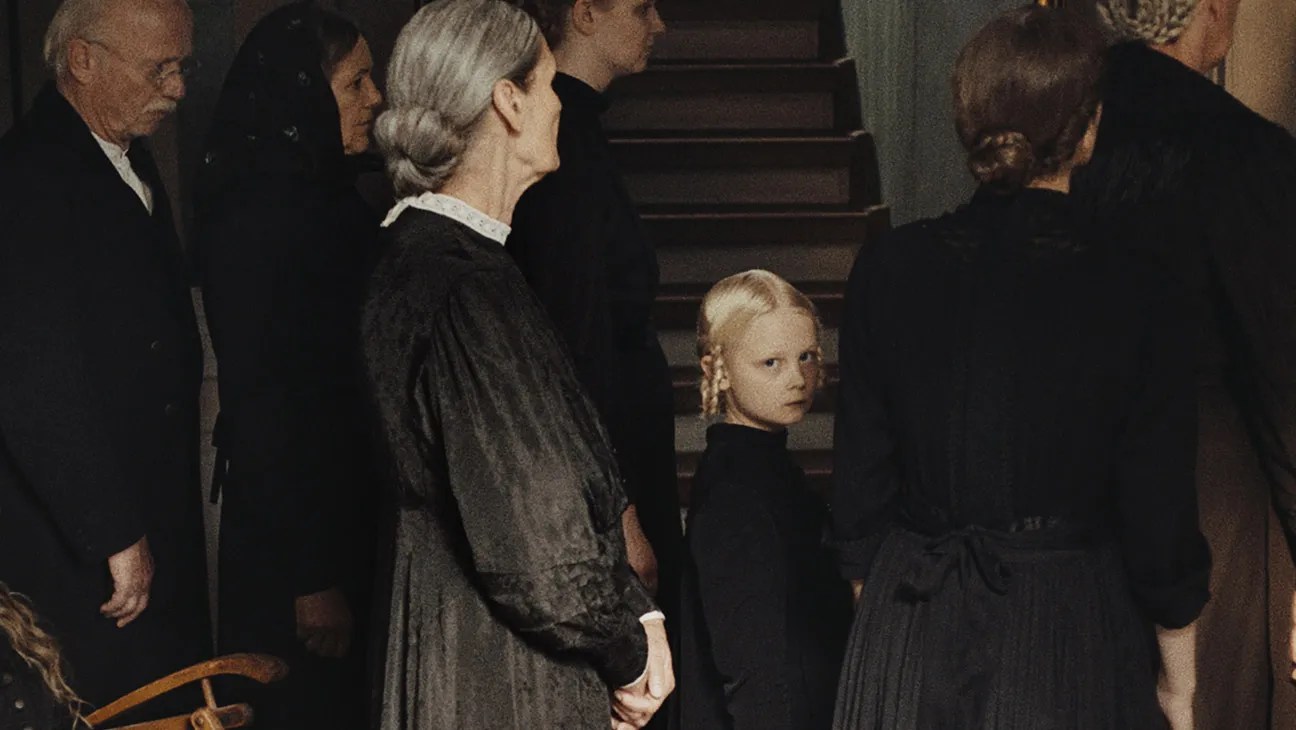
The earliest inhabitant we meet is Alma (Hanna Heckt), a young girl trying to make sense of the world around her. She’s fascinated by the photos of dead relatives on the sideboard in their living room. We see poignant moments, as she pinches the hands of her grandmother, to see how the loose skin fails to retract. We also see how the servants are treated and a shocking incident, which is described as a ‘workplace accident’. Alma’s young eyes peer through gaps in the barn doors or through keyholes into the world of adults.
In another time period, we meet Erika (Lea Drinda) as she walks through the house on crutches, with her leg strapped under her, emulating the man described as her “Uncle Fritz” (Martin Rother), an older incarnation of a man from the earlier segment. Another segment is set in the old East Germany, where teenage Angelika (Lena Urzendowsky) draws too much attention from her Uncle Uwe (Konstantin Lindhorst). The final and most recent segment is set in contemporary times, where Lenka (Laeni Geiseler) meets a local girl called Kaya (Ninel Geiger), and they spend the summer months together.
The film premiered at the 2025 Cannes Film Festival, where it won the Jury Prize. It was also selected as the German entry for Best International Feature Film at the Oscars this year.
The film could easily be presented in a linear fashion or as four separate short films. The different time periods are only united by the setting, although some characters feature in more than one segment, returning later in life. There seems to be no real reason for the moments we are shown, other than to give an impression of life in each time period. It is a slow, languid work, and the focus is on the beauty of the cinematography, along with the tender moments of family life captured. We see some terrible events take place, but not the consequences, and they are often not talked about again. The protagonists are largely young females, in their teenage years or earlier. Their innocence frames the events, with haunting images seen through the eyes of a child.
Categories: Header, Movie Review, Movies


 No More Workhorse