
Báite – Film Review
(Báite – The Drowned)
Director – Ruán Magan
Writer – Sheena Lambert
Stars – Eleanor O’Brien, Moe Dunford, Oisín Mistéil
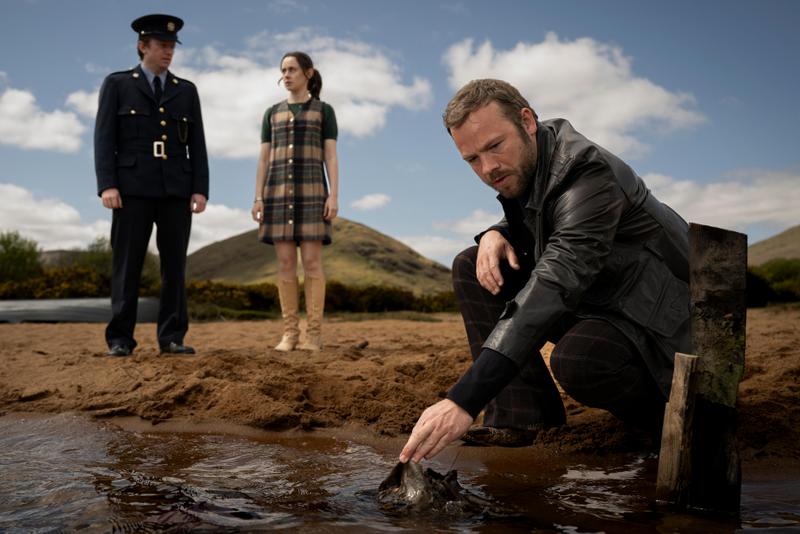
The year is 1975, and we meet Peggy Casey (Eleanor O’Brien), a hard-working young woman who, after the death of her parents, is running the family business, Casey’s pub and guest house. She has three siblings who are less enamoured with the rural community and want to sell the pub to move to various cities around the world. Each morning, Peggy swims in the lake. It is a man-made lake created when the local valley was flooded to build the power station. One morning, two anglers spot something unusual in the lake: the body of a woman. And so, this small town is engulfed in intrigue as Detective Frank Ryan (Moe Dunford) arrives to investigate the death of this woman.
This is a new Irish-language feature, released nationwide on 6 March 2026, to coincide with Seachtain na Gaeilge (1–17 March). Irish language films have been going through a renaissance in recent years, with high-profile releases such as An Cailín Ciúin (The Quiet Girl), Kneecap and Black ’47. It was nominated for four IFTA Awards, including Lead Actress in Film (Eleanor O’Brien) and Best Director (Ruán Magan).
The film is based on the novel The Lake, written by Sheena Lambert in 2015. Sheena has adapted the work to the screen. The film has an interesting collection of characters, as we meet the inhabitants of the town. If you’re a fan of Irish theatre, you’ll recognise many of the faces, including Denis Conway, Aonghus Óg McAnally and Fionnuala Gygax, among others.
The film is directed by Ruán Magan, brother of the sadly departed writer Manchán Magan. Ruán has a long history in film, mainly acting as a director and producer of a series of documentaries on Irish themes, such as The Hunger, which was narrated by Liam Neeson.
Báite is a fairly straightforward detective story, as we try to figure out what happened to this woman many years ago. We know that someone from the village was involved, and you start to speculate who is responsible for the crime. The most unusual element is how little humour is involved in the tale, as we’re used to seeing stories of small-town Irish communities that are filled with gags and quirky individuals. The characters are a touch too earnest for their own good, but the story keeps you engaged throughout. Báite won’t make waves on the international landscape like many of its Irish language predecessors, but it could find a home with any fan of detective stories.
Categories: Header, Movie Review, Movies


