
 The Boy – Abbey Theatre – Review
by Brian Merriman
Part of the Dublin Theatre Festival
The Boy – Written by Marina Carr
Directed by Caitriona Mc Laughlin
Runs until November 1st as part of a two-play programme with The God and His Daughter
Marina Carr, the multi-award winning prolific playwright, returns to the origins of Western theatre in her innovative treatment of The Boy. Inspired by Sophocles’ Oedipus Rex and in The God and His Daughter, which is inspired by Oedipus at Colonus and Antigone, which moves us onto the next generation of the incestuous royal family of Thebes. I saw The Boy as a stand-alone piece, which ran 2 hours and 30 minutes with an interval.
Carr says this is not a traditional adaptation, as the ‘time is always now’. So the ancient story is brought into our time through an interpretation of the Oedipus myth, which has parallels in the folklore of so many cultures. This is a story about three generations of a family. The ever presence of God (like creatures) is another challenge for contemporary times, when a knowledge of God no longer has the dominance of the mortal minds that God may once have had, in minds, laws, practice, beliefs and control. The Now culture doesn’t allow us the time to reflect, as in older, less distracted times.
We, because of the longevity of the stories, know what the characters do not know. In that, the audience too is ‘godlike’. A king is cursed that his son will kill him, and then he will marry his mother. He has the child taken away to die. The child is found and raised by another royal couple. When things come to pass, Oedipus, now an adult, banishes himself from the town where he was raised to avoid his part of the curse. He goes on to pursue Kingly responsibility and Godlike political ambitions himself.
Frank Blake’s Oedipus has a nice naivete and a light comic touch. He later arcs into the all-powerful King and father. His soliloquy when he realises what has come to pass is long and well delivered. It brings a new twist to the saying that every man ends up marrying his Mother! It is an ideal piece for drama students to consider as an audition piece. The only element of the production that didn’t appeal was the drama student’s affectation of acting barefoot, something the majestic Olwen Faure as The Shee did not embrace as the all-seeing messenger of the Gods.
Carr has managed to convey the complexities of the ancient societal structures and hierarchy in an accessible way. We have a Sphinx, banshee-like creatures, a hint of Beckett and other connections with Irish theatre and folklore, especially in relation to the treatment of children in our own culture, and the impact on those born in violence. It endures.
Carr’s use of contemporary vocabulary, Irish accents and phrases allows the audience to relate to the many layers of heavenly intrigue and control with ease. There is humour amongst the macabre. There is redress for the disrespected Gods.
McLaughlin’s smooth direction adds to this accessibility, and the steady pace leaves no one behind. We are in Thebes at a time when fewer believe in the Gods and more believe in the success or promises of man. Priests – the messengers of the Oracle are ignored, and the Deity decides to prove their power and presence with pestilence and planned incest.
The mortals believe they are in charge of their own destinies, but in fact are living the punishment of the Gods for their sexual sins. What is concealed from their destiny is driving it. There is blood to be spilt, cadavers to be feasted upon, wine to be drunk and lots of revenge.
The Boy has very impressive production values, including the fine set by Cordelia Chisholm, the lighting design by Jane Cox, and the composition and sound design by Carl Kennedy.
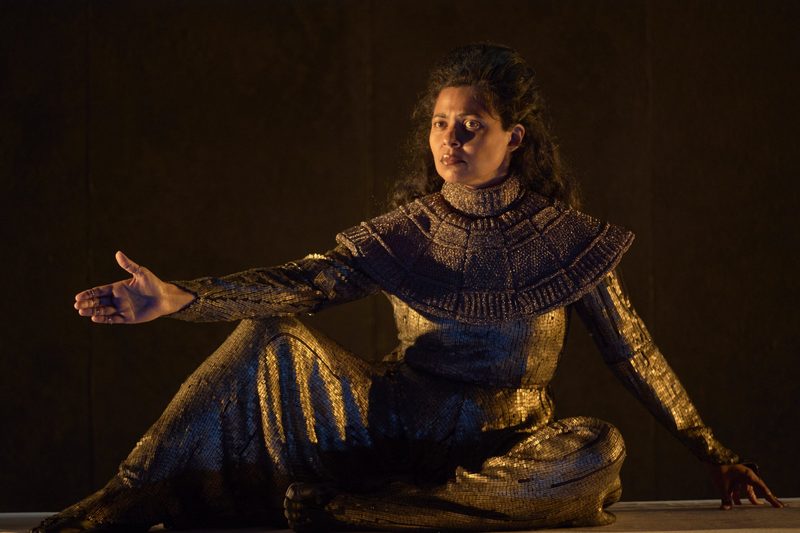
Catherine Fay’s lavish costumes (with the exception of the wedding dress) are a successful mixture of period, fantasy and some lunar glamour. The stage management and visuals flow seamlessly, and it is clear that all elements from production, writing, casting and performance are in harmony.
The approach to this new treatment by Carr and McLaughlin was initially planned in 2019. Having waited thousands of years since the original, the effort now to reintroduce this plot of incestuous intrigue and the consequences of the denial of deity to a modern audience works well.
Don’t be put off by the plot’s longevity or what you may know about Oedipus and Jocasta. There is a real attempt here in The Boy to bring the story, not just from the ages, but from the stage and into the modern audience.
The stellar cast is totally up for this considerable challenge, aided by a script that harvests the riches of old and scatters them to grow again and feed the imaginations of the present. Stand out performances amongst a talented ensemble, include Blake, a versatile and authentic Eileen Walsh as Jocasta, Amy Conroy’s luminous Moon, Jane Brennan’s physical Queen of the Furies, Frank McCusker’s sleezy Laius and Jolly Abraham’s Godwoman.
Though the behaviour of the characters has long since been restricted by legislative norms rather than by ill-tempered deities. The many characters and all their flawed carry-on come full circle to allow us to witness the tormented outcomes of the judgment and mischief of the Gods. As would happen today, they too dole out harsh sentences and demonstrate that they are not to be messed with. Where are they all today, I wonder?
Cast:
Godwoman: Jolly Abraham
Chrysippus: Noah Behan
Oedipus: Frank Blake
Queen of the Furies: Jane Brennan
Moon: Amy Conroy
Chrysippus: Harley Cullen Walsh
Woman: Zara Devlin
Haimon: Eimhin Fitzgerald Doherty
The Shee: Olwen Fouéré
Farmer: Seán Fox
Oreone: Ronan Leahy
Creon: Seán Mahon
Laius: Frank McCusker
Antigone: Éilish McLaughlin
Theseus: Abdelaziz Sanusi
Sphinx: Catherine Walsh
Jocasta: Eileen Walsh
Crew:
Set Design: Cordelia Chisholm
Costume Design: Catherine Fay
Lighting Design: Jane Cox
Composition and Sound Design: Carl Kennedy
Categories: Header, Theatre, Theatre Review


 No More Workhorse