
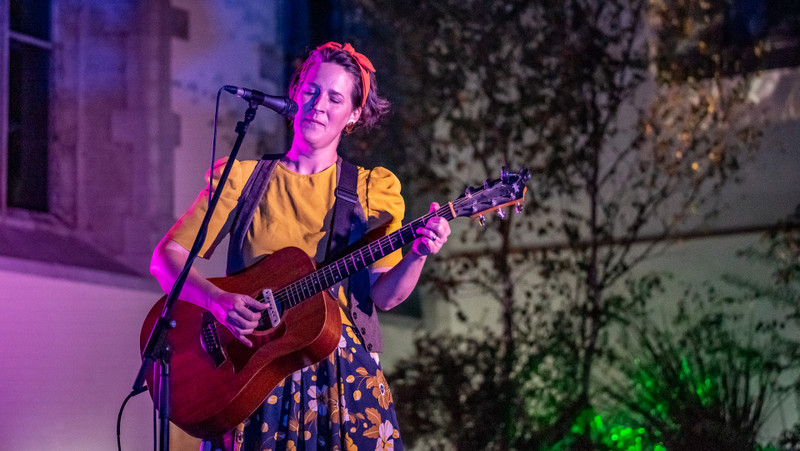
 Interview with Sophie Coyle
by David Turpin
Dundalk-based singer-songwriter (and illustrator) Sophie Coyle is preparing to release her second album, Cuentista, this month. Charming, subtle and highly melodic, the record is inspired by Sophie’s time in South America. Here, she speaks about the influences behind the record’s unique sound, her musical history, and about her personal approach to songwriting.
Cuentista is inspired by your travels in South America. What attracted you to that part of the world, and when did you travel there?
A friend and I had tickets booked for Thailand and then the huge tsunami of 2004 struck. So we changed direction. It’s not a very inspired way to select a place to travel to but it did change my life. I had been listening to an amazing compilation that year compiled by David Byrne — Afro-Peruvian Classics. It really got under my skin. Two other albums I had on repeat were the collaboration between Manu Chao and Amadou and Mariam, Dimanche á Bamako, and a Fania Allstars compilation featuring Willie Colon and some cheesy but fantastic boogaloo tracks with big, lush orchestral arrangements and angelic backing singers. When I realised I was flying to a continent filled with rhythms like these I became very excited indeed. We arrived in Rio in time for Carneval and never looked back!
I’m interested to know what, in the present, returned you to that time in your life? I’m drawn to the idea that music and creativity can be a ‘time tunnel’ between our present and earlier times in our lives.
I agree, music is an amazing time-tunnel. You only have to listen to whatever you were into at 16 to be taken right back to that time, that angst and whatever odd wardrobe you were wearing. I’m not much of a one for sentimentality, though. This album was more an exercise in memory banking. My memory is not the strongest so I take precautions in advance — in this case, it was three sketchbooks and two shoeboxes full of images and photos from the trip. Even at that, when I went to write these songs after the passage of fifteen years, whatever I could recall was more influenced by those photos and sketches than cold, hard facts. The facts had distilled down to little stories infused with feeling.
Tell the Tale, the most personal song on the album I suppose, is about a person I got mixed up with over there and was lucky to get away from — that took a chunk of time to get over but now it’s like singing a song about something that happened to somebody else. It is true the more you talk about something the greater the healing and I think that’s why creativity is so helpful — you can package something up to make it less raw — entertaining even — but you’re still not denying what happened or bottling up feelings. And there’s plenty of light on this album too, plenty of fun!
Something I find very interesting in your music is how you juxtapose a mellow, gentle sound with some quite sharp narratives and lyrical imagery. That’s very pronounced in ‘Tell the Tale’, but also, for example in ‘Honey Coloured Loving’. I wonder if you could talk a little about the balance of light and shade in your music?
I’m glad you asked me that because I get to talk about my current obsession with Jung and the Shadow! As I understand it Shadow is the unpleasantness in ourselves we often don’t want to look at but when we can accept and embrace it we become happier and more accepting of others.
I think the Irish are quite adept at handling the light and dark and it shows in our literature and music and art. And I think when you don’t find that balance in a piece of art you feel that there’s something missing. There is light and dark in every situation — even in being head-over-heels in love like in “Honey Coloured Loving” — you can let go so much you tip right off that precipice. Lyrics give me a chance to express some of the stuff that’s going on under the surface that I might not be as brave about showing in my day-to-day life.
Cuentista means ‘storyteller’. I’d be very interested to know your thoughts about storytelling through song, and the similarities and differences between how it’s practiced across the cultures you draw on in your music.
The story-telling side to folk music is what drew me to performing and writing in the first place. To my mind folk songs hold a similar purpose to fairy tales in that they resemble a real-life scenario and bear some kind of lesson or warning — often about doomed romantic entanglements and the many ways a woman can get herself into trouble. And I think that’s what makes folk music so relatable across cultures, the language may change, and the melodies and rhythms vary from place to place but the stories stay human and relatable.
In the history of South America, you can see how powerful a force folk music was when the dictatorships of the 70s, especially in Chile, were so threatened by it that they viciously cracked down on the folk singers of the time who were singing out about the political situations in their countries.
Cuentista includes two old Spanish ballads, alongside your original songs. Could you say what drew you to these particular ballads? I’m also very interested to know about your experience of singing in a language that is not your first language. Did it free you to use your voice in a different way?
Those two songs came from a cassette tape I was given by my Spanish aunt. She married my father’s uncle and moved from the metropolis of Madrid to what was then the small town of Galway and brought these tapes of a singer she had loved in her youth — Maria Dolores Pradera. Pradera had been a movie star who went on to be a singer touring South America, and the songs on that wonderful tape with its faded technicolour insert are just amazing! I learnt as many as I could from it. She sings with incredible passion so when I sing those songs I get to channel a bit of that. I’ve learnt songs by other Spanish artists but I never sing them in that same way!
Singing in a different language is freeing though because when you translate the lyrics they sound so much more dramatic than the way you would phrase something in your native tongue. For example, the first of those two Spanish songs is called ‘El Rosario de mi Madre’, a fantastically dramatic break-up song. The chorus says it all,” Give me back my love so I can kill it, give me back the tenderness I gave you…give me back my mother’s rosary beads and you can keep all the rest.”
The second is about a jilted lover crying to the bar lady Señora Maria Rosa about his fiancee, who left him at the altar, and all the good things he left behind to be with her – his beloved old parents, his little coffee farm and his ox. But he pictures meeting her in the street someday, completely destroyed by her decision to leave him. In the meantime he needs his cup refilled, please.
I found myself thinking about Astrud Gilberto, after listening to the last song ‘Great Love’. And that may be because my frame of reference for South American music is small! I’d love to know what South American musicians you might recommend for people to listen to if they have been intrigued by the palette you’re drawing upon in Cuentista?
I love Astrud Gilberto and was definitely going for that Brazilian samba song feel with ‘Great Love’!
I’d recommend Afro-Peruvian Classics: The Soul of Black Peru compiled by David Byrne for the Luaka Bop label. I’d also recommend his compilation Brazil Classics 1 & 2 with amazing songs from Brazil’s Tropicalia scene in the late 1960s featuring musicians like Caetano Veloso and Gilberto Gil among many others. I fell in love with the voice and songs of Milton Nascimento on this album. Musicians I came across while travelling are the 80’s Argentinian band Los Enanitos Verdes, I love their song ‘Mil Horas’. Other great musicians I came across thanks to the South Americans I met travelling are Pablo Milanes and Silvio Rodriguez, both Cuban folk singers, and the Uruguayan folk singer Alfredo Zitarossa who lived in exile from the dictatorship from the mid 70’s to the mid 80’s.
The album has a beautifully tactile sound. Could you share a little about the process of making it, and of developing the arrangements?
I had intended the recording of this album to be a quick process, but life got in the way: the COVID pandemic hit and myself and my husband had two more children. But I can say the end result benefited from having taken time to think about things.
I was awarded funding by Create Louth for the recording of the album and this, amazingly, allowed me to bring in the Glas Quartet and their superbly talented leader and arranger Annemarie McGahon. I presented her with four tracks and she came up with the arrangements for violin, viola, cello and flute. My heart lifts every time I hear them!
I also got the amazing percussionist JP Courtney involved on a few of the tracks. He set up Dundalk’s first samba band in the 90s, Sunshine Samba, but has since moved over to Hertfordshire and is highly regarded in the world of Brazilian percussion. He runs a two-week samba workshop in Rio every year during Carneval.
My friend and piano player Sharon McArdle added beautiful piano parts to the tracks arranged by another Dundalk composer and educator, Paul Campbell. Simon Farrell, who played double bass on my first album, reappears on Cuentista. His playing is dynamite. I think the icing on the cake was getting to work with Chris Barry from Aoilfionn Studios in Dublin on the mixing, he brought it into a new realm with amazing instrumentals and effects, it was great craic working with him.
I’ve a gorgeous band behind me for the live performances too. And I have incredible artists supporting me — SELK and Gar Cox in Dublin, Rowan in Dundalk and An Auld Lad in Belfast.
You are also an illustrator, and the artwork for the Cuentista album cover and ‘Wanderlust’ music video are based on your sketchbooks from your time in South America. I wonder if you could say a little about your visual art, and the relationship it has to your music?
The illustration really lends itself to the songwriting because I can always see a clear picture of what I’m singing about in my head. It has been so lovely to have a chance to finally use all the sketches I did on my travels. I’m producing a full colour, illustrated lyric sheet separate to the CD and it will have lots more sketches and scenes.
The scene on the album cover is of two Bolivian women waiting in a bus station surrounded by their bags. People travel huge distances there to get back and forth to family or their village or the place they bring produce to and they always have lots of bags and packages with them. On the back cover of the album is a beach scene from Rio, a sketch I did of a mother and her three children. She epitomised Mother Earth in her voluptuousness and I loved the contrast of her skinny-limbed children beside her.
The eleven songs I wrote are just the tip of the iceberg of amazing experiences I had over there, I’m sure there are several albums worth of songs but I’m very happy to be releasing this one, it’s a project I’m proud of.
See Sophie Live on Friday, 12 April – Sophie Coyle Album Launch – Bello Bar


