
 The Color Purple – Film Review
by Brian Merriman
Directed by Blitz Bazawule
Written by Marcus Gardley · Alice Walker · Marsha Norman
Stars – Fantasia Barrino, Taraji P. Henson, Danielle Brooks
I had the great live experience of seeing the musical version of ‘The Color Purple’ over a decade ago in a spectacular Ahmanson theatre in Los Angeles. This 1983 Pulitzer-winning novel by Alice Walker was published in 1982 to much acclaim. It was adapted for the silver screen by director Stephen Speilberg in 1985, a film which included the acting talents of Whoopi Goldberg, Danny Glover and Oprah Winfrey, amongst others.
Winfrey produced the onstage musical version of the book in 2005. So why remake a multi-award-winning piece now? Executive Producers, Oprah Winfrey, Stephen Speilberg and Quincy Jones decided that the musical version deserved its own on-screen run too and it has already attracted awards from the Screen Actors Guild and the Golden Globes. It is a good decision.
‘The Color Purple’ takes place in rural Georgia USA from 1909 to 1949. ‘Celie’ is 14 years old and carrying her second child. It is a story of immense cruelty, deception, and exploitation up against all the colour of passion, justice, culture and identity.
‘The Color Purple’ is ‘Celie’s emotional march to freedom from an abusive childhood, the loss of her sister ‘Nettie’ and her two children. She searches for God in all her suffering and the ultimate redemption of all she learns, on a journey that would have destroyed a lesser person. This story is peppered with so many well-constructed characters, and a storyline of power, humour and drama.
It is, despite its content, a remarkably uplifting story. Musicals tend to find personal validation even in harsh circumstances. ‘Celie’ is no better off than her enslaved ancestors, in the hands of her arranged husband ‘Mister’…as the script notes ‘Mister is a form of Massa’ – the source of so much tyranny on many a plantation.
Equally, US musicals always resolve themselves and the strong presence of faith in God in the face of brutality, may jar with some. It is though the engine of the plot.
The post-slavery, Black male culture was strongly informed by the abuses they saw dealt out to women by their former White ‘masters’. Some of it is very uncomfortable viewing though very timely, as we see extremes rise and deny the difference in circumstances and experiences lived by many others who share the planet with us. The historical references to refugees and tracing the African ancestry of Black Americans are still relevant today.
‘Celie’ bears the abuse of extremism with incredible courage and belief and the quest for an ultimate triumph is emotional and inspiring. The slew of powerful female performances and characters is the bedrock of this story of triumph over extreme adversity.
The production values are very high. Cinematography by Dan Laustsen uses the lavish palate of the coastal and period locations to infuse spectacular physical contrasts to the harsh personal circumstances.
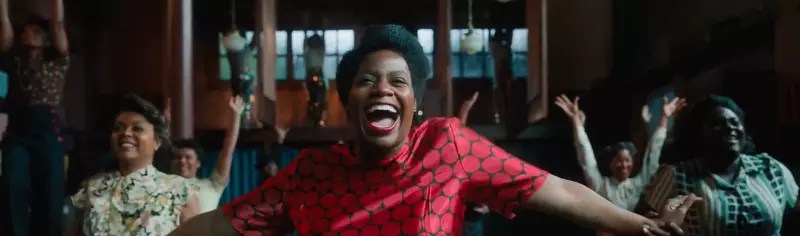
A sense of period is somewhat fluid from 1909 to 1949. The costumes are beautiful, despite the poverty and the pulsating choreography appeals in style and delivery to contemporary dance forms. There is hardly an energetic limb or joint that doesn’t seem to pivot 360 degrees as the rhythm and athleticism of the talented ensemble burst onto the screen, prompting us to query why so many of this cast are not already household names?
American Idol winner Fantasia Barrino rightfully claims her acting accolades in a powerful, dramatic and vocal performance as ‘Celie’. Taraji P Henson is a stunning ‘Shug Avery’, the banished daughter of a pastor who storms through the worlds of drink, jazz and men to liberate herself and others from the oppression of their evolving culture. Her liberation of ‘Celie’ is beautifully structured and reflects perhaps a different ‘ministry’ from her estranged pastor parents. Danielle Brooks takes on the previous memorable Winfrey role of ‘Sophia’ and makes it her own. Each character portrayed by another remarkable actress is the hallmark of the casting and the quality of this stellar production.
The next generation also shines with wonderful performances from Phylicia Pearl Mpasi as ‘Young Celie’ and Halle Bailey as ‘Young Nettie’, both of whom leave an indelible mark on the quality of the production. They are on their way in this business.
The only redeeming man in the storyline is a lovely study by Corey Hawkins as ‘Harpo’, but not to leave out the menacing portrayals of Celie’s main abusers her ‘husband Mister’ (Colman Domingo) and her ‘father Alfonso’ (Deon Cole) for their acting achievements. The coercive control and demeaning of the inherent qualities of their female prey resonates strongly with the current spotlight on the language and behaviour of that noxious act.
We are reminded of abusive control, poverty, racism, faith, family and evolving social mores. We are enthralled by colour, dance, music and a great story.
We are impressed by a stellar cast, especially of female actors, who really do need more opportunities if the current industry is to progress. There is a rich harvest of talent, thought and topics to reap in this film.
Quickly following on the successful remaking of ‘West Side Story’ is Speilberg well into a new chapter of his film journey, to bring back the power and box office of the screen musical which has been in abeyance for too many years? That would be welcome. They have all done the colour ‘Purple’ so well, but there are so many more in the musical rainbow. Perhaps we can look forward to more?
Categories: Best New Movies, Header, Movie Review, Movies


 No More Workhorse