
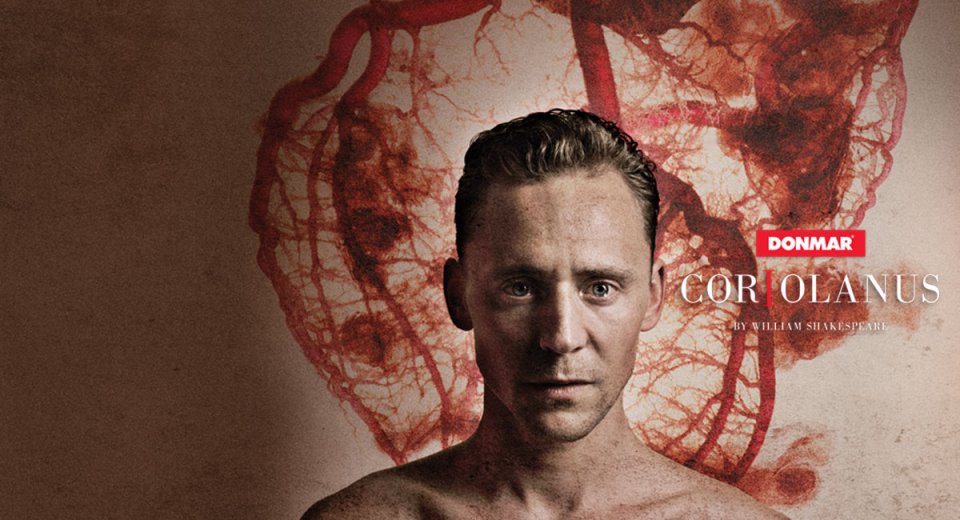
Coriolanus – NT Live Encore, Thursday 12th November – Review by LAW
Coriolanus is one of Shakespeare’s lesser performed plays. It tells the story of Caius Marcius, the arrogant soldier who loathes the common people, the hungry plebeians of Rome, who return his hatred. He gains the name Coriolanus when he virtually single handedly defeats the Volscians in a battle fought in Corioli. Once he returns from battle to Rome, he is chosen as a candidate to sit in the Senate as a consul. Detesting the obligatory display of humility in public, asking the plebeians for their votes, he carries it out with contempt. The Tribunes of the people however are in venomous opposition and accuse him of being a traitor of the Roman people. They urge the plebeians to demand his death. Instead he is banished and goes into exile. He arrives at the house of his sworn enemy Tullus Aufidius, leader of the Volscians. He joins them planning his vengeance on Rome.
The main theme of the play is the downfall of Coriolanus caused by his pride and the destructive envy between Tullus Aufidius and he.
The Donmar Warehouse was a bold choice of venue for the staging of the play but it is of a similar size to Blackfriars, the theatre for which Shakespeare wrote the play. This production chose a non naturalistic set which used minimal staging to large effect. The stage was empty bar for a row of chairs along the back wall and a ladder leading all the way up the wall. These chairs were used to represent various elements from the play from battlefields to senate buildings, from shields in battle to parlour furniture. The chairs were also handled in different ways, dragged or banging against the floor creating a percussive element which set the tone for the volatile atmosphere.
For most of the play, the cast sat on the chairs at the back wall. They entered the stage from this seated position. The only person standing is Coriolanus, denoting him as the central character and setting him out as different from the others. By keeping the cast on stage it allowed the audience to feel the ever presence of the citizens of the city of Rome and the presence of the Volsces also allow the audience to remember the ongoing conflict between Rome and them. When the cast clear the stage and leave Coriolanus alone, it compounds his isolation.
The back wall was used to great effect by the stage designer, who was influenced by the graffiti used to communicate political messages as seen on the Berlin Wall, in Northern Ireland and on the Gaza Strip. The wall throws up different messages throughout the performance to ask firstly for fairer grain prices for the people, to later beg for the death of Coriolanus.
Of course the casting of Tom Hiddleston as the title character may well be the reason for the sold out run when it was performed in 2014 and is perhaps also the reason for this encore broadcast. Certainly the encore broadcasts of Benedict Cumberbatch as Hamlet are near impossible to get so quickly do they sell out. Hiddleston conveyed the complexities of Coriolanus: a man of honour not just a war machine. A man who rejects bribes and whose first thought after victory in a bloody battle is for a stranger who gave him shelter. He is the ideal embodiment of both the emotional reserve and physical bravado of Coriolanus. His mother, Volumnia, is played marvellously by Deborah Findlay, showing both sides of the hero worshipping mother and the woman exasperated by her son’s actions. His impassioned speech at the end when she begs her son to show mercy to Rome and forge a peace treaty would move the hardest of hearts. Mark Gatiss provided the lighter shades of the play with his performance as Menenius, the humorous patrician.
Josie Rourke’s direction of this little loved Shakespearian play has made it enthralling and the perfectly cast ensemble never let up building the tension until the last bloody scene is complete.
Categories: Header, Movie Review, Movies, Theatre, Theatre Review


 No More Workhorse