
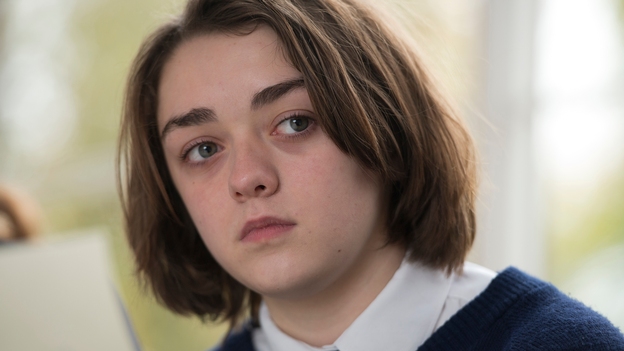
The Falling – Reviewed by David Turpin
Directed by Carol Morley
Starring Maisie Williams, Florence Pugh, Maxine Peake, Monica Dolan, Greta Scacchi.
Carol Morley’s haunting debut feature, Dreams of a Life (2011) was a documentary investigating the life of Joyce Vincent, a woman whose body remained undiscovered in her London flat for three years after her death in 2003. It’s a surprise, at least initially, to see that Morley’s first narrative feature is a quasi-supernatural, 1960s set period piece. However, The Falling – which deals with an inexplicable fainting epidemic at a girls’ school – soon reveals itself to have much in common with its predecessor, not least a nagging central mystery that resists all easy explanations.
The film centres on two girls, sullen, acerbic Lydia (Maisie Williams) and dreamy, sensual Abbie (Florence Pugh). Abbie experiences fainting spells that are possibly linked to her precocious sexual activities, but are never definitively accounted for. Following a tragic event, the condition spreads to Lydia, and thence to the rest of the girls at their school – much to the horror of the staff, including steely headmistress Monica Dolan, and a prim teacher (Greta Scacchi). Lydia’s home life in no less complicated, as her poseur brother affects an interest in the occult, and her agoraphobic mother (Maxine Peake) shows little interest in anything at all.
Morley handles her adolescent cast well. Williams is convincing at bringing out the struggle for identity in her defiantly disagreeable character, although she occasionally lapses into actorly gestures in her more heated scenes. Pugh, making her feature debut, is terrific as the otherworldly Abbie – it’s a less showy part than Williams’ but her presence hangs over the film like a fine mist.
Of the adults, Dolan and a near unrecognisable Scacchi are thoroughly convincing, as is Morfydd Clark, as the only teacher to be affected by the fainting spells. Maxine Peake, always a fine actress, is saddled with a difficult role that requires her to remain largely impassive before delivering a series of late-in-the-day revelations that arguably let the steam out of the enigmatic narrative. She certainly looks the part, though, her housecoat and acidic make-up representative of the generally pitch-perfect evocation of 1960s suburbia.
The most obvious reference point for The Falling is Peter Weir’s Picnic at Hanging Rock (1975), arguably the apotheosis of the “mysterious schoolgirls” subgenre. Morley, however, is more connected to her adolescent characters, displaying an empathy not present in Weir’s coolly curious gaze. There’s a certain affinity with Sofia Coppola’s The Virgin Suicides (1999) also, although Morley largely eschews Coppola’s pastel melancholy for a crisper tone – particularly in the sharp-edged hallucination sequences, which make disorienting use of flashcut imagery.
Like this year’s other surreal exploration of feminine enclosure – Peter Strickland’s The Duke of Burgundy – The Falling is blessed with a wonderfully evocative score, provided in this case by the magnificent Tracey Thorn. Fully capitalising on the strange combination of sensuality and naivety, hopefulness and ennui that distinguishes Thorn’s incomparable vocals, the score becomes a palpable presence in the alluring world Morley creates. Whenever the film threatens to become too vague, or too literal-minded, Thorn’s music buoys it up again, as wispy and unshakeable as the mysterious Abbie herself.
Categories: Header, Movie Review, Movies


 No More Workhorse