
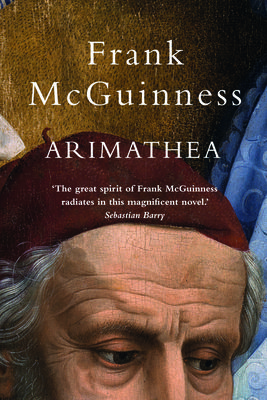
It seems an unlikely story. A Donegal priest with a passion for Italian art decides upon the death of his mother to commission artwork for the local church funded by his inheritance. The artist Gianni arrives from Italy to undertake the paintings of the Stations of the Cross. Yet the premise for this improbable story is based on an actual occurrence. Indeed an Italian painter did come to a Buncranna church in the early part of the twentieth century. The story told by his uncle fascinated McGuinness and he went on to write this fictional account of the event.
In the novel, upon his arrival in Donegal, the Italian painter is given lodgings with the local O’Donovan family. Despite his seemingly quiet and introverted ways the Italian’s presence holds a fascination for many of the townsfolk, not least among them Euni, the daughter of the O’Donovan household and Martha a single woman and niece of the Protestant minister. It is not long before the ripple of Gianni’s presence through the town precipitates a cascade.
For a novel based in rural Ireland there is freshness to the remote Donegal setting. Inevitably present are poverty, emigration and the oppressive influence of the church but McGuinness’s story set in nineteen fifties Ireland strikes an unusual note. There are religious overtones throughout the book, the priest and church of Ireland minister are two of the central characters yet there is little piety. Instead there is crudity and paganism aplenty in the town. The title of the book Arimathea is another biblical reference, reputed to be a city in Judea but also a mythical place.
This is McGuinness’s first novel after many years as a prolific and successful playwright. It is a transfer he makes with great ease. The book draws heavily on his own Donegal upbringing and the playwright’s past artistic inspirations. Frank’s own aunts worked in a shirt factory in Donegal, as does one of the main characters Margaret O’Donovan. McGuiness revisits themes featured from his early plays such the tensions between the Catholic and Protestant traditions and Italian painters and artwork.
The structure of the book cleverly makes the most of his strengths and skills as a playwright. Each chapter gives a distinct voice its stage and each voice adds to the tale and nudges it along a piece. Memories, desires and secrets are revealed through a stream of consciousness. The female characters in this book are the most luminous. The exotic dark skinned Italian pales beside the wonder of some of the women. They are strange, some are ruthless and none are dull. The writer’s gift for native speech and idiom is on display in the loose and flowing dialect of the townsfolk. The pleasing music of the Donegal speech is captured, as only a man native to the county can. In contrast the more well to do Martha living with her uncle in the rectory delivers her account in clipped and precise tones.
Unfortunately, in a book such as this where the narrator switches frequently you invariably favor some voices more than others. The young Enui O’Donovan is a bewitching combination of feistiness and awkward innocence. The reader has only adapted and tuned into her voice when it’s time to engage with the next narrator. There’s a temptation to to move hurriedly through the monologue of the Protestant minister to satisfy ones curiosity and meet the Italian painter on his pages. The voice of Gianni is not introduced until late in the book and a part of the novel takes the form of a long lyrical poem.
Sometimes the meaning of all the passages is not readily apparent. I found myself frequently flicking back and forth, re-examining details that take on more meaning in light of another character’s story. There is a final and startling turn at the eventual unveiling of the Stations of the Cross.
If you are looking for a rollicking plot driven story you might let this book rest on the shelf. I found it to be startling and memorable. It is a story that would sound wonderful read aloud. It is book that is likely to stay with you if you choose to read it.
Arimathea by Frank McGuinness. Published by Brandon Press
Categories: Book Reviews, Books


 No More Workhorse
1 reply »