
Rusalka – Bord Gáis Energy Theatre – Review
by G. O’Byrne
An Irish National Opera Production
Dates: 22- 28 March 2026
Photos taken by Ruth Medjber
“Rusalka” by Antonín Dvořák, 22 – 28 March 2026 – Bord Gáis Energy Theatre, Dublin by Irish National Opera in a co-production with Royal Swedish Opera and Nouvel Opéra Fribourg. Sung in Czech with English surtitles.
“Rusalka” is the ninth opera written by Czech composer Antonín Dvořák. It premiered in Prague in 1901. The story, reminiscent of “The Little Mermaid” by Hans Christian Andersen, tells of a water nymph (Rusalka in Czech) who falls in love with a human prince and the awful consequences for them both.
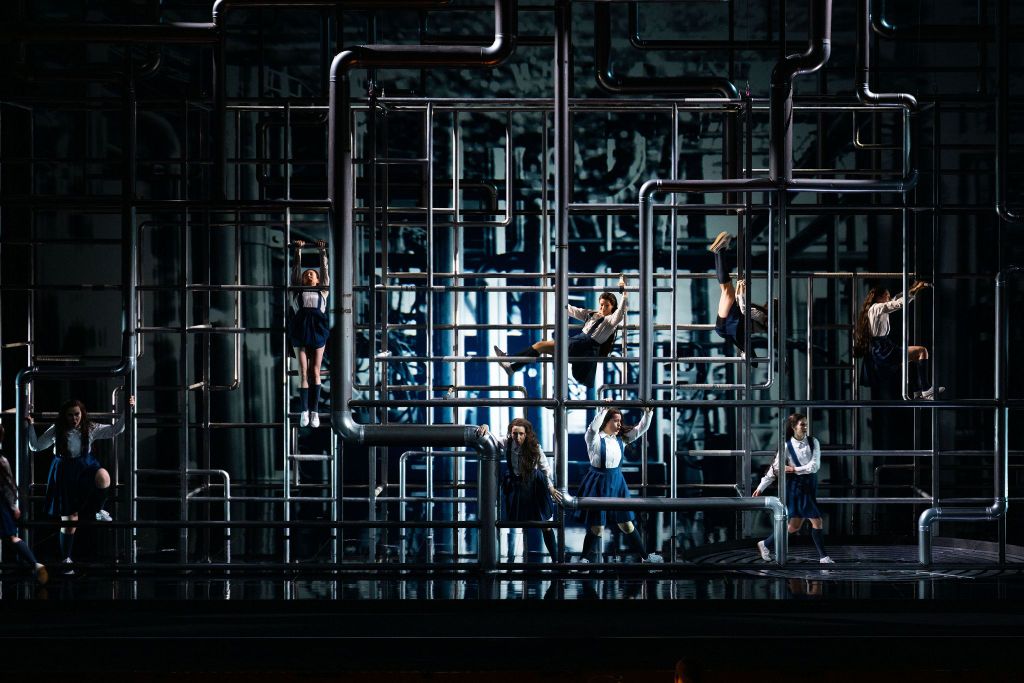
The staging is wonderful throughout the performance. At times, a transparent screen is used, permitting footage to be projected from both the front and back of the stage, which creates a 3D effect that makes the underwater scenes spellbinding. During the overture we see sunlight dappling the water from above and a long haired girl slowly swimming around, utterly at ease in that element, then heading down a tunnel to an underwater hall, like the engine room of a sunken liner, the home of Vodnik the water sprite (Croatian bass Ante Jerkunica), his daughter Rusalka (Irish soprano Jennifer Davis) and the other wood nymphs (soprano Rachel Croash and mezzo-sopranos Sarah Richmond and Alexandra Urquiola). When the screens rise, we see a similar huge scaffolding of pipes on stage with wood nymphs dressed like schoolgirls without a care in the world, moving acrobatically around the pipes in three dimensions. This is a stunning visual display accompanying the music.
Rusalka tells her father, Vodnik, of her love for the human Prince, and he tries to steer her away. Jennifer Davis’s rendition of “Měsíčku na nebi hlubokém” (Song to the Moon), probably the best-known aria from the opera, was exquisite. Later, when Rusalka seeks the help of Jezibaba, the witch, to achieve a human transformation, Jezibaba (American mezzo-soprano Michelle DeYoung) is wonderfully depicted as a femme fatale, wheeled out on stage elegantly smoking a cigarette in her private clinic with sinister silhouettes of medics in hospital gowns holding saws and knives, etc., against a backdrop of heart monitor readings. At the end of the first act, the transformed Rusalka goes to the forest to meet her love, the Prince (New York tenor Ryan Capozzo), who falls for her even though she has been rendered mute by Jezibaba’s magic.
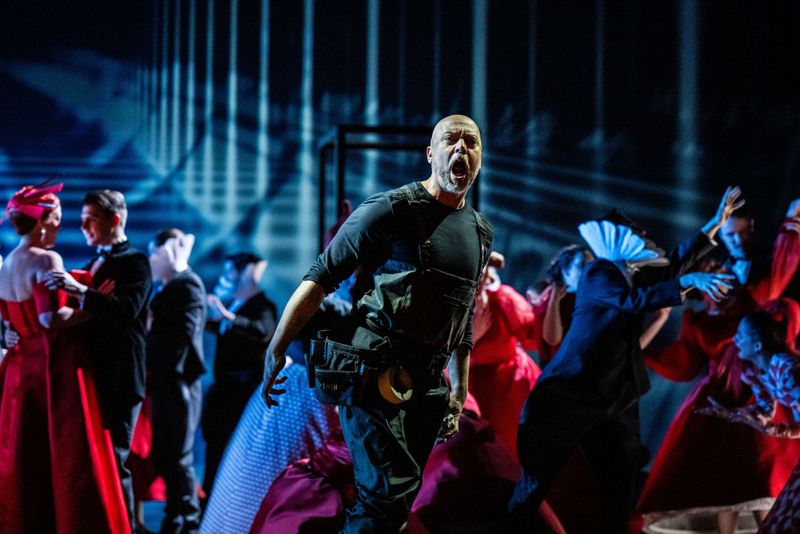
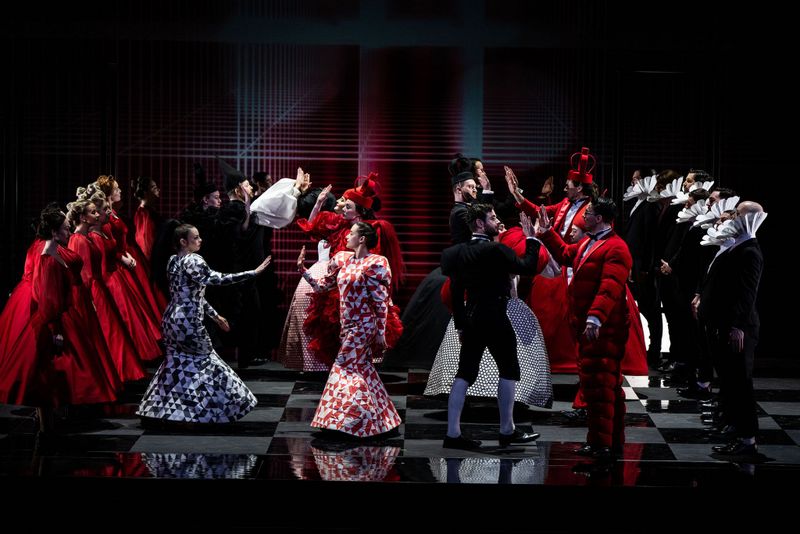
For Act II, the setting is the Prince’s palace kitchens, all Michelin gleaming steel and chrome, busy with chefs working away. The Gamekeeper (baritone Benjamin Russell) hacks away at a carcass with footage of raw steaks on the backdrop – not one for the vegetarians! There was much humour in this section. The Prince is struggling with his mute love and enters the Foreign Princess (Soprano Giselle Allen), well able to bamboozle the naïve Prince. Then on to the Ball with the courtly dance, wonderfully depicted as an interlocking chess game with the superbly costumed chess pieces weaving in and out of each other’s spaces. Poor mute Rusalka, in a ridiculously bouffon wedding dress, is literally out of her element, a “fish out of water”. Her father, Vodnik, appears, and she rushes to him in tears. The Prince declares his love for the Foreign Princess and ends up rejected by both women.
The final act is by the lake again. Jezibaba appears (pulling a wheelie bin and throwing a couple of plastic bags onto the stage – perhaps a metaphor for humans polluting the lakes and oceans?) and tells the disconsolate Rusalka she can recover her former status by killing the Prince, and offers her a knife, but she declines. The other water nymphs reject her. Finally, the lovelorn Prince appears and calls for her. Rusalka appears and is now able to speak to him. He asks her to kiss him, even knowing her kiss now means death. This final section of the opera – the great duet of the prince and Rusalka was heartbreaking in its beauty. After the Prince’s death, Vodnik, brokenhearted, sings that all sacrifices are futile. In her final song, Rusalka calls on God to have mercy on the Prince for his love, his beauty and his inconstant human passion, all of which have cursed her.
Jennifer Davis was superb in the title role of Rusalka, her voice capable of both tenderness and power, and in this she was well matched by the impressive lyricism of Ryan Capozzo as the Prince. Ante Jerkunica as Vodnik was also excellent as Rusalka’s grief-stricken father. The score shows Dvorak at his peak, with Wagnerian influence apparent in the music, as well as in the folkloric theme. Artistic Director Fergus Sheil ably conducted the INO Orchestra and Chorus. Direction and design were by Netia Jones. The staging of this production is outstanding and reflects the adaptation of opera to the possibilities of modern multimedia forms, all wrapped in Dvořák’s great score. Even Timothée Chalamet would be impressed!
Categories: Header, Music, Theatre, Theatre Review


 No More Workhorse