
The Crucible – Gaiety Theatre – Review
The Crucible – written by Arthur Miller
Dates: 9th Feb. – 21st Mar.
Arthur Miller wrote The Crucible in the early nineteen fifties. At that time, the United States was embroiled in an intense anti-communist fervour, which was encapsulated in the phrase “The Red Scare”. The fears of the population were exacerbated most prominently by Senator Joseph R. McCarthy as chair of the Senate Permanent Investigations Committee. The scare of a red under the bed stalked the land. Miller chose the well-documented witch hunts in Salem, Massachusetts, in the late seventeenth century as a parallel to what was happening in the nineteen fifties. In the intervening years, the play has become a classic, and the issues that it raises are as relevant today as they were when it was written.
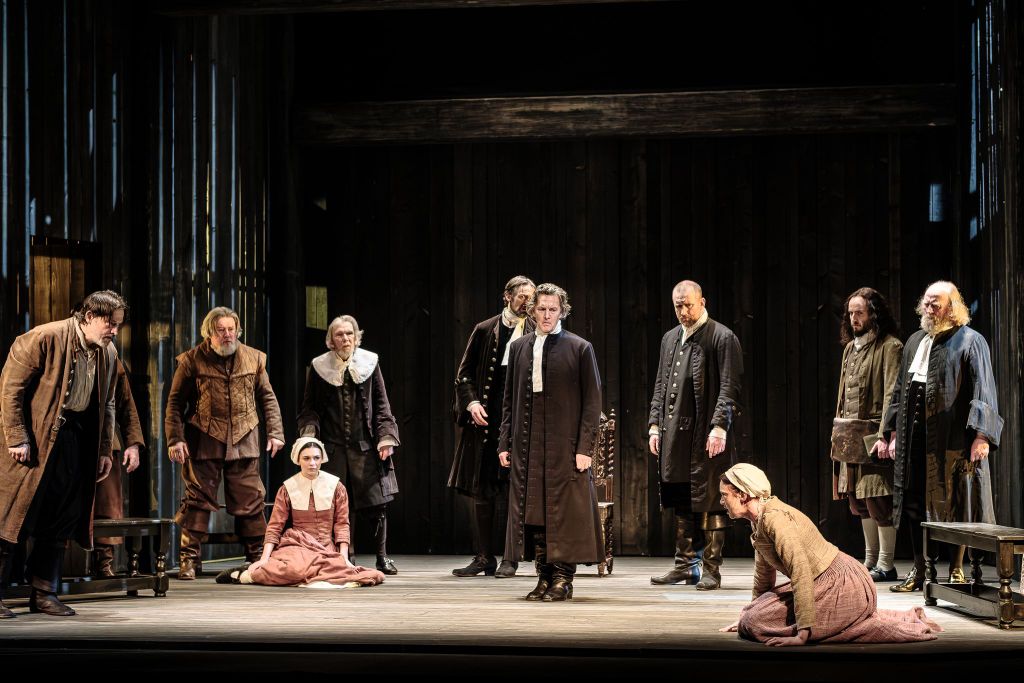
The set is predominantly black, and there is the occasional use of simple furniture appropriate to the late seventeenth century. The cast is all dressed in muted dark shades in attire typical of that time. It is a closed, God-fearing, church-going community that can see the work of the devil everywhere, particularly through his agents – witches. Once a rumour about a female starts that she is a witch, no matter how irrational, she is in danger of being denounced. Under such threats, confessions are made. In the hysteria that is generated, it becomes an epidemic of arrests, confessions and even executions.
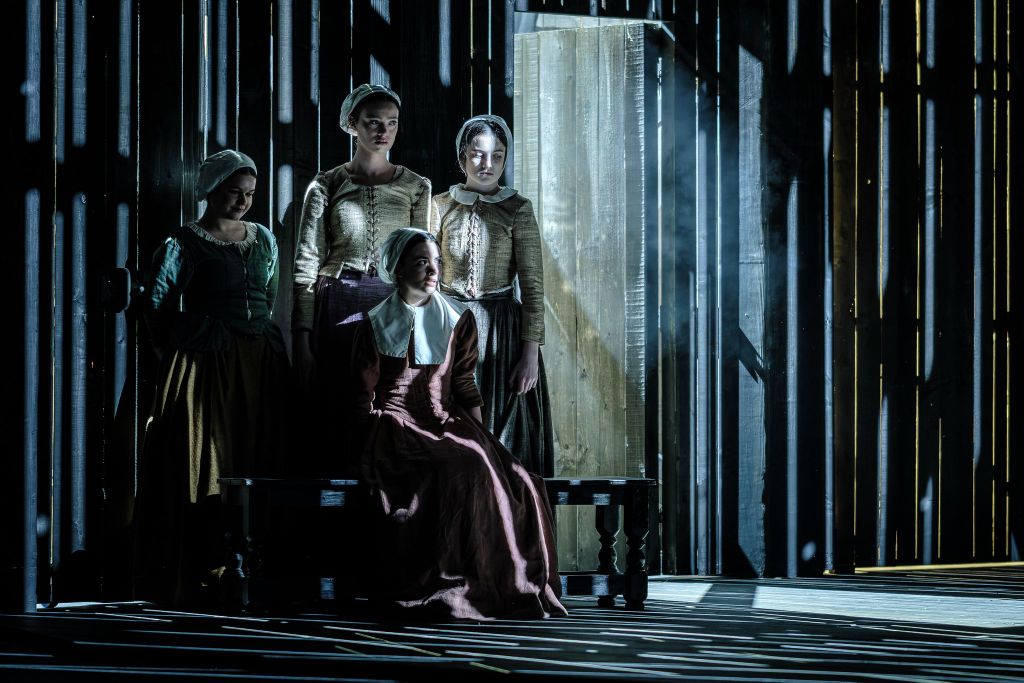
One of the initial catalysts for the events which unfold is the mysterious illness which has laid low Betty Parris (Lilymai Clancy), daughter of the Reverend Parris (Marcus Lamb), whose everyday fanatical love of God is matched by his love of material wealth. Another catalyst is that a group of young girls were discovered dancing in the fields naked. This has to be the work of the devil by the medium of his agents – witches. The chief culprit amongst the girls is Abigail Williams (Niamh McCormack). In the recent past, she had an affair with John Proctor (Adam Rothenberg), a married farmer who lives in the vicinity with his wife, Elizabeth (Charlene McKenna). Their neighbours, the Putnams, had six children die shortly after birth. Ann Putnam (Gina Costigan) believes it is the work of the devil.
There is a black slave, Tituba (Tierra Porter) from Barbados, who works for the Reverend Parris, has a markedly different social background from the other protagonists, and is easy prey to be accused of witchcraft. Another very different outsider is the Reverend John Hale (Rory Nolan), an authority on witchcraft from Boston who initially encouraged the noisy, irrational clamour but gradually comes to realise the false base from which the accusations have arisen. The forces of the establishment are represented by Governor Danforth (Andrew McCarthy), who will twist any fact through his myopic, fanatical gaze as evidence of witchcraft. It is a toxic brew.
There is a cast of 17 actors plus 4 stage extras, and the play lasts just under three hours. It is a substantial undertaking, and the quality of the acting and direction ensures that, apart from one or two brief passages, the audience is kept engrossed in the moral challenges which unfold. One’s thoughts move in many directions, not least to current political challenges such as immigration. It is a difficult topic for rational debate, as it is undermined by those with various agendas. The revival of the play is therefore to be welcomed.
The production is performed in a straightforward manner, dressed appropriately for the late seventeenth century and the text, although deliberately dated by Miller, was easily understood by the quality of the delivery. The complexities of hard-working and honest but all too human John Proctor were well realised by Rothenberg, while McCarthy was magnificently devious, slippery, and cloaked in a veneer of respectability as Judge Danforth. Rory Nolan depicted the gradual metamorphosis of the Reverend Hale. The entire cast made a cohesive whole.
The issues which Miller so eloquently ventilated in the nineteen fifties are, sadly, manifested still today in different guises. The fostering of hysteria is alive and well in the twenty-first century. Although this play is historical in context, the issues which it portrays are topical and relevant. The need for rational public discourse to be heard remains a constant. The Crucible shows what can happen when it is stifled. This is a fine iteration of the play, bringing the complex narrative to life and asking questions of a new generation.
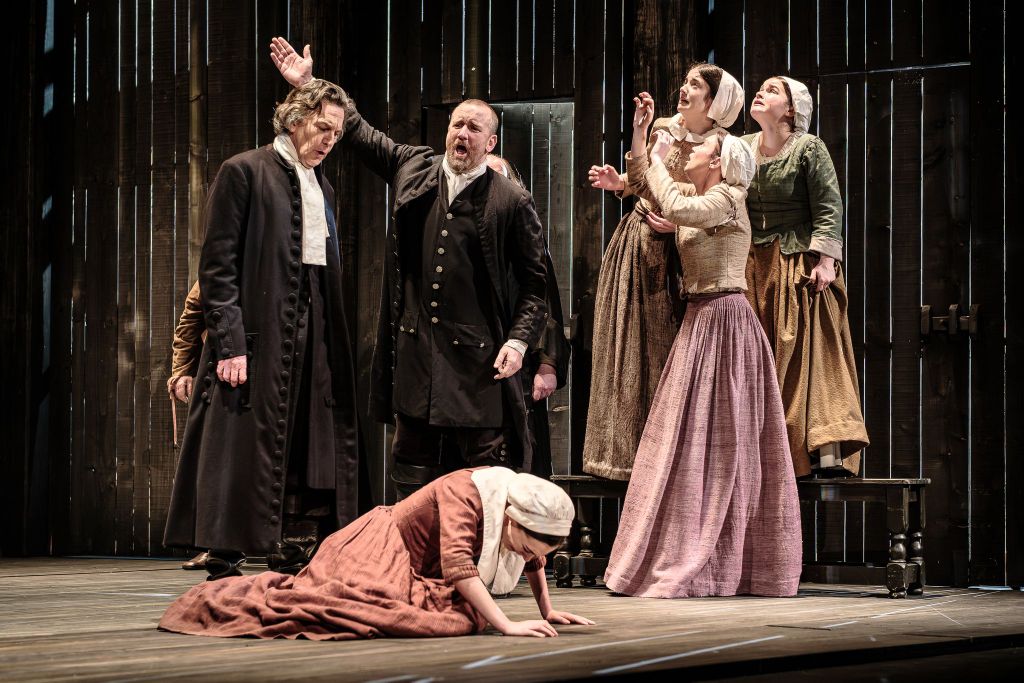
Starring:
Lilymai Clancy (The Ferryman), Denis Conway (Bodkin, Brooklyn, The Lieutenant of Inishmore), Gina Costigan (Kin, The Ferryman), Darragh Feehely (The Body is Water), Marcus Lamb (Dublin Murders, Rebellion), Niamh McCormack (House of Guinness, Small Town, Big Story), Lara McDonnell (Belfast, The Hills of California), Ciarán McGlynn (Conversations with Friends, Love Rosie), Charlene McKenna (Peaky Blinders, Clean Sweep, Raw), Bríd Ní Neachtain (The Banshees of Inisherin, Rosie & Frank), Rory Nolan (Deadly Cuts, DruidShakespeare), Anna Nugent (The Walsh Sisters, Going Dutch), Gerry O’Brien (Pirates of the Caribbean), Tierra Porter (The Sugar Wife, Tall Tales & Murder), Bryan Quinn (Bad Sisters, The Dry), Daniel Reardon (Hangmen, Chekhov’s First Play), Mazzy Ronaldson (Youth’s The Season-?), Adam Rothenberg (Ozark, Ripper Street), Paul Rowan (The Clinic, Fair City), Patrick Ryan (Small Things Like These, Red Rock), and Andrew McCarthy (Pretty in Pink, Weekend at Bernie’s, St. Elmo’s Fire).
Categories: Header, Theatre, Theatre Review


 No More Workhorse
I could not understand a word Adam rothenburg was saying…his sentences were of uneven volume…tapering off and booming on the second and third dyllable …unbearable to sit through.
Too much talk, not enough emotion and way too long. Very disappointed.