
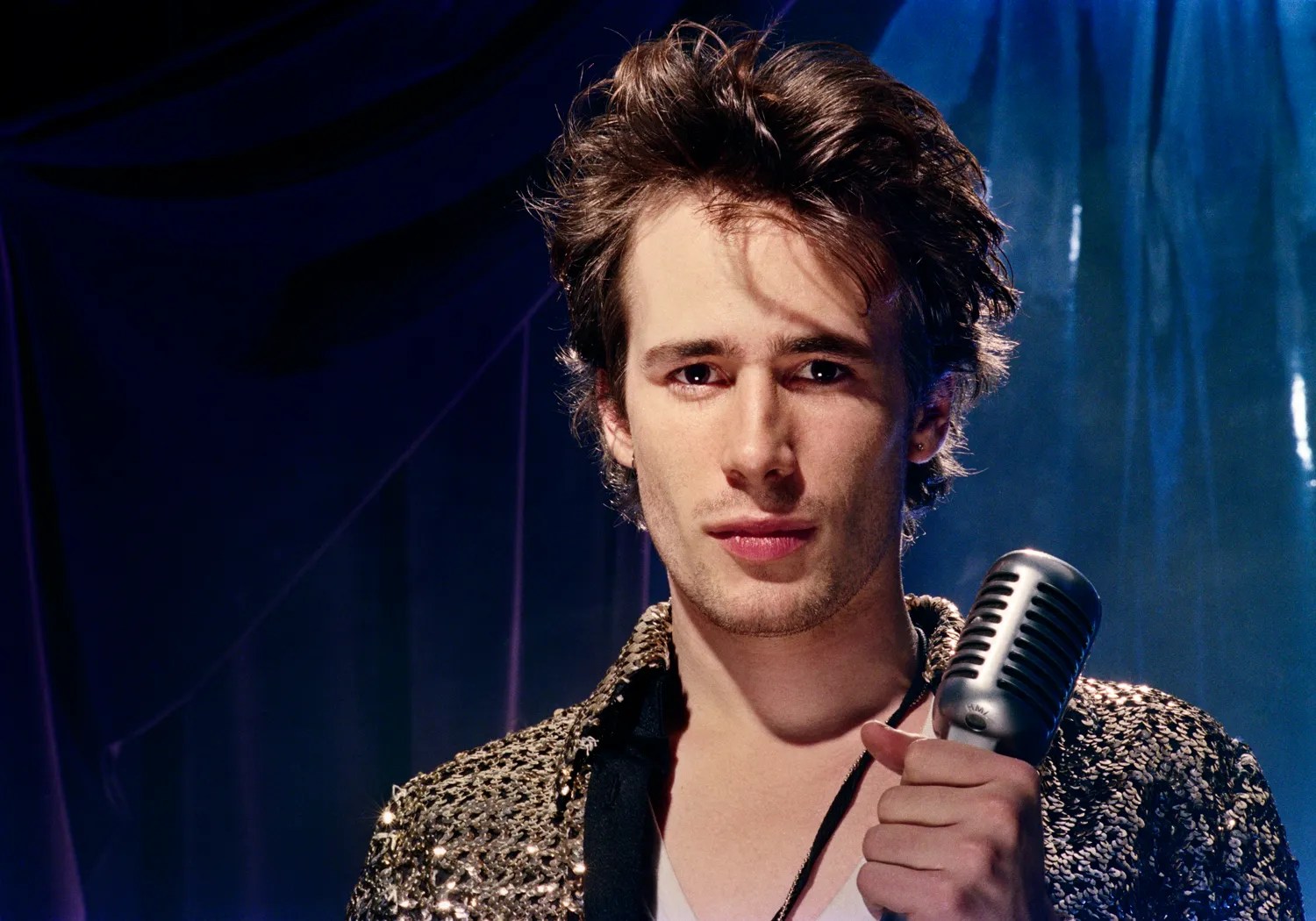
 It’s Never Over, Jeff Buckley – Film Review
by Cormac Fitzgerald
Director – Amy Berg
Stars – Jeff Buckley, Mary Guibert, Ben Harper
Jeff Buckley, the incredibly talented singer and musician (singer-songwriter seems too limiting) who burned brightly before dying far too young, was a man of contradictions. He was both shy and outgoing; he craved the spotlight and shunned it. He was serious and very goofy, fun-loving and laser-focused. He was determined, but unsure. To those who knew him best, he could be kind, caring, attentive, but sometimes mean, angry and neglectful.
This is the incomplete picture that emerges of Buckley in director Amy Bergin’s new retrospective documentary, It’s Never Over, Jeff Buckley, about the troubled, beautiful musician’s short life and career. Despite pulling at the various threads that made up Buckley’s personality, the documentary never lingers long enough to allow us to properly understand what truly made him tick.
What we get instead is a more or less linear account of Buckley’s life from conception, through his childhood and years in New York City, to his short career and untimely, tragic and bizzare death at the age of just 30 in 1997, when he waded fully clothed into a river in Memphis, Tennessee, and disppeared while a crewmember and friend looked on helplessly from the shore. His body was later recovered.
The story is told through an extensive collection of footage, music, images and voice message recordings of Buckley, many of which are being heard for the first time, along with interviews with the people who knew him best. The women in Buckley’s life feature most prominently: his mother Mary Guibert, who granted Berg access to the archive, and his former partners Joan Wasser and Rebecca Moore. We also hear, in varying degrees, from his close collaborators, friends, bandmates, influences, record executives, casual acquaintances, fans, and others.
The footage is used to great effect in painting a picture of the New York music scene in the early 90s, as well as Buckley’s US and European tours. He came to New York City from California and gigged in Sin É, an Irish-run venue in the East Village, before being signed to Columbia Records. Grace, his first and only album, was released in 1994. It didn’t sell well in the US, and Berg is adept at capturing the intense pressure heaped upon Buckley to deliver. She also captures the fact that record executives just didn’t know what to do with the immensely talented, multifaceted artist they were dealing with.
But the sheer amount of footage and the number of interviewees makes for crowded viewing at times. We never really get the full picture of Buckley – just hints. His biological father was the 60s countercultural icon and musician Tim Buckley, who died at the age of 28 from an overdose. Tim abandoned Jeff’s mother when she was pregnant with him, and remained a structuring absence throughout the younger Buckley’s life, haunting him.
Jeff claimed to be a feminist but is shown to be neglectful of his girlfriend and mean to his mother (who was a less-than-stable presence in his life). He sometimes disappeared for days at a time. There is a brief discussion that he may have suffered from bipolar disorder; it is stated casually that he loved to dress up in his girlfriend’s dresses, but again, questions around his state of mind or sexuality are not answered with any real depth. The documentary does not follow the thread of these contradictions but instead lingers too long on tour footage, salacious anecdotes, and trippy graphics that miss the mark.
This is where the documentary fails. Where it succeeds is in depicting Buckley as a singular talent. He had an incredible voice, vocal range and capacity for mimicry, performing amazing covers of Bob Dylan, Nina Simone, Nusrat Fateh Ali Khan, and of course, Leonard Cohen, among others. He was obsessed with music, most notably Led Zeppelin, and was a brilliant songwriter. Buckley’s sonorous, captivating voice is heard throughout the documentary, but we are never treated to a full, unbroken performance or given any deep insight into his songwriting method.
As a proper portrait, It’s Never Over, Jeff Buckley, lacks the depth to truly capture the underlying motivations behind the man, but as a chronicle of his life and his early death, the documentary succeeds. The most touching moments are when his friends and relatives break down in tears, still reeling from his senseless death all these years later. If Buckley remains elusive, perhaps it necessarily so. He was elusive to those who knew him best; elusive to himself, even. His star has risen and risen since he died; his tragedy is that he will never be able to tell his own story.
It’s Never Over, Jeff Buckley will run in selected Irish cinemas from Friday, 13 February
Categories: Header, Movie Review, Movies


 No More Workhorse