
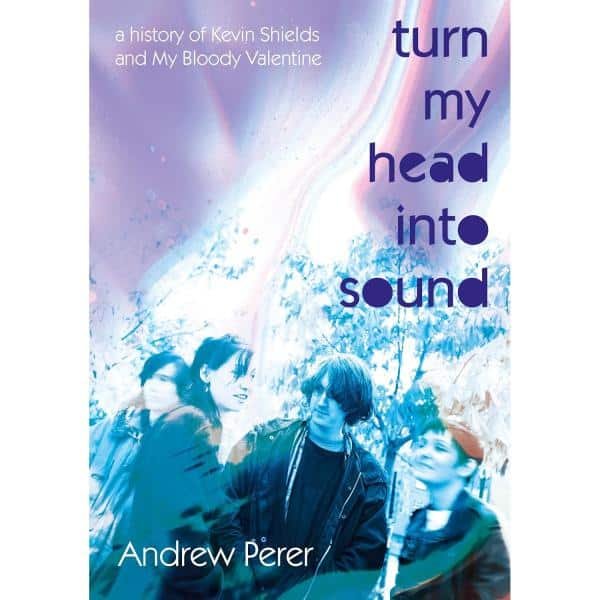
Interview with Andrew Perer – Turn My Head Into Sound
by Killian Laher
No More Workhorse caught up with Andrew Perer around the release of his book Turn My Head Into Sound, about My Bloody Valentine:
No More Workhorse: Is this your first book?
Andrew Perer: Yeah. I’m not a journalist or anything, which means it’s statistically rare to get a book published the first time out. But I took a lot of time to navigate it. I had a huge amount of research, and I was committed to doing it one way or the other. Not necessarily to get it published, but to do a book on Kevin Shields because no one had done one properly. The whole arc of his story was a lot more interesting than I understood. People don’t understand what he went through because people don’t know what happened at Island, or any of this stuff. I was looking at the many things that allowed this book to happen. I got in touch with Marc Marot, who ran Island. Chris Blackwell chose him, and he ran it for about 10 years.
The other point is, Shields did a lot of interviews. He’s a very personable, nice guy. He’s done a billion interviews, and he says what’s really going on. He’s very honest. He’ll do an interview in a German magazine and say something different that he didn’t reveal in a French magazine. He’s done a huge amount of interviews, and you can piece together everything from those interviews about him. The one other thing that happened was that Bilinda gave an interview to Ika Johanneson, a Swedish journalist. She came to her in 2004 and asked for an interview. Bilinda didn’t know if the band was done or what. She revealed a lot of stuff, and that was really helpful. The interview appeared online in 2008. Those were three key things, but I didn’t know any of this going into it, I just wanted to do it. I have an archive.
NMW: When did you discover My Bloody Valentine?
AP: I grew up in South Florida, which is not that connected to anything. Not that many bands came down there and toured. They might go as far down as Orlando. But we still had access to NME, Melody Maker and Sounds. A girl who was two years older than me followed the English bands. Felt in particular, and then compilations from Cherry Red to Creation. We got some of those compilations and picked up on My Bloody Valentine from there. You Made Me Realise came out when I was 16, which is a prime moment in your life, I suppose. The Smiths were before me. I missed them by a couple of years, and Joy Division were way before me. My Bloody Valentine were the band that just hit right then. They couldn’t have been timed more perfectly. They were the most attractive, sexy band, combining all the stuff I wanted. I thought, this is everything that a band should be. They had all the rhythm and the noise and the bass and everything that was missing from so much. Much like Sonic Youth, but I thought they were better than them even then. He knew exactly what he was doing.
Kevin Shields was really influenced by Evol and Sister. Those are really good albums. You’re Living All Over Me by Dinosaur Jr. There’s a certain vibe. But he was on his own path, and he just hit it at the right time. It was good to break it down more. It was fun to figure that all out.
NMW: Did it take you long to write the book?
AP: Yes. It took me a long time because I didn’t know what I was doing, and I didn’t know the publishing industry. I didn’t know how to find an editor. The hardest thing was just knowing how to get an editor. Once I found the right editor, that helped a lot. I went to college and I could write a 10-page paper, but that has nothing do with writing a book. It was a totally different endeavour. I found a really good editor. It cost money. And it had to go over seven years. He wasn’t cheap. But it was worth it. I’m very confident I wouldn’t have gotten published without him because he not only helped me structure the book, but he did a really good proposal for Jawbone Press.
Jawbone asked me to restructure the book, and he did a lot of the heavy lifting on that. The way it’s broken out into the main chapters and then the interludes, that was their idea. The main narrative just goes forward, and then if you want to read the interludes about the deeper dives, you can do that, or skip them. So Tom Seabrooke has edited every book of Jawbone. He knew what to keep. The book was 140,000 words, I think, and he brought it down to 100,000.
NMW: Did you look to contact the band directly at all?
AP: I think at one point I did early on and I realised they don’t give a shit. They did that one book with Mike McGonigal (Loveless 33 1/3). If you read that closely, he wrote something based on the Creation book by David Cavanagh (My Magpie Eyes Are Hungry For The Prize). Which is not that accurate. He (McGonigal) didn’t interview the band. They were probably broken up at the time. He based it all on that, and Shields thought that was terrible. That was probably a bad experience. Shields is not going to work with some random person he doesn’t know on a book. He has enough trouble motivating himself to do certain things… getting up to clean his room… but I think he’s in a good place now that he’s married and he has plenty of money. I think he’s going to have two albums out. I’m willing to bet.
They’ve been talking all along. If you hear every little interview with Colm (Ó Ciosóg) or Deb (Googe), they say he’s still working. I’m curious to see if he’s going to fill in all these dates. I heard one rumour, that they’re trying to negotiate for the US, and they’re having trouble with the venue. I have no idea if that’s really true. But everything I’ve read over the years, he has unfinished business, and he’s definitely making it bigger and bigger. He was talking about putting out two EPs, then two albums, and a couple of EPs. With his wife helping him, and with his life being organised… I don’t think he’s fundamentally changed as a person, but there’s nothing stopping him from working when he wants to, having complete control, which is what he always wanted. However long it takes, he’s going to put out two more albums.
It might take a couple more years… or it might be done now, I don’t know. Though COVID slowed things down, I believe he wants to establish and finish his place in history and make sure he has some pride, making sure he finishes strongly and finishes things off. He said in 2008, “Loveless, we can’t stop there. We have to put out two more good albums, then we can die”. I don’t know if the mbv album counts as one of those or not, it was left over from ’96/’97. I didn’t fully realise this till recently because he said confusing things on it. He said 30% of it was recorded then, but then he said all the melodies were from them, too, but they weren’t recorded. That’s a really accessible album. He’s just uncompromising and wants to do it his way, but he wants that recognition on some level. So that’s what I see.
NMW: Is Kevin Shields appreciated in the US?
AP: It’s hard to judge that. When you go to his concert, it’s mostly young people, under 35. They’re not nostalgia shows, like a Ride or a Slowdive show. If you can be a cult band in this day and age with the internet and all that, they (My Bloody Valentine) are. If you look on YouTube and Reddit, all these kids love him and want to play the guitar like him and are learning the stuff. So he has a really rabid following. The fact that they could tour and fill certain venues without putting any albums out in 2018 means it’s nice to have something not completely in the mainstream these days. His music is never going to be accessible enough to be a Nirvana or something like that. But I think he’ll become better known with the book and albums, and reach more of a tipping point.
When they were at Creation, Shields spent more than a year after Isn’t Anything, encompassing all of 1989, just experimenting with more advanced guitar ideas and guitar feedback. Nothing was released in 1989, and despite pressure from Creation, he didn’t worry. He had faith that things would come together, and they did. He made another huge leap forward with the Glider EP and ‘Soon,’ most notably. But things were never going to come together at Island, that was never going to happen, despite what he said publicly.
It was confusing, and you can’t make any definitive statements about what was going on, about what Shields was thinking, or what was in his own head. I think there was a dissonance that, I’m going to do this album, I’m going to finish this album, but I’m not recording anything of value. He was saying one thing and yet thinking this other thing. So there was this dissonance. It ended up being the stuff he did in the interim. It’s very interesting if you put it all together.
NMW: Do you mean his collaborations with other artists?
AP: Yeah, if you put all the remixes together. I really like the Joy Zipper album (American Whip). They’re a really good band, and they had some momentum within their second. Everyone who worked with Primal Scream worked with them, David Holmes and all these other people. Their record company went out of business during their second album but he hung out for all the mixing and all the mastering and he didn’t get paid. He got paid to work on one track just because he liked them and he thought they were good. Besides the Primal Scream stuff, that’s a really good album worth hearing, I think. Just a uniquely American sunshine, even though they’re from New York. It’s very strange and pretty. You could put three CDs worth of stuff together of truly interesting stuff, between his remixes and then the songs he mixed for other people.
NMW: What do you think much of the other bands that were associated with My Bloody Valentine in the early 90s?
AP: They have nothing to do with My Bloody Valentine, other than being English or in a similar age. The one band that did that use some of his techniques is the Boo Radleys. On Giant Steps and stuff before that. You can hear clearly, and they work with three of the engineers who work with Shields. All the other bands were using really straightforward modulation pedals, which was all done by 1970. The Beatles and Hendrix had all done this stuff by 1970. It hasn’t changed. John Mayer is one guy who built pedals for Hendrix, and Shields does work with him.
What Shields does is so much more emotive. It’s just indicative of him just having this natural connection to sound that he discovered this way of playing differently. That he was always going to do something original. So these other bands didn’t understand what he was doing. He talked about it in 1991, he said, ‘If I had a secret weapon, it’s reverse reverb’. The original reverse reverb went back to Led Zeppelin. But this was a particular digital version that he likes. It’s percussive and it’s very specific. That’s what he used on everything up to Loveless, in one form or another on most songs. That’s why he can play the songs live. There’s just one guitar on most songs. The reason why it’s so interesting is instead of Hendrix soloing, you’re getting this one performance by someone chord bending and playing this very emotive part, but with chords. So he’s doing this dry, upfront guitar. That’s why he’s so bemused. When I was young, I didn’t understand the difference that much. But now as I get older, I realise it’s totally different. He starts every song with an acoustic guitar, mind you. He can write really sophisticated songs, and he follows Burt Bacharach and Brian Wilson. He does a lot of weird tuning stuff. It’s very emotive that he’s doing these effects. Robin Guthrie used a lot of flanging and phasing. They’re very top down, you can’t really interact with them. The whole thing with Shields is that he’s using effects that work with his playing and are bottom up. He’s writing these interesting songs before he adds any effects or any reverse reverb. That makes him stand out.
Those bands (Ride, Slowdive) really have so little to do with him, even though he’s nice and respectful, he likes some of their songs. He said, ‘I like them all as people’, but he was resentful at first. Now, he has his own thing, and he’s away from all that. But in ’91/’92, he was just like, ‘What are they talking about? These bands are doing the exact opposite of what I’m doing’. They’re using some of these reverb things and echo and stuff. We’ve just heard so much, and it’s not psychedelic or disorienting anymore. When the Beatles and Hendrix did it, it was so fresh and new, but it became a cliché. The worst album that really demonstrates that is the first Slowdive album (Just For A Day). If you listen to that, there’s some songs in there where there’s just too many cliched effects, just a brown, awful sound. That’s the low point of any of the shoegaze bands.
NMW: For the uninitiated where would you start with My Bloody Valentine?
AP: I’ve been telling people that if you watch the videos, on a computer or something, you’re not going get the sound very well. The songs and the mixes are really blunted mixes. He remixed Soon and To Here Knows When for Loveless. There’s a certain sound of those, and they’re really hard to make out. If it was something visual, you’d have to dilate your eyes. You have to dilate your ears! My favourite thing of theirs is the Tremolo EP. But I guess the easiest thing to take in is maybe that Blue MBV album. The first six or seven songs in that are very easy to get into.
The other stuff is maybe the EPs collection (EPs 1988-1991). If you’re younger and don’t mind the harsher sounds. Those four EPs are so key, and they show such specific growth and change and exactly where he was at. You could actually include Strawberry Wine and Ecstasy. Those sound terrible when they were collected by Lazy Records. But if you hear the actual albums of those, which are expensive, they sound beautiful. Those are an important demarcation point where they finally did something that was better than more than some of its parts.
When Bilinda came in, that’s when everything changed. But he was really proud of those (Strawberry Wine and Ecstasy) when they first came out. He was really thrilled that they did something that good. Then when they did You Made Me Realise, which was so much better, then he’s referring them as demos. The MBV album seems easier to get into, except for the last couple of songs are difficult.
NMW: Any plans to do another book?
AP: This is the only book. I think it’s gotten harder with writing being devalued with the internet. The internet is just destroying everything as far as I can tell. America is going to be taken apart by the internet because of Trump taking advantage of it. It’s such a closed fraternity of people who make a living out of it. I don’t have another book in me.
Turn My Head Into Sound by Andrew Perer is out now.


 No More Workhorse