
The Magic Fountain – Wexford Festival Opera – Review
by Brian Merriman
The Magic Fountain by Delius.
Performances 19, 23, 25 and 31 October
Duration: 1 hour 30 minutes plus 30-minute interval
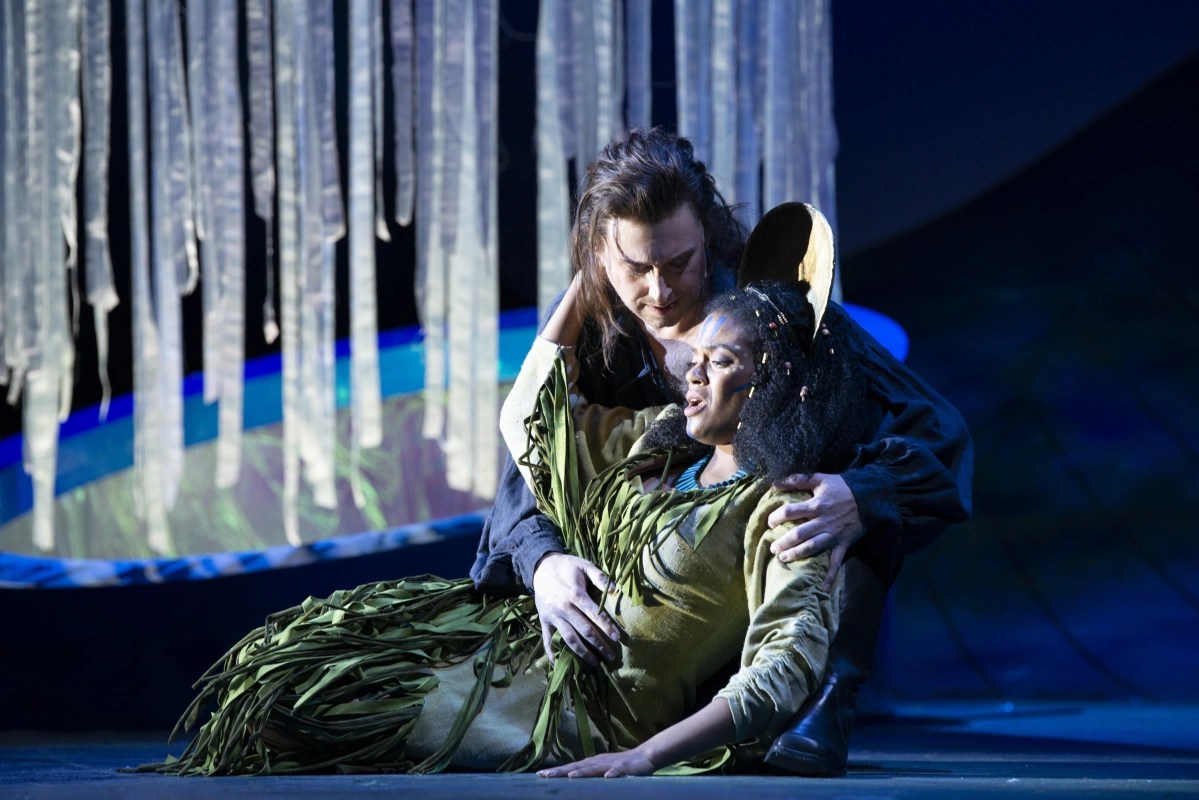
Photo: Pádraig Grant
The wonderful National Opera House in Wexford welcomed its third opera in this year’s quality 74th programme, ‘The Magic Fountain’ by Frederick Delius. Sung in English, with added surtitles, it has a surprisingly melodic and accessible score. The orchestrations were the source of the real magic and gave a great sense of legend to the production.
Francesco Cilluffo conducted with authority and revelled in the fine playing from concert harp, oboe, bassoon and horn amongst the full orchestra. The interludes were full of light and shade, and the recitative was melodious, possibly at a cost of an absence of aria. It really could have done with a few more arias to complete the beguiling quality of the orchestral score.
Simon Higlett’s set design (and costume) was striking and artistic, beautifully lit by the co-lighting design of Daniele Naldi & Paolo Bonapace. There was a lovely sense of greenery in this faraway, magical island that hosts the much sought after, elusive fountain of youth.
Such was the joy in the orchestration that the two staged dance and movement pieces by Amy Share Kissov, well executed by the ensemble, really lifted what was otherwise an overly static production. It cried out for more movement.
The talented cast was left wandering around the stage in the long melodious riffs, staring endlessly upwards, as if they had never seen the island landscape that they and their ancestors inhabit. It became monotonous.
Christopher Luscombe, director, assisted by Will Ashford, opted for the ‘stand and deliver’ traditional operatic approach, despite the score calling to them to utilise the light and shade of the many atmospheric underscoring moments. It was disappointing. Surtitles were above the stage and to the extreme left and right of the auditorium. The ones on the sides could be edged in more to allow them to be seen in peripheral vision, rather than having to take away from the visual feast that the design created.
The majestic Axelle Saint-Cirel dominated the stage with her noble presence as Watawa, a tribal Princess, whose ancestors had been wiped out by ‘the palefaces’ previously. Intent on revenge, the latest fountain seeker, Solano, well played by Dominick Chenes, was in fine voice throughout.
The only person to drink from the fountain and to survive, because he truly thirsted for its knowledge, is the reclusive oracle Talim Hadjo, impressively sung by Meilir Jones, who mastered the deep bass register in style. It was no mean musical feat. Jones was well matched on the tribal island by its leader, the warrior, Wapanacki, in an impactful performance by Kamohelo Tsotetsi.
The talented ensemble impressed from the opening on board ship scene, nicely supported by Seamus Brady’s sailor. Later in the production, they were bizarrely placed in complete stillness around the campfire, on the eve of a battle, for a duration. The use of stillness or minimalist movement seemed to contradict the staging potential and the melodies emanating from the orchestra pit.
As with many operas, the plot can be thin. Composers seem to have it in for leading ladies, as so many succumb at the end. The Magic Fountain is no different. It does, however, push the logic limits. All through the first Act, Walama is intent on a two-pronged option for revenge. She carries a poisoned knife. At the end, as she guides Solano to his certain death and there is a hand clasp to close the first Act.
Even though there is a 30-minute interval, a lot seems to happen off stage. As the curtain rises, we find our heroes deeply in love and willing to die for the same, over the next thirty minutes. Except for the one hand-holding moment, we are still left wondering how that intensity of feeling happened. However, strange things can happen on magical islands not found on a map!
Visually and aurally, Delius’s 1895 gem, The Magic Fountain, was a treat. The quality vocal skills of the cast further illuminated the really impressive score, which certainly warranted a production in this year’s festival. Wexford Opera Festival is a joy, and this night in the Opera House maintained its well-earned reputation for producing lesser-known, quality work and presenting it to new generations of loyal Wexford supporters.
CAST: Dominick Chenes, Axelle Saint-Cirel, Kamohelo Tsotetsi, Meilir Jones and Seamus Brady
CREATIVE TEAM
Francesco Cilluffo – Conductor
Christopher Luscombe – Stage Director
Simon Higlett – Set & Costume Designer
Amy Share Kissov – Choreographer
Daniele Naldi & Paolo Bonapace – Co-Lighting Designers
Will Ashford – Assistant Director
Categories: Header, Music, Theatre, Theatre Review


 No More Workhorse