
Late Shift – Film Review
Director Petra Biondina Volpe
Writer Petra Biondina Volpe
Stars Leonie Benesch, Sonja Riesen, Alireza Bayram
Based on Richard Gordon’s comic novels, the Rank-produced Doctor series was a huge hit in the 1950s, beginning with Doctor in the House (1954), a vehicle for heartthrob Dirk Bogarde (1921-99). Leading to many film and TV spin-offs, not to forget Carry on Matron (1972). The original film highlighted a public thirst for hospital/ medical-based drama, which had not been anticipated. The taste continues since then, unabated, over the decades from the George Clooney springboard vehicle ER (NBC 1994-2009), to Grey’s Anatomy, and closer to home, the London-based Call the Midwife and Casualty, the latter initiated as far back as 1986. All films and TV have the close focus of the hospital setting, with various heart monitors and saline drips, acting as a background to the emotional lives of the many actors involved, running around in scrubs while still maintaining full and sometimes colourful private lives. The patients and their worries are only occasionally the main focus. Reconciling the home life with the emergency dynamic of the hospital is often the starting point for the narrative. And it obviously works, to judge from the success of the formula.
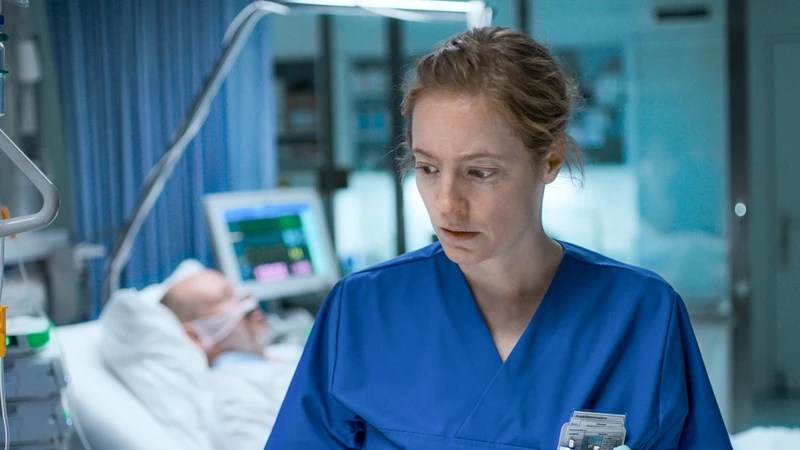
There is not much of this formula to hand in the wonderfully tight and focused Late Shift. In essence, there is not much narrative to relate at all. A young nurse starts on her hospital shift – one day like any other. There is no underlying romance or tragedy in the air, no sexual tensions with an attractive intern or senior staff, and although there is some off-screen family issue, it is parked more or less for the duration of the work shift. So, instead of narrative flow with a developing storyline, we are instead presented with a food blender out-of-control melange of many narrative moments. There is simply no time available to explore in full any character or their back story. From the moment she dons her scrubs and new runners, our main protagonist, Floria, is literally run off her feet. To compound the panic, the ward is down on staff numbers, and it is a case of constant firefighting from beginning to end. Cleaning an elderly patient who has dementia, and has soiled herself, Floria is interrupted by a buzzer demanding that another patient be brought immediately to surgery. The absence of hospital orderlies means it is quicker to do something oneself, but this also results in another task being forgotten or overlooked, while the family of another patient demands answers for which the nurse could not possibly have input or explanation. One patient is terminally ill, another sees the nurse as a domestic servant, while another is truculent when asked to stop smoking, and so it goes on endlessly. Senior doctors are elusive. It is all utterly breathless. While hugely compelling to watch, it is all captured with such immediacy and believability that we are left wondering why on earth anyone would become a nurse. If the film were to be used in teaching schools, there would probably be a complete clear-out of trainee nurses.
Despite the Swiss setting and contrary to our uber efficiency presumptions and stereotype, there is a sense of unbridled panic from beginning to end. We come out on the street afterwards, gasping for air, or at least a drink. It is no surprise to read, as the credits roll, that there is a huge crisis in the Swiss hospital system, one reflecting a wider problem internationally. There is a striking shortage of nursing staff internationally, estimated in the hundreds of thousands – undoubtedly a fulfilling career but one, on the basis of this film, requiring stamina and nerves of steel.
Categories: Header, Movie Review, Movies


 No More Workhorse