
 Our New Girl – Lyric Theatre – Review
by Cathy Brown
Our New Girl, by Nancy Harris A Lyric Theatre, Belfast Production
Dates: Tue 8 Apr—Sun 4 May 2025
Our New Girl by Nancy Harris is a psychological drama that sinks its teeth into the messy realities of modern parenthood, domestic power dynamics, and the unsettling presence of an outsider. Set in the sleek, sterile kitchen of a well-off London family, the play unfolds with a slow-burning intensity that neatly balances dramatic tension and narrative ambiguity.
This Lyric Theatre production opens with a short, unforgettable scene that left the press night audience gasping in shock, before doubling back to focus on Hazel, a heavily pregnant former lawyer grappling with a failing online olive oil distribution business and a troubled young son, Daniel.
Her husband, Richard, a plastic surgeon off on a humanitarian mission to help the poor and scarred in earthquake-stricken Haiti, has hired a nanny, Annie, without Hazel’s knowledge. Annie’s arrival—unannounced and eerily cheery—sets off a chain of tensions that promise to unravel the glossy facade of the Robinson household. Harris skilfully plays with familiar tropes (the sinister nanny, the disturbed child), but she twists them into something fresh, avoiding cliché through sharp dialogue and a balance of humour and dread.
The play is darkly funny—Hazel’s exasperation with her son’s oddities, Richard’s egotistical mansplaining or Annie’s overly polished helpfulness land plenty of laughs—but the unease bubbles beneath. Hazel’s resentment of motherhood feels raw and taboo, Annie’s tragic backstory adds layers to her motives, and even Richard, though less nuanced than the two women, exposes the arrogance of well-meaning privilege. Daniel, meanwhile, is both a victim and a wildcard, his behaviour amplifying the household’s fractures.
Mark Huberman brings some much-needed humour and charisma as the rather one-dimensional Richard – particularly in the first act of the play – but has less to work with as the tensions escalate. At times, Richard comes across as a caricature of male obliviousness, which slightly undercuts the play’s subtlety. Jeanne Nicole Ní Áinle plays the role of Annie with an intelligent equivocation, her true intentions and subtle power plays depicted with nuance, until her personal agenda is revealed. Lisa Dwyer-Hogg gives a painfully honest portrayal of a woman close to breaking point, perfectly depicting Hazel’s genuine stress and exhaustion and generating sympathy despite her unpleasant attitude towards her young son.
Special mention must go to Canice Doran (who alternates the role of Daniel with Milo Payne), who carries a lot of responsibility on his young shoulders, in this, his professional stage debut. A central focus in many of the scenes, he brings a chilling calm and sharp wit to the role, as a boy being played by his parents like the football his father unthinkingly gifts him on his return from Haiti.
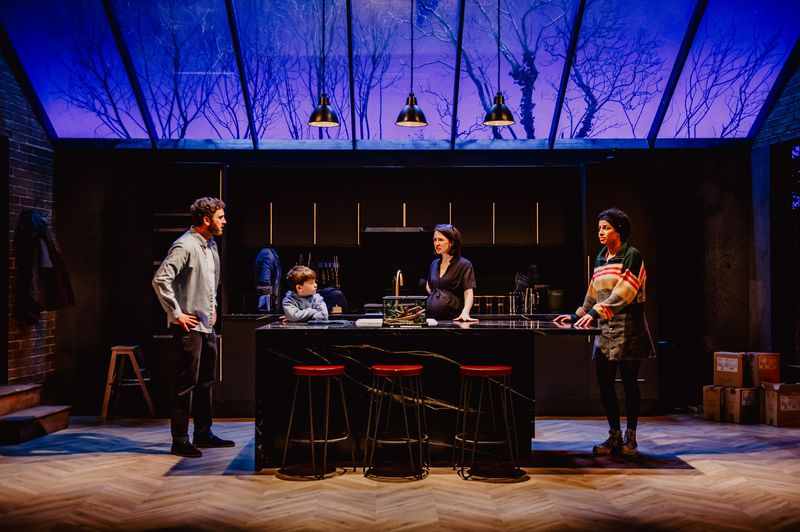
Maree Kearns’ set amplifies the themes of the play; the Robinson’s sharp, sleek modern kitchen has everything a family could want yet lacks warmth or personality. The bottles of olive oil slowly overtaking the family space are a subtle metaphor for the maternal love and calm that Hazel once witnessed in Sicily but can’t seem to replicate in her own home. Garth McConaghie’s unsettling soundscape and Sarah Jane Shiels’ striking black outs add to an atmosphere that could be felt creeping across the auditorium.
Rhiann Jeffrey’s sure-handed and intelligent direction gives the play drive and tension, highlighting the changing power dynamics without sacrificing emotional consistency. The opening act zips along and features a secret pet tarantula, which acts as a powerful metaphor for the family’s conflicts and concealments.
The second half is more static and loses some momentum with an ending that doesn’t really live up to the promise of what has come before. However, the audience leaves with a glimmer of hope that Daniel – whose actions are driven by the lack of love and attention he receives – and Hazel, might find a way to deal with their emotional scars.
The play is at its best when it is exploring its themes of maternal abandonment – ‘you’re the creator and you’re the destroyer’ – and its strength lies in this dichotomy, finding real horror in the unspoken gaps between what people want and what they are willing to sacrifice to get it. Our New Girl is a bold, modern and unmissable production.

Categories: Header, Theatre, Theatre Review


 No More Workhorse