
 The Crime is Mine – Film Review
by Hugh Maguire
Director – François Ozon
Writers – François Ozon, Philippe Piazzo, Georges Berr
Stars – Nadia Tereszkiewicz, Rebecca Marder, Isabelle Huppert
Hot on the heels of this summer’s Olympics – as much a paean to Paris as to sport – comes this all too enjoyable and delectable feast of effervescence. In the best tradition of the Parisian garret as a cue for misery – think La bohème – two young women share an attic living space with poverty almost knocking at the door, if not quite Angela’s Ashes. The landlord is looking for unpaid rent. One occupant being accused of a crime of passion is defended by the other, a young lawyer, in a celebrated court case which instead of a death penalty results in popular acclaim and celebrity. The twist is whether the defendant actually committed the crime. Which of the characters is worthy of the much-publicised notoriety?
Significantly, as with an array of successful French cinema of late, a courtroom scene provides the main focus. Although it must be admitted that this courtroom is angst-free. Around this core narrative are various secondary plots and twists which allows a stellar cast of actors to sparkle and shine. Like the best patisserie and champagne, there is little of substance but how life-enhancing it all is at the same time. From the opening shots and the twists and turns of the improbable plot, there is a whole film of fun. Celebrating a Paris of the imagination (is there any other?) we find ourselves in the territory of Amélie (2001) and Emily in Paris. Everyone, or almost everyone is beautiful, and the architecture is of an Art Deco perfection that even the 1925 Exposition des Arts Decoratifs… would have been proud of. Verging on the pantomime at times and yet moving deftly along. There is never a dull moment and all are enjoying themselves – possibly too much. Isabelle Huppert is having a riot and it must have been a blast of fun to be on set.
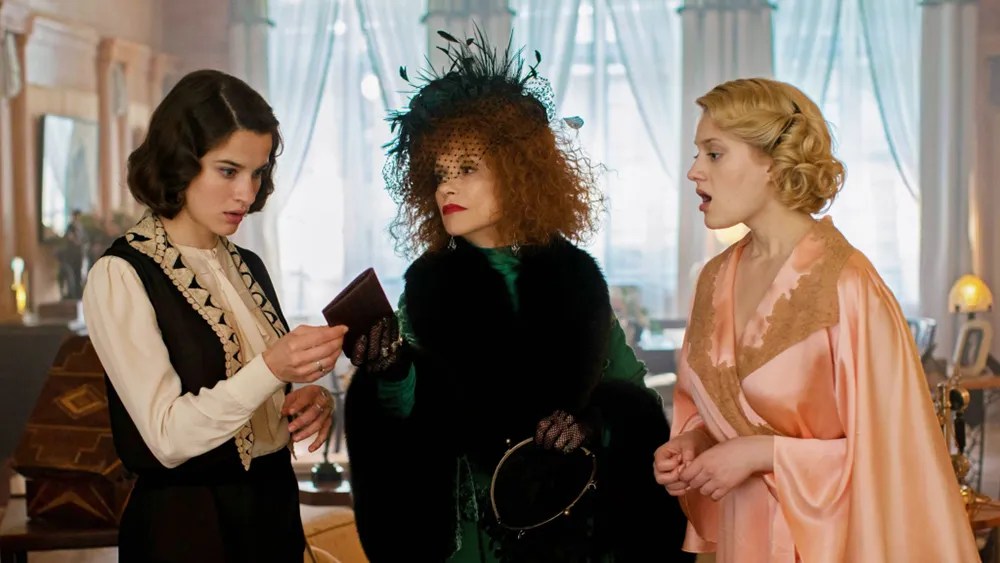
For the aesthete, there is a wonderful array of archaeological accuracy with an attention to detail that accurately reflects the period setting, the class and the status of the subject. The finer the cut of the suit, the more affluent the character and so forth. But all of this is not to imply that we are watching a film of fastidious froth. It may on the surface have no solid substance but despite this, there is still an underlying core message. Even the most sparkling of champagne requires skill and good grapes. And the kernel here reminds us of the marginalised role of women in the period – all glitz and glamour with no power. Remarkably to us French women were only allowed to vote in 1945 (Irish women had the vote in 1918). Reading critically we can see how women could be forced to exploit sexuality and a perceived vulnerability to survive in a prevalent sexist culture. What is the role of the legal system and to what extent can a jury be influenced by looks? It may all be exaggerated in a colourful and jolly way but there is still something to consider in depth.
Categories: Header, Movie Review, Movies


 No More Workhorse