
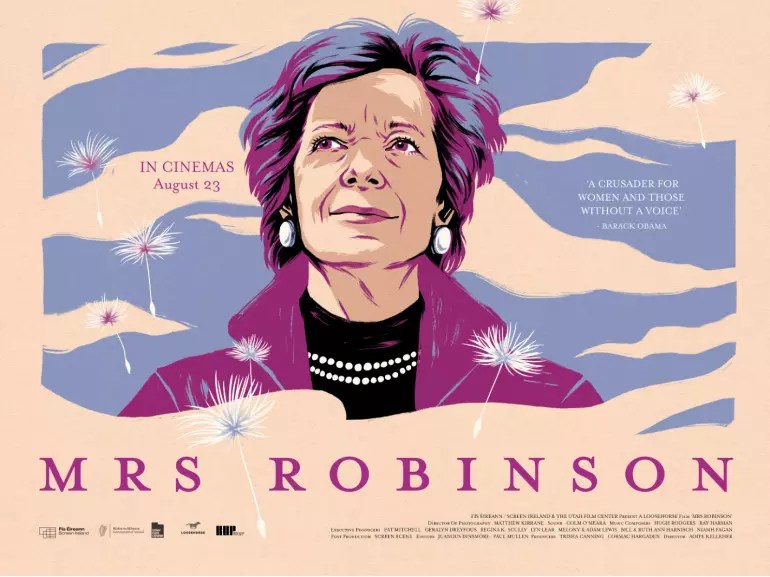
 Mrs Robinson – Film Review
by Frank L.
Director Aoife Kelleher
To an Irish audience, Mary Robinson aka Mrs. Robinson needs little introduction. In simple terms she was the President of Ireland from 1990 to 1997 and UN High Commissioner for Human Rights from 1997 to 2002. Since then she has been active in world politics as a founding member and chairperson of The Elders which was founded by Nelson Mandela in 2007. She has been a vocal advocate for the challenges facing the world’s environment due to industrialisation in the last three hundred years. Throughout the documentary, Kelleher makes extensive use of contemporary footage.
She was born in Ballina in County Mayo and Kelleher starts the story there as Mary Bourke, as she then was, the sole daughter in a family of sons. Kelleher then tracks her remarkable career as a schoolgirl at Mount Anville and stellar legal student at Trinity, the broadening of her horizons at Harvard and her return to Dublin as a practising barrister and a lecturer at Trinity. She interweaves this professional story with her relationship with Nick Robinson who also studied law with her in Trinity but whose forte was as a cartoonist. Kelleher does not shy from the less happy moments in her life such as the opposition of her parents to the marriage with Nick. She tracks comparatively quickly over the early part of her political career until she becomes the Labour Party’s nominee in the election for the President of Ireland. Kelleher deals with that campaign in some detail but surprisingly makes no reference to the self-inflicted difficulties of her principal opponent Brian Lenihan with his now infamous “on mature recollection” interview but concentrates on the verbal attack on her in an interview by Lenihan’s party colleague, Padraig Flynn, the then Minister for the Environment.
Kelleher engages with the controversy Robinson created by resigning the Presidency three months early which Robinson now regrets. Similarly, she regrets becoming unwittingly involved in the family affairs of the ruler of Dubai and his daughter Princess Latifa. However, Kelleher concentrates on Robiinson’s continuing work in relation to human rights and her tireless work to make the industrial world face up to the urgent need to change its ways.
The challenges of climate change are Mrs. Robinson’s principal crusade now. She states in the documentary that the African continent’s contribution to greenhouse gases is a mere 4% of the total. However, Africa is seeing some of the grimmest consequences. It is a timely reminder of where the responsibility for climate change lies however much the rich industrial world may not like the verdict.
As a documentary of a person who has had a remarkable public career, Kelleher tells that story with Robinson’s personal life playing an important but albeit secondary role. Wisely the early resignation of the Presidency and the Princess Latifah debacle are included. Kelleher shows that Robinson’s work is far from done as she continues to campaign for human rights and for all political leaders to wake up to the catastrophic challenges of climate change. It is in effect a rallying cry for those campaigns.
Categories: Header, Movie Review, Movies


 No More Workhorse