
 Twig – Film Review
by Brian Merriman
Written and Directed by Marian Quinn
Director of Cinematography Declan Quinn
Starring: Sade Wilson, Barry F O’Byrne, Donncha Tynan, Naoise Kelly, Susan McKeown
Duration: 107 minutes
It is always good to see Commisuin Na Mean, RTE, Screen Ireland etc supporting a new Irish film. Twig, by Marian Quinn had the great honour to open the Dublin International Film Festival earlier this year, a fitting accolade to the writer and the production company.
Set in Dublin’s docklands, we are treated to a story that has a certain fluidity in time and location, including some very traditional locations and sets from yesteryear. Yet ‘Twig’ draws on the criminal activities that have driven so many of our more recent contemporary gangland TV series. Though in the present day, the Gardai are either lax or passive, as we see inner city Dublin in a struggle for control of its streets and people, led by the sinister Barry F O’Byrne as ‘Leon’. The ‘King’ family still lived in an untouched Council flat, despite considerable wealth being on display in other locations.
The contemporary backdrop is powerful in its casting. Here we have a refreshingly cast central family the ‘Kings’, as a Black Irish family, whose two sons are lost to gangland criminality, leaving the two sisters Twig (an impressive Sade Malone) and Issy (Ghalia Conroy) to find a way forward.
If the story seems familiar, it is an acknowledged re-telling of Sophocles play ‘Antigone’, and this presents somewhat of a dilemma. If Quinn had used this story to inspire her own, that would have given her more dramatic freedom. Instead, it is structured with a prologue, Acts and an epilogue and this was quite cumbersome, as was some of the dialogue, which drew on paying homage to the original play, with the rest of the story told in contemporary Dublin accents.
Quinn has a strong concept here and her embedding of a Black Irish family into the plot is inspired and original. It should have been let fly as a story in its own right, but there was a struggle throughout in her desire to relate the plot itself too closely to the original, rather than allowing her originality take on a new life of its own. All the potential was there despite an absence of dramatic tension one would expect amongst a terrorised community. The safety of the original play always seemed to reassure in the background. Quinn was at her best telling her own story.
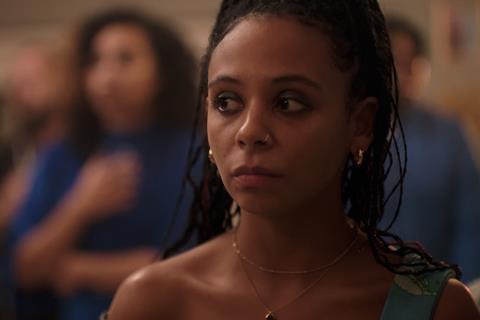
Sade Wilson as ‘Twig’ was a slightly built, driven leading woman. Bereaved by the loss of her two brothers and the need to bury the disgraced ‘Paulie’, her grit and determination drove the plot, which began slowly, but gathered a momentum of its own as time went on. The burial subplot from the original is not plausible today, as if no one claims a body, the State buries the deceased.
Donncha Tynan’s (Eamonn, son of Leon) was well played and a good contrast to his sinister father. Barry O’Byrne was not well served by his few lines and too many scowls in the first part. There is huge potential to sculpt his character, by us seeing his skill at manipulating the deceased brothers ‘Eddie’ and ‘Paulie’. Instead, this was described in an opening onscreen graphic. It is a challenge to establish oneself after that. As he gained dialogue, it was the part most burdened with more than a nod to the themes of the original play. Despite that, O’Byrne as always acquitted himself with style and a fitting presence.
Quinn had some lovely creative touches in the adaptation of the ‘see-er’ Susan McKeown’s ‘Teresa’ which also mixed in traditional Irish songs with contemporary gangland culture, and a truly delightful portrait of young ‘Mikayla’, beautifully delivered by Naoise Kelly, who shone throughout.
Sade Wilson’s ability to be vulnerable and strong was a huge asset in engaging us with the modern-day locus of the plot. There was a particularly strong supporting group of women actors whose diverse characters, when it comes to the crunch, stand up for what is right in their community. Ultimately, it is the women who prevail, though the loss along the way, as in the original play, is calculable.
Categories: Header, Movie Review, Movies


 No More Workhorse