
 The President – Gate Theatre – Review
The President written by Thomas Bernhard
Translated by Gitta Honegger
Photo: Ros Kavanagh
Thomas Bernard was a 20th-century Austrian playwright who died in 1989, aged 58 years old. He was a fierce critic of his homeland and its inhabitants, so much so that in his testamentary instructions he forbade his work from being performed in Austria. Tom Creed, who directs, states his belief that this is the first performance of “The President” in English anywhere and the first production of any of Bernhard’s plays in Ireland. Tom Wright, the dramaturg, states in the programme notes “For Bernhard the stage was a place where the machinery of the state was stripped back to reveal mendacity and neurosis.” In “The President” the initial locus is not identified but it seems to be somewhere in Eastern Europe while the second Act takes place in Estoril in Portugal which in 1975, when the play was first produced, had just ceased to be a dictatorship.
Elizabeth Gadsby’s set is of one large fragile space which consists of what appears to be six floor-to-ceiling panel mirrors on the back wall and five on each of the sides. With subsequent lighting, it transpires the panels are translucent. There are two large tables of clinically simple design and four white chairs which complement the tables. There are two unadorned coat racks one on each side of the stage. There is also, incongruously, a dog basket stuffed with powder blue cushions. It is a set which generates a sense of designer-stylish perfection and at the same time a sense of unease.
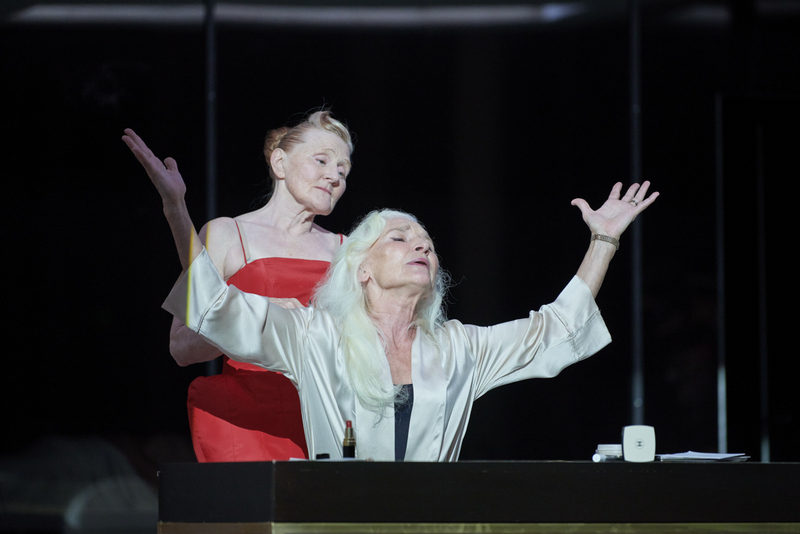
In this space, the First Lady (Olwen Fouere) reigns. It is her domain even though her husband the President (Hugo Weaving) is in a neighbouring room, attending to his ablutions and getting a massage. Appropriate noises of water can be heard intermittently. The First Lady has a maid, Mrs. Frolick (Julie Forsyth), who is at her every beck and call. Mrs. Frolick is on stage for a large portion of the first Act but has only one or two lines to speak. She carries out a variety of manual and menial tasks mostly in silence. Meanwhile, the First Lady reveals her fears of the assassination of herself or her husband, the terrifying path their son has chosen and the death of her pet dog who died of a heart attack in her arms in unusual circumstances. Her self-obsession knows no bounds. Fouere keeps up a terrific pace and all is spoken at full throttle. Comic light relief is provided by Forsyth whose scurrying movements and facial passivity are a masterclass in how almost no lines can still be used to create a substantial stage presence. The act lasts approximately an hour and a quarter and the intensity of the First Lady’s fears and skewed values creates a sense of exhausted bewilderment in the viewer.
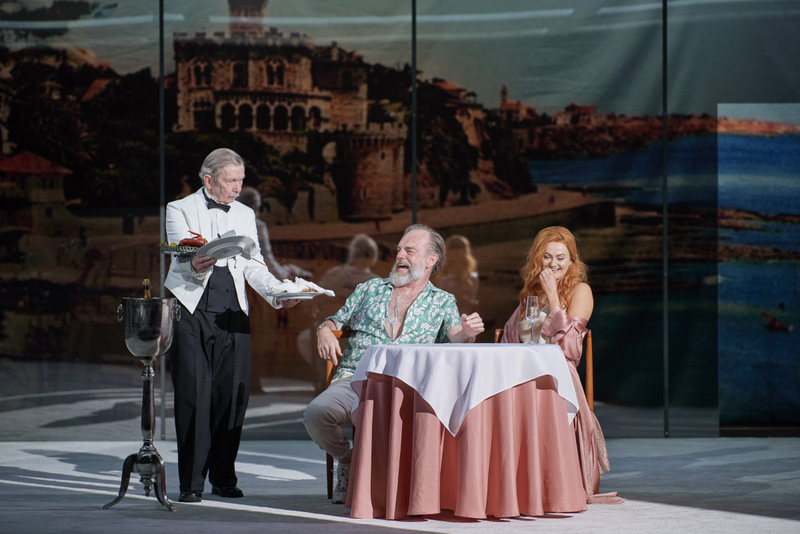
The second Act takes place in a luxury hotel in Estoril. The backdrop is a coastal habitation of charm and ease. Here the President is entertaining a young actress (Kate Gilmore) to champagne al fresco on a terrace with a splendid view. He too like his wife is self-obsessed as he explains to his young admirer the means by which he rose from nothing to this all-powerful political position but it is not enough for him. He has regrets that he had not achieved it in a larger country. Weaving is magnificent as he engages with the young actress. He equates her path to becoming a world-famous actress with his own career as a politician. His copious drinking unleashes his old man’s desire to fondle the actress’s more youthful flesh. It is meticulously executed by Weaving. Again like Mrs. Frolick the young actress has almost nothing to say. Her role is to simper and shrewdly comply with the President’s whims as they drink. Gilmore managed through eye gestures to show that the actress understood her role but that she also has an understanding of how to handle the President. There is also a collection of other small roles nearly all silent and these were well executed. In this regard, Daniel Reardon’s waiter was a little gem.
The structure of the play which in effect is almost two consecutive monologues certainly makes it a challenge for the audience. With the increasing rise throughout the world of strong man political leaders, this play is a fine reminder of the catastrophe that lies endemically within such an obsession. The final scene encompasses the inevitable end and the audience’s participation in that scene is a reminder that the rise of a demagogue is enabled by all citizens to a greater or lesser extent.
The Gate Theatre and Sydney Theatre Company are to be congratulated on putting on this timely, uncomfortable play. It is great that it is being seen in Dublin and Sydney. It would be even more valuable if it could be seen in Buenos Aires and Moscow and in many other cities worldwide.
.
Cast:
BRYAN BURROUGHS – Masseur, Officer, Attendant, Butcher
JULIE FORSYTH – Mrs. Frolick
OLWEN FOUÉRÉ – First Lady
KATE GILMORE – Actress
CHRIS MCHALLEM – Colonel
WILL O’CONNELL – Officer, Chaplain, Attendant, Maid
DANIEL REARDON – Waiter, Ambassador, Officer
HUGO WEAVING – President
Creatives
Directed by Tom Creed
Written by Thomas Bernhard
Translated by Gitta Honegger
Designer – Elizabeth Gadsby
Lighting Designer – Sinead McKenna
Music and Sound – Stefan Gregory
Movement Director – Danielle Micich
Dramaturg – Tom Wright
Associate Director – Ian Michael
Associate Designer – Florentina Burcea
Voice & Text Coach – Charmian Gradwell
Crew
Stage Manager – Roxzan Bowes
Deputy Stage Manager – Sophie Flynn
Assistant Stage Managers – Mark Jackson and Aoife Malin
Production Manager – Kate Chapman
LX Programmer – Eoin Lennon
Production LX – Rory Donnelly, Maeubh Brennan
LX Operator – Matt McGowan
LX Crew – Avram Rosewood, Niamh O’Farrell-Tyler, Cathal Bruce
Set Construction – TPS
Production Carpenter – Ian Thompson
Production Stage Technician – Darren Magnier
Stage Technicians – Vincent Doherty, Ben Moore, Ross McSherry, Gus McDonagh
Sound Technicians – Paddy Creegan, Mark King
Dresser – Sarah Higgins
Maintenance – Dara Gill
Hair and Make-up Artist – Sarah McCann
Tailor to Mr Weaving – Denis Darcy
Categories: Header, Theatre, Theatre Review


 No More Workhorse