
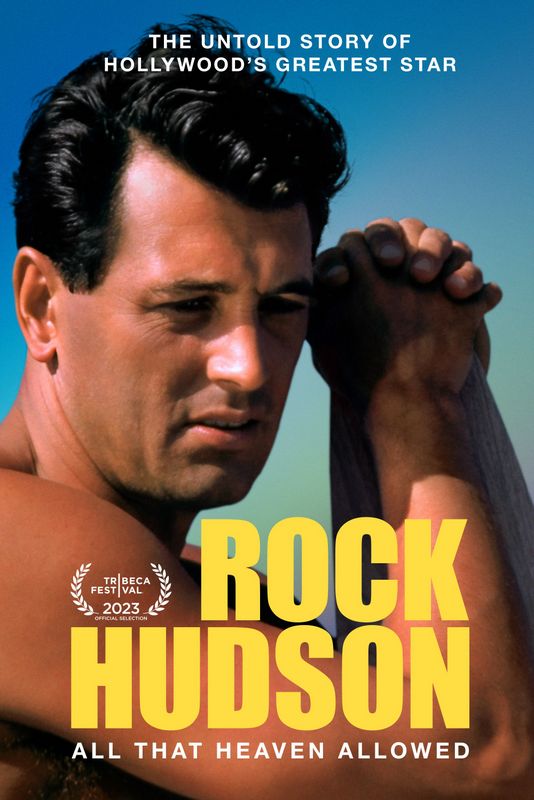
Rock Hudson: All That Heaven Allowed – Film Review
by Hugh Maguire
Director – Stephen Kijak
Stars – Rock Hudson, Joe Carberry, Tim Turner
At some point in this richly rewarding documentary, we are informed that Rock Hudson (1925-85) was the Tom Cruise of his day, but that is surely a great inaccuracy. With no disrespect to Cruise, it is difficult to grasp the colossal status of earlier generations of Hollywood actors. In pre-television days, they towered over popular entertainment, chiselled and pummelled, they presented dream images not only on screen but in their personal lives, vast fantasy-like mansions, beautiful wives and husbands, the gleaming dental work when half of Ireland had false teeth.
Rock Hudson was one such hero among many – ridiculously handsome as if created by some early form of AI and starring in films that exuded American power and authority globally. Through a wealth of film footage and interviews, we race through Hudson’s starry career to his ignominious death in 1985, but this film is more than a straightforward American hero documentary. There is the story of a Hollywood actor. There is the personal story, and, there is the story of AIDS, or more correctly the public’s reaction to the disease – the so-called ‘Gay Plague’.
The first is of a type we have seen before, the young man coming to seek his fame and fortune and becoming a star. The personal story is, however, the main plot line because Hudson’s greatest act was himself. Like Somerset Maugham’s Julia in Theatre, he may have felt only truly at ease on screen or in front of a camera. His biggest performance was his life itself. His on-screen image of the All-American Hero – a post-war type including John Wayne and so forth, stood in marked contracts to the sexual voracity of his private life. A stream of male lovers, some of whom speak to the camera as the old men they now are, highlight poignantly the fading of beauty but also the changed nature of sexual mores. Hudson had healthy appetites, so to speak, and not only had streams of lovers but hosted large male only poolside parties at his celebrated mansion. The film calls these gatherings parties but of course, they were much more than social occasions, their notoriety being ignored by the Hollywood dream machine that continued to present Hudson as the dream beefcake for American women. In the days of the emerging politicisation of gay identity, one thinks of the Stonewall riots (1969), a hero of Hudson’s stature could have advanced matters significantly. Hudson’s silence is bemoaned by Armistead Maupin (b. 1944). But fate moves in strange ways and succumbing to AIDS himself, Hudson’s illness, rapid decline and premature death, received huge attention globally and in its way galvanised a whole awareness raising and ultimately fundraising for research and treatment by Elizabeth Taylor (1932-2011) and scores of celebrities.
It is difficult for the viewer to recapture or imagine the scare factor involved at the time; the Paris clinics asked for him to be removed, and Air France refused to fly him home to the USA. The film is not without its critical lacunae. In the age of ‘Me-too’ would the viewer be so forgiving of a male star who crowded his villa with young women and starlets, as they were called, and went through female lovers with abandon. And of course, the past is a foreign country. A younger audience may not ‘get’, not only the fear around AIDS, but they may not ‘get’ Hudson. That square-jawed brawny look is not to today’s tastes. Who was he they may well ask. The Financial Times in early August discussed the link between celebrities and corporate brands –noting that ‘No celebrity can be relevant for many decades. Even Clooney has a limit.’
Categories: Header, Movie Review, Movies


 No More Workhorse