
Dubliners Women – New Theatre – Review by Frank L
Adapted from James Joyce’s “Dubliners” – Nov 28th – Dec 17th @ 7.30pm
Katie O’Kelly has chosen “The Boarding House”, “Clay” and “Eveline” from Joyce’s collection and adapted them into an hour long piece of theatre. At the start the stage is entirely bare. Then Madi O’Carroll and Katie O’Kelly emerge on stage with a motley collection of suitcases, six in all. Subsequently and with considerable effort, O’Carroll pushes onto the stage a large trunk. The reason why it required such energy to move soon becomes clear, as it contains the third actor, Gordon Quigley! All three are wearing Edwardian underclothes.
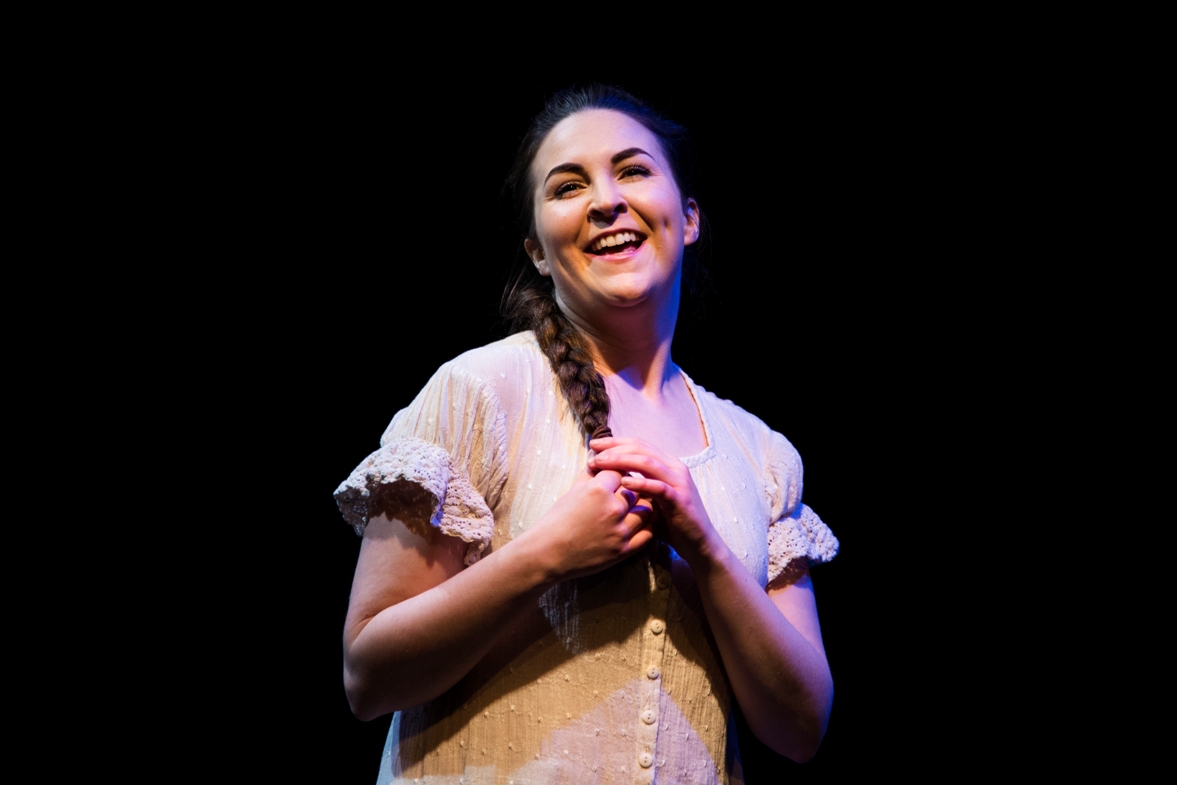
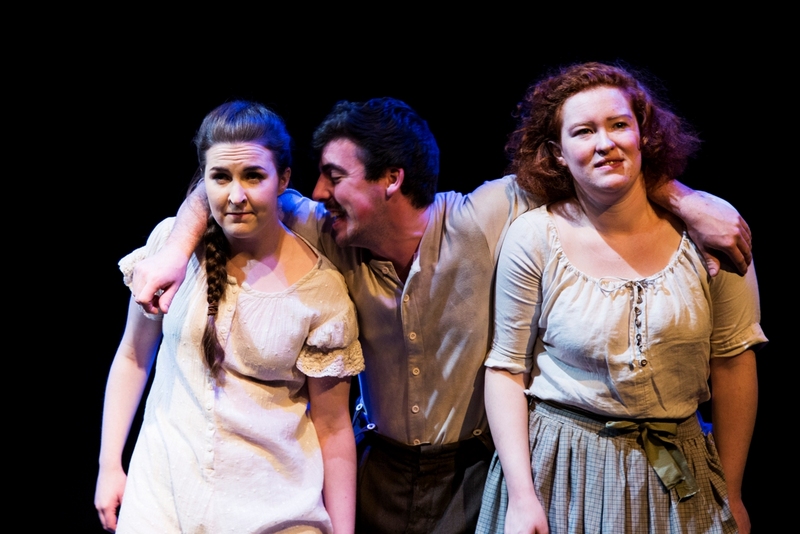
From the suitcases, each finds suitable items of clothing. On a small blackboard, capable of being held in the hand, O’Kelly writes the words “The Boarding House” in chalk, and shows it to the audience. In an instant the world of Mrs.Mooney, “the butcher’s daughter”, is brought to life. O’Carroll is a fine, scheming Mrs.Mooney, a woman who knows what is happening on her patch. O’Kelly is her 19 year old daughter Polly, confined in the claustrophobic world of her mother’s boarding house. Quigley plays Mr. Doran, one of Mrs.Mooney’s boarders who takes a shine to young Polly. Mrs.Mooney observed and she considered “he had simply abused her hospitality” and as Joyce stated “she dealt with moral problems as a cleaver deals with meat”.
There is a strong feeling that the audience is back in the early 1900s, in Mrs.Mooney’s very own parlour, with the belfry of St. George’s Church just across the way. The “reparations” which Mrs.Mooney now seeks requires all of her skills to obtain. Mrs. Mooney, at the height of her powers, the respectable Mr. Doran and young Polly deliver the cleaved meat on a platter as a tasty dish.
The other stories are then introduced by Quigley and O’Carroll in a similar manner with the blackboard and chalk. The other members of the cast adjust their attire as each changeover takes place. The use of the blackboard is a device that works well and in particular, it harks back to a time past. A time when each individual knew where they fitted in the structured society in which they existed. All of the stories give rich play to Joyce’s humour and there is a great evocation of Edwardian Dublin.
The actors rely on minimal props to create the atmosphere of Dublin over a hundred years ago. Sarah Baxter directs each of the stories with elan. The end result is a need to go back to Joyce’s stories and delight in them once again. An enjoyable adaptation of Joyce’s first major work.
Photo Credit – Al Craig
Categories: Header, Theatre, Theatre Review


 No More Workhorse