
A View From Kilkenny Arts Festival 2016 – Review by Frank L.
Dates – 5th to 14th August 2014
This piece concentrates principally on three of the smaller events; offerings which were memorable for different reasons. The reviewer was present from the 8th to 12th August so no attempt is made to review the entire festival.
Kilkenny is blessed by a variety of historic buildings which make great settings for the performance of music. One of them is the first floor reception room of Rothe House, which traverses the front of the house, with its simple, rough white painted walls and creates an intimate space in which to hear an individual instrument. Cleek Schrey, who resides in New York but was originally from Virginia, was advertised as playing his hardanger fiddle in a solo performance which he did. However in the audience was Liam Byrne, a viola da gamba player, who Schrey invited to play with him. That was a revelation. He then invited Doug Wieselman and his saxophone to join him for the finale. It was all beautifully modulated. It was an unexpected pleasure in the haunting half- light of the Rothe House to hear this unexpected trinity of sounds.
The following evening at 6pm there was a recital entitled “Kurtág at 90” in the Parade Tower of the Castle. The Parade Tower is a circular space with light entering from various points of the circular structure. The performers were Barry Guy and Maya Homburger. It was also advertised that the performance would include a world premier. The world premier was a piece written for Guy and Homburger by the 90 year old Kurtág.
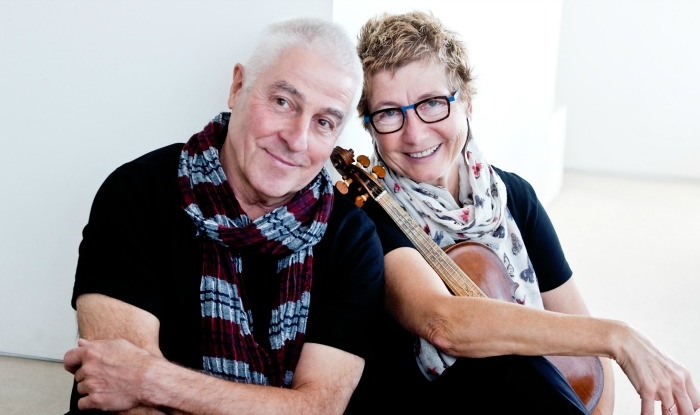
The recital began with various works by Kurtág, Bach and Biber played without interruption. It had been engrossing. One of those events at which the proverbial pin could be heard if it had dropped. The recital moved to the new composition by Kurtág.
It was a setting to music of Beckett’s poem Roundelay. The poem consists of thirteen lines and utilises a mere 18 words. It is short. Homburg explained that they had had a meeting with Kurtág. Guy began to recite the poem. On about the third word Kurtág stopped him and demonstrated how the poem had to be recited. A long discussion ensued. Then Guy recited the poem in the manner required by Kurtág. This was in itself a revelation into the creative process between artists. The audience having been so prepared, Homburg and Guy performed the minute and a half long piece. The concentration and distillation was intense as Guy was not only playing the double bass but also intoning, speaking or singing, call it what you will, the words of the poem. At the end the audience exploded into applause. Homburger explained, when the hubbub had died down, that they had not prepared an encore but as new works often do not obtain a second hearing they would play it again as an encore. They did. It was even more exciting on the second performance. The end result was that those lucky enough to be present in the Parade Tower heard not only the premier but also the second performance of this piece inspired by Beckett.
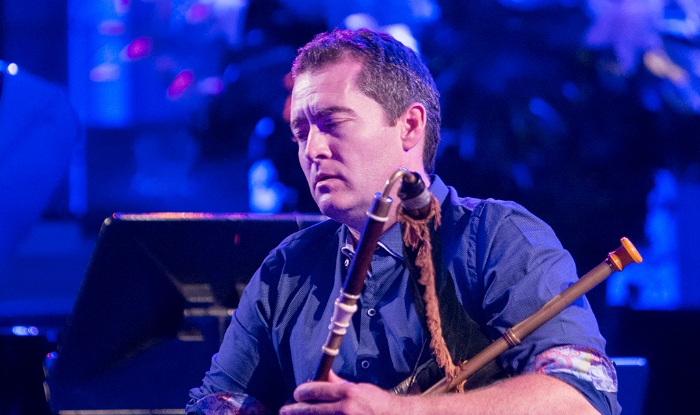
The third unexpected but captivating happening occurred also in the Parade Tower. It was advertised as “Uilleann goes electric”. David Power is an Uillean piper of virtuosity. Linda Buckley’s practice as a composer is to explore the intersection between live music and programmed sound. Initially in this illustrated talk Power explained his relationship with the pipes and in particular with an 1843 set of pipes which had a broken reed in the chanter. In his search to rectify this fine instrument, he became aware of the physical strength of a jet of air being unleashed by these venerable pipes which set his mind thinking. Those thoughts assisted by ideas from certain individuals led him to Linda Buckley. She then explained how her practice utilises common place sounds such as that of a milking parlour. It is then her skill to work with those sounds to develop them with that of a musical instrument. The challenge that Power and Buckley have set themselves is to create a work for the Uileann pipes which works with programmed sound. It is scheduled to debut in the Festival in 2017. A substantial challenge for this duo but an exciting prospect for Kilkenny 2017.
In concentrating on these three “smaller events” the purpose is to emphasise the depths and diversity of creative excellence that is available in the Kilkenny Festival.
Finally outside of the sphere of music, there is in the National Craft Gallery an imaginatively curated (by Brian Kennedy) and well displayed collection of ceramic Vases created by artists from all over the world. In addition in the Butler Gallery there are 6 geometric videos pieces of rare simplicity, colour and beauty created by Michael Snow. Both of these exhibitions continue after the festival, which concluded on Sunday 14th August and are very much worth a visit.


 No More Workhorse