
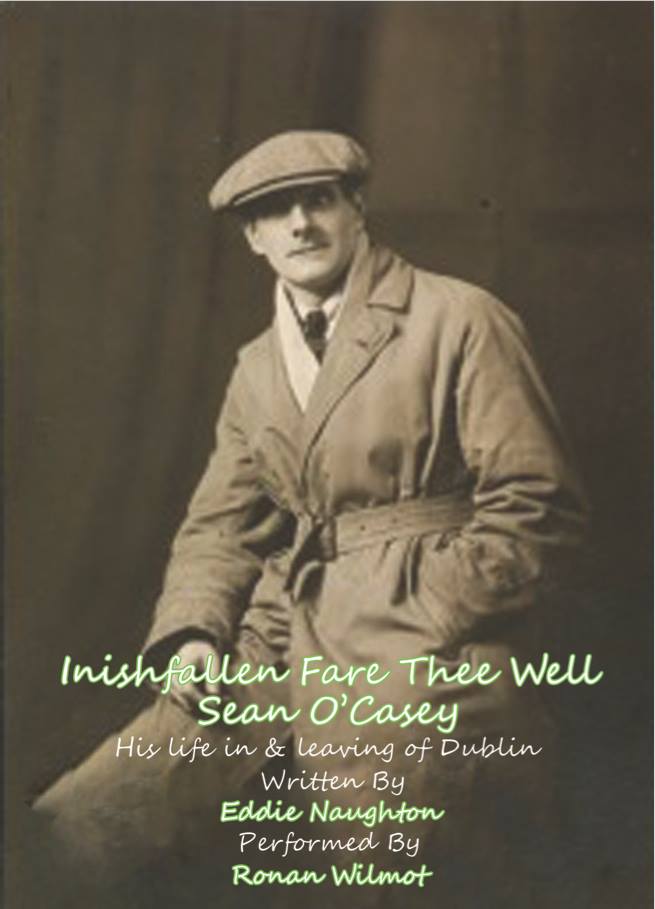
Inishfallen Fare Thee Well by Eddie Naughton, performed by Ronan Wilmot
At the New Theatre from Aug 8th – Aug 20th @ 7.30pm – Tickets: €16 (€12.50 conc.)
Sean O’Casey is a fascinating figure in Irish history who lived through some unusual times. He was born in 1880 and grew up in the north inner city, in Dorset street. In his early years he was known as John Casey and was baptised a protestant. His father died when he was just six years old and left behind thirteen children. Later in life, Casey became involved in the Irish nationalist movement, learned Gaelic and changed his name to Sean O’Casey. He joined the Irish Republican Brotherhood and was involved in the Dublin Lockout in 1913. This was all before he started to write for the stage and completed such works as the Plough and the Stars and the Shadow of a Gunman, which were performed on the Abbey stage. This play by Eddie Naughton was inspired by the 3rd volume of Sean O’Casey’s autobiography. The play takes in these fascinating years in the playwright’s life as he moves from his childhood in inner city Dublin to his career as a writer.
This is a one man show with Ronan Wilmot taking the role of O’Casey at 78 years of age, according to the programme. He is looking back on his life, as he talks directly to the audience. There are minimal props on stage, with only a writing desk and a rug. We are left in O’Casey’s hands as he reminiscences about his early years.
Wilmot is a man of advanced years, but still managed to hold the attention of the audience with ease. His voice has lost none of its power and was more than capable in the small space. At just under two hours including the interval, it is a long piece for any actor to perform.
The convention of talking directly to the audience allowed us inside the head of O’Casey, but the amount of ground the play covers makes it little more than a whistle-stop tour. The early section about his life in the tenements in Dublin did feel clichéd. These would have worked better if they were told from O’Casey’s direct experience rather than in a generic sense. After the interval, we get to meet the major players of the era such as Yeats, Lady Gregory and Jim Larkin. It also gives you an impression of the complexity of the politics of the time. It’s difficult for a modern audience to appreciate how exciting and raw O’Casey’s work must have been, with the original run of the Plough and the Stars causing a riot on its fourth performance.
With the centenary of the Rising this year, we’ve seen a resurgence in O’Casey’s work, with his Dublin trilogy all appearing on the major stages around Dublin. This play is an enjoyable insight into the man and the other major characters of the period.
Categories: Header, Theatre, Theatre Review


 No More Workhorse