
Suicide Squad – Film Review by David Turpin
Directed by David Ayer
Starring Will Smith, Jared Leto, Margot Robbie, Viola Davis
With the August doldrums just ahead, it seems fair to pronounce the summer of 2016 DOA for blockbuster entertainment. Ghostbusters, Tarzans, Bournes and Warcrafts have come and gone, with nary a Mad Max: Fury Road to be found among them. The tone of the summer seems to have been set by the late-spring release of DC Entertainment’s garbled Batman V. Superman: Dawn of Justice, so it’s with a certain logic that many have looked to DC’s next release, Suicide Squad, to turn things around. This it does, but only in the sense that it makes the season’s string of disappointments look better in hindsight.
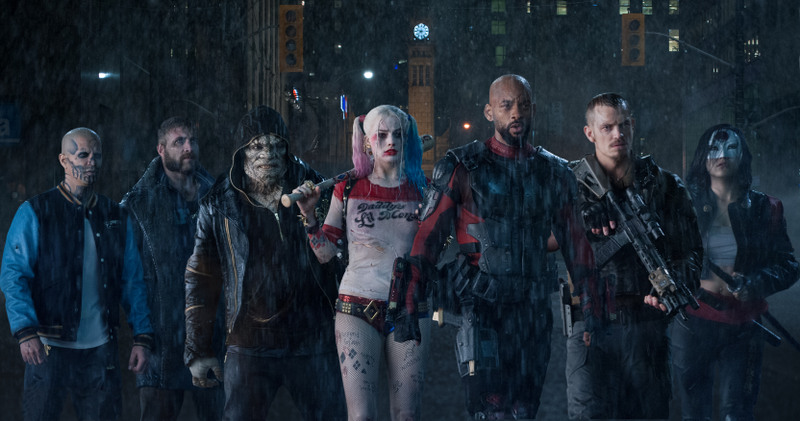
This soggy piñata of a movie brings together a clutch of minor characters from various DC Comics “properties”. Headed by hitman Deadshot (Will Smith) and the Joker’s concubine Harley Quinn (Margot Robbie), they form a mercenary taskforce out to save the world from a digitally animated threat so generic is must surely come as a pre-set with effects software packages. Smith is a bore, as usual – although it’s a blessing to see him restricted to an ensemble role – and Robbie is certainly game, although her character is little more than a comic-book re-tread of the queasy mixture of innocence and carnality she patented in 2013’s The Wolf of Wall Street.
It isn’t hard to see why the rest of the characters have long languished on the margins of assorted Batman and Superman comics. Adewale Akinnuoye-Agbaje’s Killer Croc looks like a crocodile, Jai Courtney’s Captain Boomerang has a boomerang, and Jay Henandez’s Diablo does much the same thing as the Fantastic Four’s Human Torch. The fact that very few of these “supervillains” have actual super-powers seems to be lost on their shadowy manipulators, led by scary-lady-in-suit Amanda Waller (Viola Davis). While Harley Quinn is certainly handy with a baseball bat, Waller’s conviction that this ability will come in handy defending the Earth against the threat of a “terrorist Superman” seems a touch optimistic. It’s also not as if Waller hasn’t had the time to think it through – the entire first half-hour of Suicide Squad is devoted to a video-game-style itemisation of each character’s abilities, accompanied by the most crushingly obvious music cues since producer Zack Snyder’s Watchmen (2009).
Jared Leto’s Joker has been heavily touted as the villain of the film, but this quickly emerges as one of the marketing’s many bait-and-switches. It’s among the least egregious, though, as – for all the hoked-up stories of Leto’s method-acting investment in the character – this Joker is a featherweight contraption running on fumes. The real adversary the squad must face is Cara Delevingne’s Enchantress, who wants to (very slowly) create a non-descript supernatural weapon that will decimate humanity, or something. Delevingne is absolutely, jaw-droppingly terrible in the film, both as Enchantress and as her human alter-ego Dr. June Moone, an “archaeologist” whose first action is to abseil into a long-lost pagan tomb and blithely snap a mysterious artefact in half.
This correspondent must apologise if the early revelation of Enchantress as the villain constitutes a mild spoiler – but Suicide Sqaud is so addled and antic that it is, in fact, very difficult to determine which plot points, if any, are supposed to carry an element of surprise. Flashbacks are interspersed seemingly at random, based on the flimsiest of visual cues, and adjacent action sequences are so similar to one another (three sequential, unrelated, helicopter crashes!) that it becomes difficult to remember what happened when, and why. The nadir is reached before the foggy climax, as Joel Kinnaman’s he-man soldier Rick Flag delivers – as an apparent revelation – a glut of information to which the audience has been privy for over an hour.
Much like Batman V. Superman, which promised a showdown between the eponymous characters and instead offered only a contrived misunderstanding and a trailer for sequels, Suicide Squad neglects to deliver on the very simple premise upon which it has been sold. What purports to be a monster-mash of “supervillains” becomes something much more pedestrian as, with grim inevitability – and the usual litany of deceased spouses and children – these “villains” are revealed to be misunderstood good guys who are deep-down yearning for a shot at redemption. Suicide Squad’s moralistic conviction in the “goodness” of (nuclear) family and (military) camaraderie is so hopelessly at odds with its spray-on “anarchism” that the film’s entire premise dissolves right before your eyes – around the time Deadshot offers his cutesy daughter a homily on the importance of good parenting. When the only character who seems to be actually deep-down bad is Davis’s sinister – but distinctly non-super-powered – government handler, viewers may find themselves wondering how, after queueing up for a promised dose of fluorescent perversity, they ended up with this bunch of squares.
Categories: Header, Movie Review, Movies


 No More Workhorse
Any way you slice it, this looks to sound disappointing. A damn shame if so. Nice review.