
Gods of Egypt – Film Review by Shane Larkin
Director: Alex Proyas
Writers: Matt Sazama, Burk Sharpless
Stars: Brenton Thwaites, Nikolaj Coster-Waldau, Gerard Butler
“If I even attempted to explain, your brain would liquefy and run out of your ears,” Chadwick Boseman’s God of Wisdom tells our main character at one point. And so it is when trying to approximate the experience of watching the royal mess that is Alex Proyas’ Gods of Egypt, possessed of flaws and incompetencies so baffling they actually become intermittently fascinating. Completely oversaturated in shoddy, sub-Attack of the Clones-quality CGI, and a sense of pacing so off-base as to render everything in a hopelessly perplexed fog, from the overarching plot, to the construction of scenes, to the individual conversations right down to the neural activity responsible for speech production in human brains; everything is just terminally off, confused and confusing. Oblivious of its own strangeness, and never quite embracing and harnessing its stupid insanity in a compelling way, it proves unworthy of even the sacred pantheon of so-bad-it’s-good movies. Not only are there better ways to spend your time, there are better bad ways.
The movie is set in a fantastical ancient Egypt, comprised mostly of white people, in which the gods walk among us, standing a few feet taller and soaking up the love and admiration of mere mortals while delivering little in return. After Set (Gerard Butler, never more Scottish) kills his brother Osiris and blinds his nephew Horus (Nikolaj Coster-Waldau), he begins a tyrannical rule over Egypt and seeks all-encompassing power and strength. In exile, Horus eventually endeavours to reclaim his eyes and his kingdom, with the help of a B-league-Aladdin-type named Bek (Brenton Thwaites), who wants his girlfriend Zaya (Courtney Eaton) rescued from the afterlife, and a few Gods sympathetic to his cause, including the aforementioned Boseman and Elodie Yung as the Goddess of Love. Once your mental faculties have been reassembled after an initial viewing, I think this is about as succinct a description of the premise as you’re likely to make.
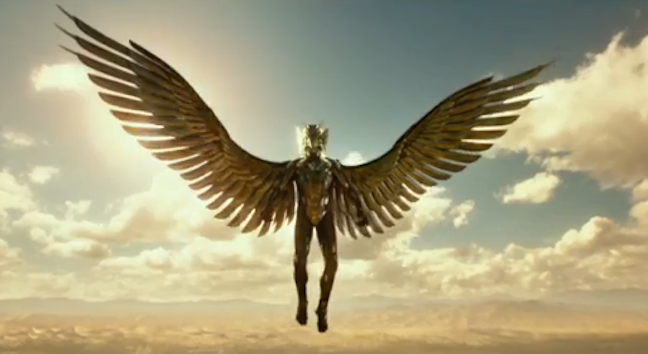
There actually are occasional flashes of intriguing creativity and visual inventiveness. If you can come to terms with a bald-but-ponytailed Geoffrey Rush as Sun God Ra, riding a cosmic sailboat and firing red lasers at a leviathanic space worm with endless rows of teeth, there’s an interesting and visually striking representation of Earth as a flat disc suspended in space and comprised entirely of Egypt. The Gods’ transformation into shiny, textureless Iron Man-meets-Power Rangers-meets-Transformers power suit things as they duke it out in mid-air has all the potential in the world for barmy, over-the-top, kitschy fun, and the complete disregard for restraint is actually kind of an endearing trait in some ways. But it’s all marred by a completely unmotivated and amateurish visual strategy, performances that are either not hammy enough or completely devoid of any nuance or charisma, silly but humourless dialogue and scattered plotting. Really, for the most part what we’re offered is the actors walking from one 3D green-screen background to the next, punctuated by a few early 00’s video game set-pieces, resulting in a lifeless, cardboard-cutout-like unreality that resides somewhere between the Star Wars prequels and a Battlefield Earth-induced fever dream.
The issue of whitewashing has followed Gods of Egypt around ever since people saw the first trailer, and understandably so. Put lightly, casting Scottish, Danish, Australian and French people as Egyptian Gods and Goddesses is an odd decision worthy of scrutiny. But as nice as a modicum of cultural sensitivity would have been, the unfortunate truth is that it ultimately could not have saved us from the bewildering hell Proyas and co. hath wrought. Maybe nothing could.
Categories: Header, Movie Review, Movies


 No More Workhorse