
The Hateful Eight – Film Review by Shane Larkin
Director: Quentin Tarantino
Writer: Quentin Tarantino
Stars: Samuel L. Jackson, Kurt Russell, Jennifer Jason
The eighth film from Quentin Tarantino, his second Western, opens on a lonely crucifix framed against the wintry horizon of the Wyoming frontier. In the distance, a stagecoach charges through the snow, eventually emerging into the foreground as the snow-capped Christ gazes down mournfully. Whatever we’re meant to glean from this on a symbolic level, it acts as a perfect primer for Tarantino’s principal strategy for most of The Hateful Eight: the keen utilization of every inch of the frame to tell his story, and the importance of spatial relations; the background as it relates to and infringes on the foreground. He wants you to keep your eyes open. Watch out for that shady sumbitch in the far corner.
The bulk of the film operates as a paranoia-laden chamber piece, where everyone is hiding something and bloody chaos is just an itchy trigger finger away. There are ostensibly two versions; one (the “Roadshow” version) with a 12 minute intermission, a brief overture and a small bit of extra footage, the other without. Much has been made of the filmmaker’s decision to shoot on 70mm with Ultra Panavision lenses, and there’s a definite sense that he’s trying to recapture the grand feeling of the event pictures of old. Does the film itself hold up and warrant all of these bells and whistles and presentational flourishes? Sort of. First, let’s meet the titular Eight.
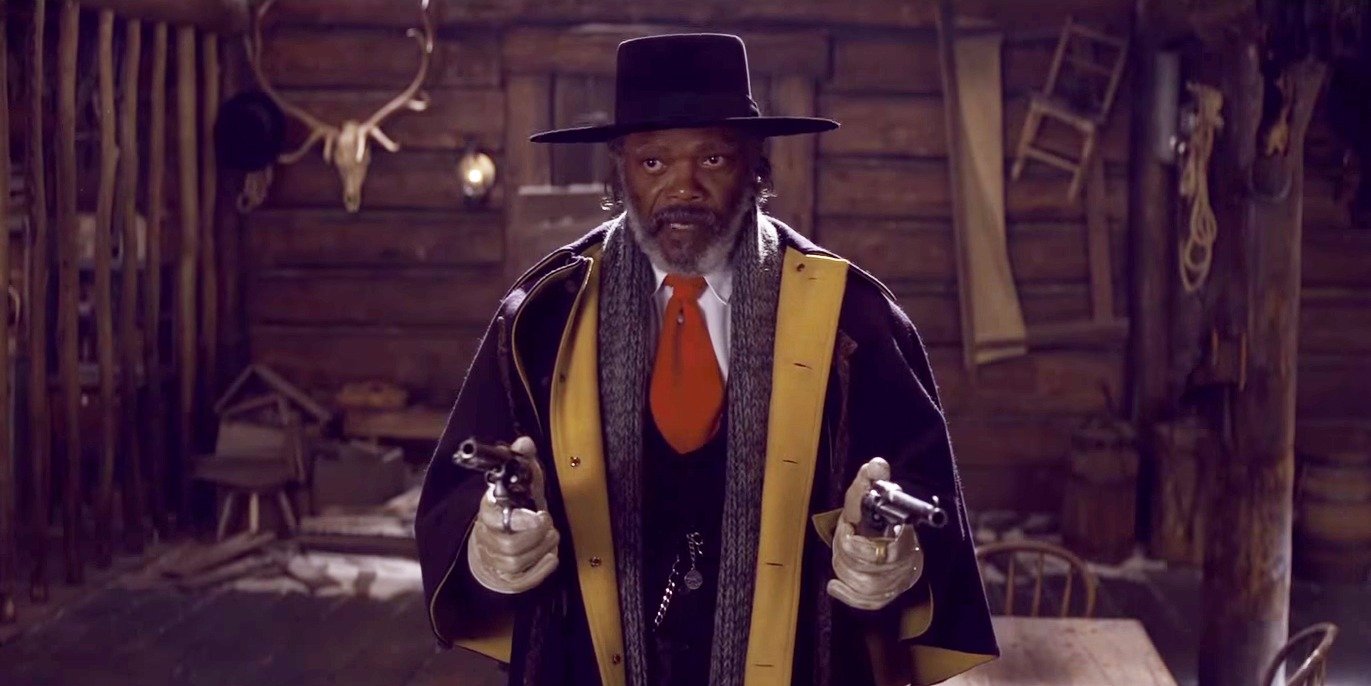
Occupying the aforementioned stagecoach is bountyhunter John “The Hangman” Ruth (Kurt Russell) and his bounty Daisy Domergue (Jennifer Jason Leigh). Their driver is O.B. Jackson (James Parks). They’re on their way to the town of Red Rock, where the fugitive Domergue will be hanged and Ruth can collect his reward. A blizzard quickly approaches. They happen across fellow bounty hunter Major Marquis Warren (Samuel L. Jackson) and soon-to-be sheriff of Red Rock Chris Mannix (Walton Goggins), both heading the same direction and both in need of shelter. After an extended and apprehensive greeting within the confined space of the stagecoach, the group find themselves seeking refuge at Minnie’s Haberdashery.
It is here that we meet the rest of this vile bunch. There’s Oswaldo Mobray (Tim Roth), an eccentric hangman also headed to Red Rock; Joe Gage (Michael Madsen), the unassuming cowboy headed to his mother’s house for Christmas; Civil War general Sandy Smithers (Bruce Dern); and Mexican Bob (Demian Bichir), the current caretaker of the haberdashery while Minnie is away. The door is nailed shut, the blizzard rages outside, and the characters circle each other like caged animals, sniffing each other out. It’s a tense, colourfully populated petri dish and the result is a sometimes frustrating combination of Tarantino’s greatest strengths as a storyteller and his more self-indulgent impulses.
It’s mostly damn good stuff. The slow, methodical build of the first half is some of the most mature and sophisticated storytelling Tarantino has ever exhibited. He draws his characters broadly but expertly, even as we’re given every reason to doubt everything they say. The cast uniformly make his stylized dialogue sing to the heavens, Jackson in particular. Ennio Morricone’s chilling score evokes Bernard Herrmann, laced with mounting dread and suggesting that something unnatural is transpiring right from the start. The movie’s greatest strength is the palpable intrigue, the question of just what exactly is occurring, or about to occur. And when this is supplanted by the realization of what’s what and who’s who, the feeling is a little underwhelming. The pay-off is not quite up to par with the exquisite table-dressing of the set-up, and the languid pacing doesn’t help. The filmmaker’s trademark explosions of violence don’t always land with the weight that they should.
But he still spins a good yarn, and clearly takes great pleasure in doing so. It is in some ways a portrait of uneasy post-civil war attitudes and tensions and there’s a temptation to see it as a microcosm of a turbulent America, one overflowing with hatred, distrust and potential bloodshed, but Tarantino is best appreciated when he isn’t trying to uphold ideas outside of cinema. This is equal parts Agatha Christie drawing-room mystery, Peckinpah-esque nihilism, and blood-soaked christmas pantomime. And above all, for better or worse, it’s pure Tarantino.
Categories: Movie Review, Movies


 No More Workhorse