
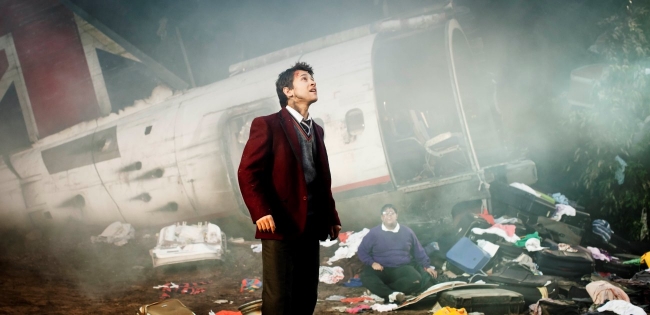
Lord of the Flies – Bord Gáis Energy Theatre – Tuesday 24th to Saturday 28th of November – Review by M.Quinn
24 Nov 2015 – 28 Nov 2015 – €15 – €45
Adapted for the stage by Nigel Williams
A plane crash-lands on a remote island. A group of school children survive the disaster and are now left stranded there. After the initial shock they start to figure out how to live on the island. They are a typical collection of school boys and their pecking order within the group is quickly established. For the first time in their lives, they are left without the rules of society and are free to live whatever way they please. Their initial attempts to form something resembling a democratic group quickly break down. Over the course of the play, the rules of civilised society are torn apart, and something primordial starts to emerge.
This is based on the novel of the same name, written by Nobel prize winning author William Golding. It is a classic and is required reading for many school courses. It is an attempt by Golding to see what lies beneath civilised society and how we would live without the rules and punishments that control our daily lives. The device of the plane crash and the collection of school children hastens the process, making it happen over the course of the short novel.
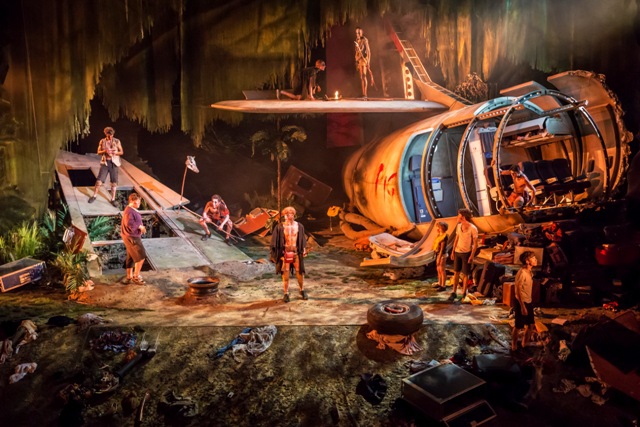
Bringing this story to the stage was always going to be a challenge for the theatre makers, as the set required for this story is quite dynamic. The site of the plane crash is very impressive, as you would expect from London’s Reagent Park theatre. The rear of the fuselage of the plane seems an impossible sight on the stage, with the shell of the craft stranded on a mound of suit cases and other debris.
The book was written in 1954, a few years before the Suez crisis and with the British Empire still very much intact. As such, it was a very different time and place. There is an attempt to modernize the setting, with references to selfies and ‘I’m a celebrity, get me out of here’ among others. It seems somewhat incongruous in this clear morality tale. It is possibly an attempt by Nigel Williams, who adapted the book to make it more relevant to the modern audience, but it did feel unnecessary.
There are a number of subtle differences between this version of events and those of the novel, but the essence of the tale is very much intact. It is unusual for the set design of a piece of theatre to be the lasting image, but such is the presence of the wreckage on stage it is hard not to be disturbed by it. This is an impressive production, with the team of young actors displaying daunting physicality in their dance and fight scenes. The jungle beats that dominate the second half grow louder as it leads to the climatic ending.
Categories: Header, Theatre, Theatre Review


 No More Workhorse