
Love and War: A Western Front Courtship – Bewley’s Cafe Theatre (at Powerscourt) – Review by P McGovern
Love and War at Bewley’s Theatre (now in Powerscourt Centre) tells the story of the other 1916, the one a lot of political shapers would like to expunge from Irish history.
In the story of a young Athlone woman and her soldier husband-to-be that never was, we witness in miniature the lives and deaths of millions throughout Europe in the 1914-1918 War. It is one with which we are familiar from fiction, stage and screen (most memorably, perhaps, in Thora Hird’s exceptional performance in Alan Bennett’s Waiting for the Telegram – available on DVD and well worth seeking out).
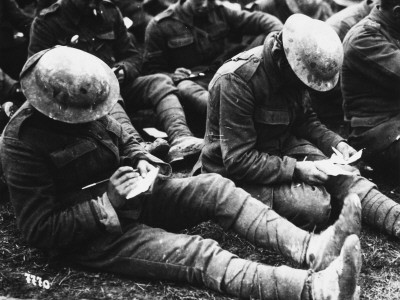
The piece is based on the letters of Phyllis Kelly and her lover Eric Appleby, a young Liverpudlian soldier. The letters are interwoven with songs from that period and some war poems. Polemics on war in general or accounts of the progress of this particular war are secondary to the central love story.
The obvious, better-known war poets such as Siegfried Sassoon and Wilfred Owen are avoided. Instead we have Edward Thomas, Charles Hamilton Sorley and works in a minor key such as Francis Ledwidge’s June, which focuses on the brevity and fragility of life and the consequent need to “dance and sing” before the roses go the way all roses go. This emphasis keeps our focus on the poignancy of the story of the lovers. Our imagination readily supplies the multiplication tables . . .
Michael James Ford’s delivery is beautifully measured – clear, appropriately detached and assured. Darina Gallagher’s Phyllis Kelly is brimming with love and longing, her eyes shining and her face glowing. If her singing is at times a bit strained, it is none the less authentic for that: this isn’t primarily the story of a singer but of a young woman whose singing delighted her lover. Elliot Moriarty has great stage presence, speaking the poems naturally, free of the over-emphasised straining for emotional effect that this kind of show can invite. His duets with Gallagher need a little more work on music and cues.
Appelby was killed, aged twenty-three, in October 1916. Kelly lived on, dying in 1991 at the age of 99. Their story is that of millions of others. As various political parties scramble to wrap the green flag round them in the run-up to the centenary of the Easter rising, this show reminds us that there was another 1916. And 1917. And 1918. More than 30, 000 Irish men died in British uniforms in WWl , their motivation ranging from idealism, however misplaced, to sheer economic necessity. The total number of Irish people who died in the Easter rising was less than 500. Each left a legacy of equal sorrow and enduring loss to their loved ones. This show reminds us that while there may be lots to commemorate, there is little to celebrate.
It is well worth seeing as it continues until November 14th at 1 p.m daily.
Categories: Header, Theatre, Theatre Review


 No More Workhorse