
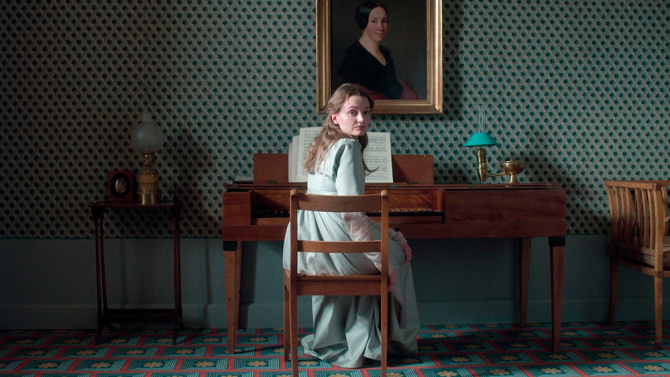
Amour Fou – Review by David Turpin
Directed by: Jessica Hausner
Starring: Christian Fridel, Birte Schoenik, Stephan Grossman
The fifth feature from Austrian director Jessica Hausner – and the first since her international breakthrough with Lourdes (2009) – Amour Fou is a characteristically reserved and analytical portrait of a romantic-era suicide pact that is low on both love and mania, but strangely compelling nonetheless.
The action is derived from the true story of the poet Heinrich von Kleist, played by Christian Fridel as a sullenly self-involved young man who is swiftly, and understandably, rebuffed when he approaches his cousin with the suggestion that she allow him to kill her before taking his own life. Distressed but undeterred by her insensitivity, he transfers his attentions to married woman Henriette (Birte Schoenik), who ultimately proves more receptive to the idea, for reasons of her own. Grim as the subject matter sounds, Amour Fou leans toward the comic – albeit a glacial, and very Austrian, form of comedy that elicits wry acknowledgment rather than actual laughter.
Unlike, say, Jane Campion, whose excursions into period drama have made a thematic virtue of the genre’s tendency toward fussiness, Hausner shoots her early 19th-century milieu with detachment, each meticulously composed shot framing the characters as specimens for observation, held at a remove from the viewer. The crisp, cool-toned images (captured with an Arri Alexa camera) are commendably uncosy, although the use of digital stock also has the effect of making the setting difficult to accept as the “past”. This may well be intentional, given the story’s contemporary resonances, but combined with the constricted framing and minimally dressed settings, it occasionally makes the film feel like a diorama of history rather than an immersion in it. For those interested in the effect of shooting techniques on the conjuring of the past, Amour Fou film might make for an interesting (if slow-paced) double-bill with Stanley Kubrick’s Barry Lyndon (1975), or indeed with Michael Haneke’s The White Ribbon (2009).
The performances are strong, particularly Friedel’s turn as the self-regarding but essentially juvenile poet. As the object of his attentions, Birte Schoenik faces the unenviable task of making boredom and disaffection compelling, and she rises to it admirably. In fact, the performances are so persuasive that the climactic scene carries an unexpected power that may catch viewers off guard, given the reserve with which Hausner operates.
Following Lourdes’ wryly analytical treatment of religious devotion, Amour Fou continues Hausner’s habit of approaching potentially incendiary subject matter with forensic detachment. As such, it is of a piece with the work of Haneke and his disciple Markus Schleinzer, although Hausner has a somewhat lighter touch. Grasping the nettle of suicide-as-narcissism with poise and restraint, Amour Fou is as provocative as it is understated.
Categories: Header, Movie Review, Movies


 No More Workhorse